

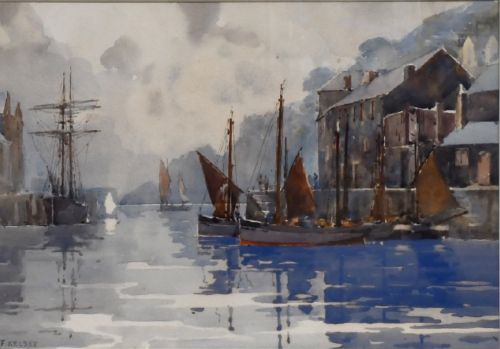


Cornish Harbour Artwork
These cornish harbour artwork pieces capture coastal life through traditional watercolours and oil paintings.
Cornish Harbour Artwork
When you search for cornish harbour artwork, you encounter coastal scenes depicting locations such as St Ives, Polperro, and Mevagissey. These paintings portray fishing vessels, harbours at low tide, and maritime life along the coast.
The versions most likely to appear on this page date from the late nineteenth century through to the mid-twentieth century. They range from detailed watercolours to textured oil paintings on canvas and wood.
How they were made
Artists painted these coastal subjects using oil paint or watercolour applied to paper, canvas, or wood panels. Many examples retain their original framing under glass or surrounding stretched canvas.
Techniques vary from precise marine draftsmanship to looser brushwork associated with the Newlyn School and British Impressionism. Pigments capture the changing light on harbour walls and fishing luggers.
Materials recorded across these listings include paper, canvas, wood, glass, oil paint, and watercolour.
What varies in quality
Quality rests upon the artist's handling of light, atmosphere, and maritime architecture. Works by named painters from recognised circles demonstrate superior draughtsmanship and compositional depth.
Condition of the medium and the preservation of the original surface determine the integrity of each piece. Stronger examples display confident pigment application and secure framing.
William Banks Fortescue·Frank Kelsey·George F Pennington·Edward Matthew Elliott·Richard Harry Carter·Gyrth Russell·George Turland Goosey·Ernest F Hill·Frederick Stuart Richardson·Ralph Todd·Jack R Mould·William Lee Hankey·Walter Sweet·Hendrik Yan Wolter·S J Lamorna Birch·William Edward Webb
The Cornish Harbour Artwork Glossary
- Newlyn School
- An art colony based in Cornwall focusing on naturalistic plein air painting of local fisherfolk and coastal life.
- Lugger
- A traditional two-masted fishing vessel commonly seen depicted in West Country maritime scenes.
- Woodblock print
- An image printed from a carved block of wood, occasionally found alongside watercolour views.
- Watercolour painting
- Pigments suspended in a water-based solution applied to paper to create translucent coastal washes.
Cornish Harbour Artwork: Frequently Asked Questions
What periods do these paintings cover?
The selection spans from the late nineteenth century through the Edwardian era into the mid-twentieth century. Most examples reflect movements like British Impressionism and the Newlyn School.
Dates generally range between the 1880s and the 1960s, documenting historic Cornish fishing ports.
Which harbours are commonly depicted?
St Ives, Polperro, Mevagissey, and Mousehole appear frequently across the watercolours and oil paintings. These locations served as primary subjects for visiting and resident artists.
Scenes often focus on local maritime activity, harbours at low tide, and working fishing vessels.
How do I identify a Newlyn School piece?
These works typically focus on plein air coastal subjects, local fisherfolk, and harbour life painted with naturalistic observation. Many pieces date from the turn of the twentieth century.
Signatures of associated artists often provide direct attribution to this artistic community.
What framing is normally found?
Many paintings retain period wood frames that complement the maritime subject matter. Watercolour examples are frequently mounted behind glass.
Original frames help preserve the historical context of the artwork.