
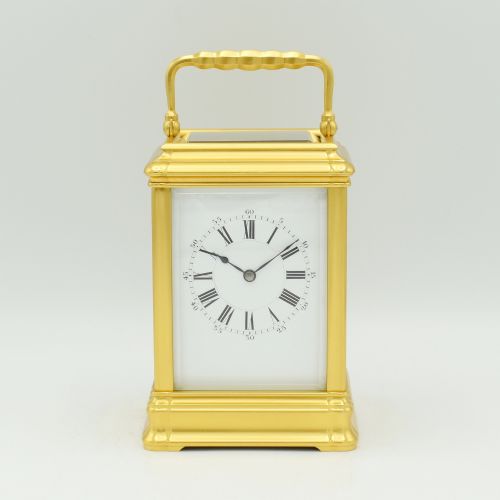
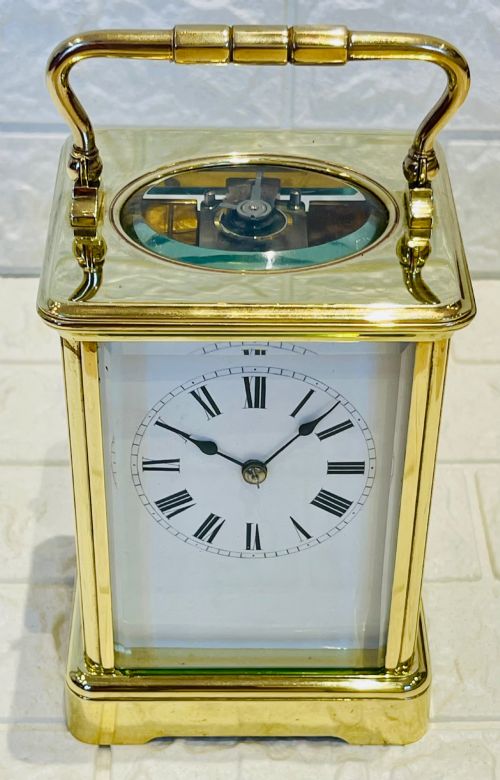


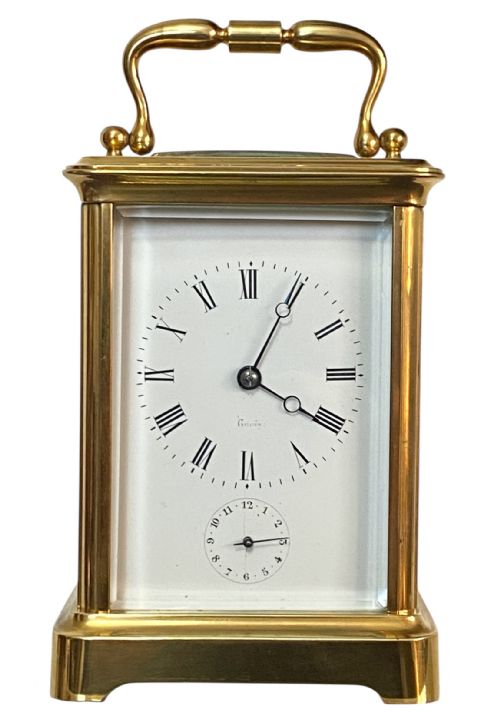


Corniche Cased Clock
A corniche cased clock sits heavy in the hand, offering the precision of nineteenth-century French carriage travel with a clear glass case.
Corniche Cased Clock
A corniche cased clock is a portable timepiece housed in a polished brass or gilt bronze frame with stepped mouldings and glass panels. These pieces date principally from the nineteenth century, spanning the Victorian era and the years around nineteen hundred. They take their name from the distinctive corniche moulding that defines the upper and lower edges of the case.
Most examples found here are French in origin, built to keep time on the move or in temporary lodgings. The design prioritises visibility through bevelled glass windows that reveal the escapement and gear train within. Buyers encounter them as robust timepieces, often equipped with striking mechanisms, alarms, or repeaters.
How they were made
These clocks rely on heavy brass and gilt bronze castings to form the structural skeleton of the corniche case. Workers shaped the metal into substantial pillars and frames before applying a polished or gilt finish. Bevelled glass panels fit snugly into channels within the metal framework to enclose the movement.
Dials were produced from white enamel, fired onto copper discs, and painted with fine black numerals. The interior mechanics depend on steel pinions and brass wheels, driven by springs housed in barrels for eight-day operation. Workshops fitted platforms for the escapement visible through the top glass panel.
Listings span the Victorian period through the end of the nineteenth century, featuring brass, gilt bronze, and enamel materials.
What varies in quality
Quality rests in the weight of the metal and the crispness of the casting around the corniche mouldings. Finer examples display heavier gilt bronze frames with sharp, clean corners rather than light, stamped brass. The depth and clarity of the gilding separate standard production pieces from higher workshop output.
Internal complexity dictates the standing of the mechanism within the maker's output. Simple timepieces sit below models featuring striking trains, quarter-striking petite-sonnerie, alarms, or push repeaters. The inclusion of signed backplates and matching numbered components confirms a higher grade of manufacture.
Henri Jacot·Drocourt·Baveux·Richard and Co
The Corniche Cased Clock Glossary
- Corniche case
- A brass or gilt case with distinctive stepped mouldings at the top and bottom corners. This architectural framing style defines the classic French carriage clock silhouette.
- Carriage clock
- A portable spring-driven timepiece designed for travel during the nineteenth century. They typically feature a swinging handle on top and heavy protective metal framing.
- Platform escapement
- The small horizontal assembly mounted on top of the movement containing the balance wheel and hairspring. It allows the clock to keep accurate time while portable.
- Repeating mechanism
- A complication activated by pressing a button on the case to sound the last hour and quarters audibly. This allowed users to check the time in the dark.
- Petite-sonnerie
- A striking system that sounds the hours and quarters automatically as they pass without requiring a manual pull repeat. It represents a more complex movement standard.
Corniche Cased Clock: Frequently Asked Questions
What is the handle for?
The folding handle on top allows the clock to be carried safely during travel. It drops down flat when the clock rests on a mantelpiece or desk.
Lifting the handle engages the internal locking mechanism in some travel versions, though many decorative pieces allow free movement.
How do alarm mechanisms work?
An auxiliary train drives a small hammer against an internal bell or gongs at a set time. Setting the alarm usually involves a small hand on a secondary dial.
Owners wind the alarm spring separately from the main time train through a dedicated winding square on the backplate.
Why does the glass have bevels?
Thick bevelled edges add structural strength to the glass panels and refract light into the movement. This technique prevents simple flat panes from looking stark.
The sloping edges also fit securely into the rebated brass channels of the corniche frame without rattling.