


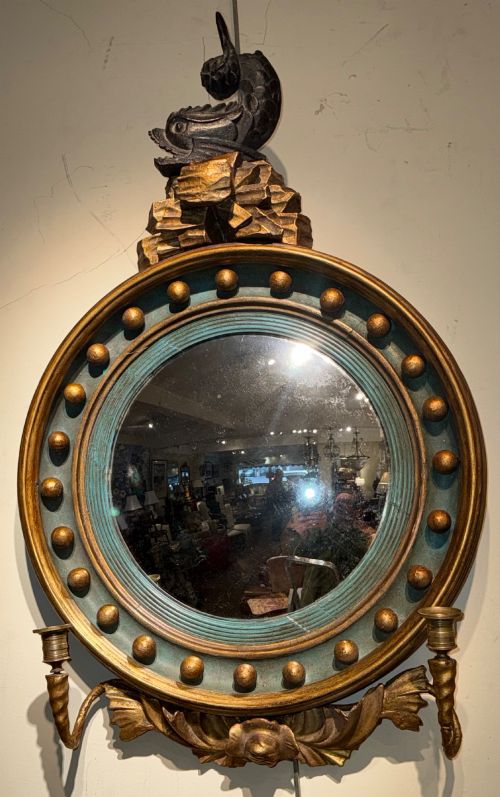


Convex Girandole Wall Sconce
A convex girandole wall sconce bends the light of a room in a single circular sweep, offering the classic Regency optical illusion buyers seek.
Convex Girandole Wall Sconce
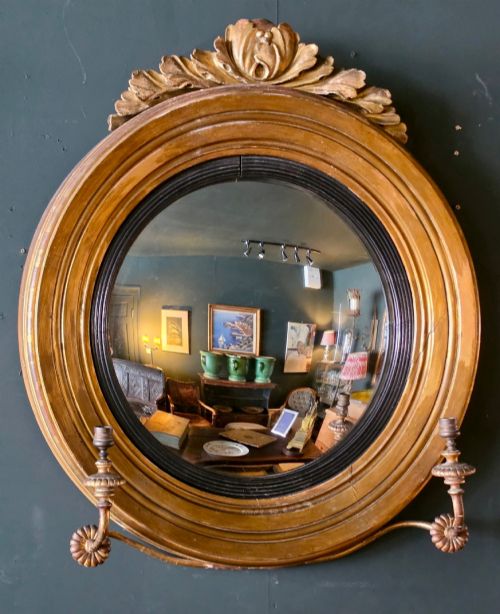
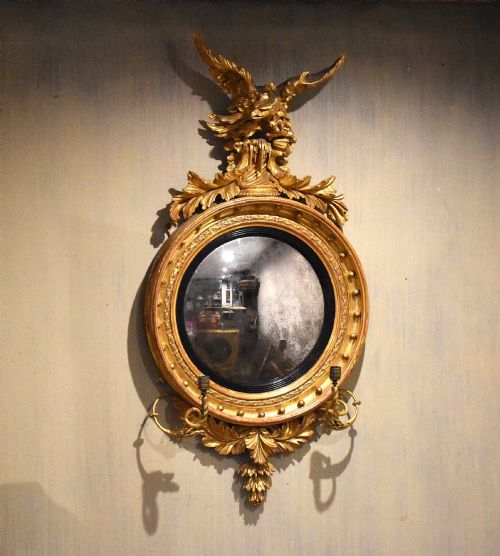
A convex girandole wall sconce is a round wall mirror designed to capture and scatter daylight across an interior. Every piece recorded here belongs to the Regency period or the nineteenth century, establishing a clear historical footprint for these circular wall mirrors.
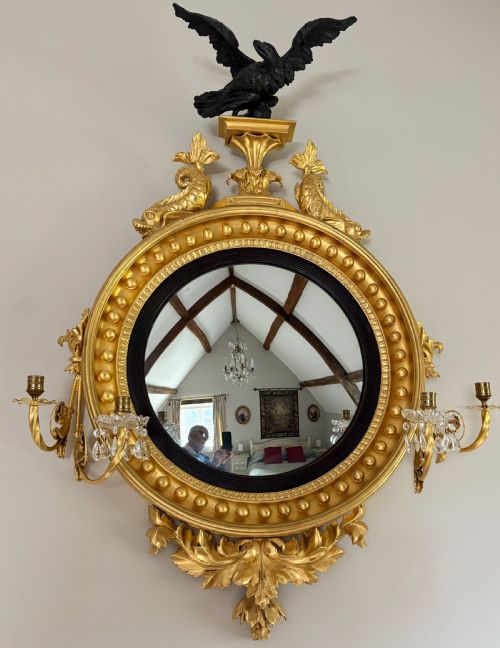
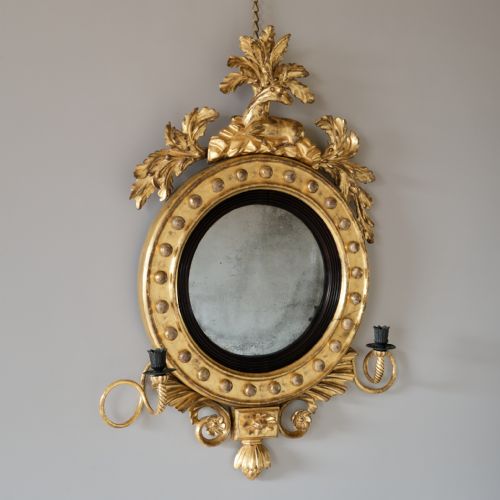
The primary forms found on this page are large wall mirrors framed in giltwood, often retaining their original girandole arm fittings for candles. These wall mirrors measure up to sixty-nine inches, offering a commanding focal point for a principal reception room.
The Regency style dominates the selection, bringing a distinct architectural presence through bold circular frames and carved wooden details. Buyers meet pieces that reflect the height of early nineteenth-century interior design tastes.
How they were made
Makers built these frames primarily from giltwood, applying thin sheets of gold leaf over a prepared gesso and wood base. Ebonised wood and painted wood variations also appear, providing a contrasting dark finish to the reflective glass.
The distinctive curved mirror glass sits within a moulded frame, often secured by a reeded ebonised slip and decorative sight edge. Artisans shaped the heavy glass to create the convex surface that makes these wall mirrors function as optical devices.
Convex Girandole Wall Sconce Retail Price Guide 2026
Typical asking prices for convex girandole wall sconce among the pieces listed under this phrase on Sellingantiques today, from the lower quarter to the upper quarter. They describe what is for sale here now, not the wider market.
The convex curve was originally designed so butlers could keep an eye on the whole dining table without turning around.
What varies in quality
The finesse of the carved giltwood decoration dictates the visual standard of each mirror. Crisp relief work on the frame ornament shows the hand of a skilled artisan rather than a hurried workshop.
The preservation of the original mercury or silvered mirror glass alters the character of the piece. Clear, undisturbed reflection contrasts with the heavy foxing and dark spotting of age, changing how the glass gathers light.
The Convex Girandole Wall Sconce Glossary
- Giltwood
- Wood coated with gold leaf applied over a gesso ground. This material provides the brilliant reflective surface characteristic of Regency frames.
- Girandole
- A wall bracket or sconce fitted with branches for holding candles. These arms direct flickering light back towards the convex mirror glass.
- Convex glass
- Curving outward to create a spherical reflection of the entire room. This optical form distorts perspective to capture a wide-angle view in a compact frame.
- Reeded slip
- A narrow inner moulding carved with parallel convex ridges. It sits between the outer frame and the mirror plate in many Regency designs.
- Ebonised wood
- Timber stained or painted black to imitate ebony. This dark finish provides a sharp visual contrast against gilt ornament.
Convex Girandole Wall Sconce: Frequently Asked Questions
What is a convex girandole wall sconce?
A convex girandole wall sconce is a round wall mirror featuring a curved glass plate and candle branches attached to the frame. These pieces served both to illuminate and to monitor activity within large Regency rooms.
Today, buyers use them to bounce natural light into dark corners and add architectural depth to a wall arrangement.
How do I date a Regency wall mirror?
Dating relies on examining the construction of the wooden frame, the methods used to apply the gilt leaf, and the composition of the glass plate. Regency pieces display specific carving motifs such as reeded slips and classical appliques.
Nineteenth-century examples follow these same stylistic rules while showing the natural ageing patterns expected of materials from that era.
Where should I hang a large convex mirror?
These mirrors require a substantial wall space, often finding a natural home above a fireplace mantelpiece or centered on a principal dining room wall. Their wide-angle reflection means they capture light from multiple windows across the room.
Ensure the wall fixings match the considerable weight of the giltwood frame and glass plate.
Did all these mirrors originally have candle arms?
Not every convex mirror included girandole arms, though the term often encompasses both simple framed mirrors and those equipped for illumination. Some pieces were built strictly as wall mirrors without provision for candles.
Checking the frame sides reveals the mounting points where candle branches were once attached.