
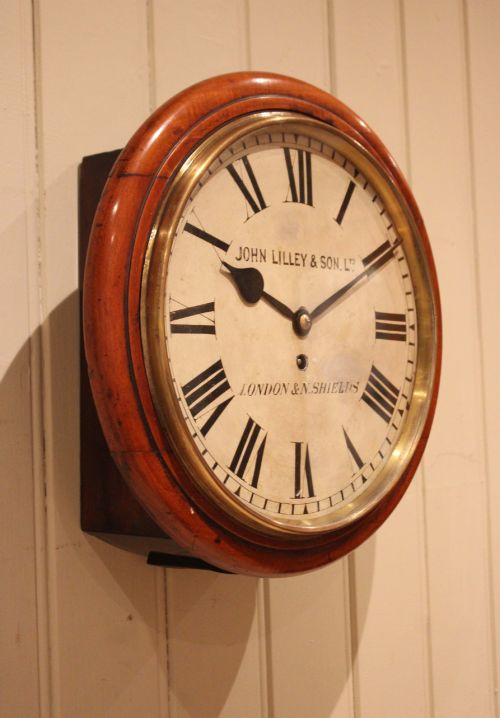
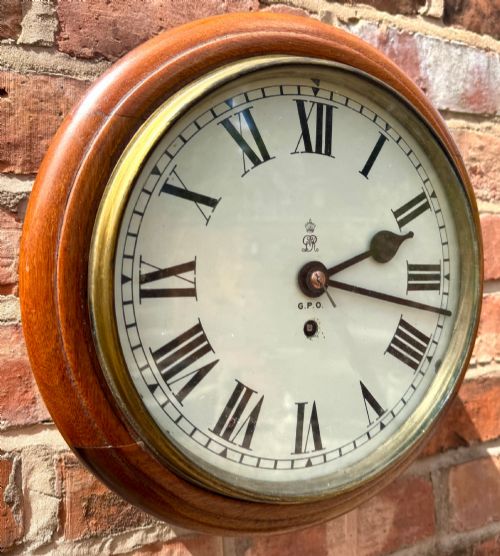


Commercial Wooden Wall Clock
A commercial wooden wall clock brings practical timekeeping into a room, offering the sturdy housing and clear dial required for everyday work.
Commercial Wooden Wall Clock
When you search for a commercial wooden wall clock, you are looking at timepieces built for offices, stations, schools, and railways. These heavy-duty clocks are designed for legibility and endurance in busy public spaces.
On this page, you are most likely to meet round dial wall clocks and drop dial examples housed in timber cases. They span periods from the early nineteenth century through to the Art Deco and George V eras.
The selection includes specific institutional timepieces, such as railway and General Post Office clocks, alongside large octagonal and school variations. Mahogany and oak dominate the timber housings, fitted with glass and brass bezels.
How a commercial wooden wall clock was made
Maker workshops constructed the structural housings primarily from dense hardwoods like mahogany and oak, often incorporating hinged bezels in brass or iron to protect the face. Dial surrounds varied from simple wooden rims to deep octagonal profiles.
Movements relied on fusee mechanisms to maintain steady tension and accurate time as the mainspring unwound. Dials utilised painted wood or paper laid over metal or wood backings, marked with clear numerals suited to quick reading from a distance.
Listings feature oak and mahogany housings fitted with fusee movements spanning the Victorian, Edwardian, and Art Deco periods.
What varies in quality in a commercial wooden wall clock
The sophistication of the internal movement dictates the standard, with chain fusee mechanisms representing a higher grade of mechanical execution. Stamped case numbers and signed dial faces indicate institutional provenance and workshop care.
The preservation of the original timber case and the clarity of the painted dial influence desirability. Clocks retaining authentic railway or postal service markings show a direct link to their operational history.
John Walker·Anglo Swiss Watch Co.·Camerer Cuss
The Commercial Wooden Wall Clock Glossary
- Fusee
- A conical pulley used in clock movements to equalize the declining power of the mainspring. This device ensures consistent force is delivered to the gear train for greater accuracy.
- Drop dial
- A clock case featuring a rounded dial top above an extended lower trunk that houses the pendulum. This shape protected the pendulum while keeping the overall footprint compact on the wall.
- Dial clock
- A timepiece dominated by a prominent face with minimal surrounding cabinet work. These were standard for offices and transport hubs where visibility was paramount.
- Bezel
- The metal or wooden ring that holds the protective glass pane in front of the clock face. It often hinges open to allow hand-setting and regulation.
Commercial Wooden Wall Clock: Frequently Asked Questions
What is a fusee movement?
A fusee movement is a mechanical system that uses a cone-shaped pulley to regulate the pull of the mainspring. It ensures the clock receives even power as the spring unwinds.
This mechanism helps the clock maintain accurate time over its running period without losing speed.
How do I identify railway clocks?
Railway clocks typically feature specific company lettering or numbers painted on the dial or stamped into the wooden case. Initials such as GVR or BR indicate use by national transport services.
These timepieces were built to strict specifications for punctuality on the network.
Where were these clocks used?
These clocks were installed in public buildings, railway platforms, post offices, and school rooms. Their primary purpose was keeping synchronized time for staff and the public.
Today, they suit domestic hallways, kitchens, and studies requiring functional wall art.
How do I hang a heavy wall clock?
A heavy wooden wall clock requires secure fixing directly into wall studs or through appropriate masonry fixings. The weight of the timber case and brass bezel demands a robust anchor.
Ensure the hanging bracket on the back of the case is firmly attached before mounting.