
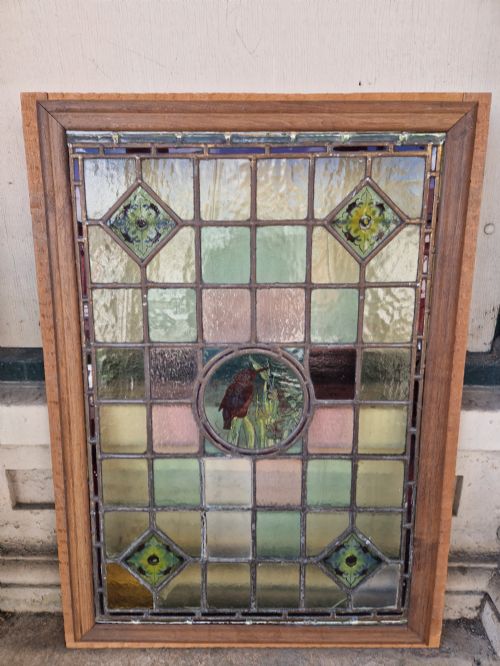


Coloured Leaded Glass Panel
These coloured leaded glass panel pieces bring rich period light and colour into a room, offering genuine architectural character from the Victorian era onwards.
Coloured Leaded Glass Panel
A coloured leaded glass panel forms a decorative architectural window or partition, constructed to filter light through coloured and sometimes hand-painted panes. When searching this phrase, buyers encounter architectural salvage pieces ranging from domestic door windows to large church sections.
The pieces on this page span the Victorian and Edwardian periods, stretching into the 1920s and 1930s with styles such as Art Nouveau, Gothic Revival, and Arts and Crafts. Domestic scenes, floral motifs, and bird designs dominate the surviving examples, alongside specific regional works like Dutch folk art.
Most items take the form of rectangular window panels or pairs of windows, though arched church windows and multi-section formats also appear. Buyers find both simple geometric square panes and complex pictorial works featuring hand-painted countryside landscapes.
How they were made
Maker's workshops built these panels using shaped pieces of glass held together by lead cames, soldered at the joints to form a rigid web. Timber frames in pine and other wood frequently encase the glass structure for support.
Coloured Leaded Glass Panel Retail Price Guide 2026
Typical asking prices for coloured leaded glass panel among the pieces listed under this phrase on Sellingantiques today, from the lower quarter to the upper quarter. They describe what is for sale here now, not the wider market.
Several panels swap stately church arches for cheerful Dutch boys and girls or a solitary parrot.
What varies in quality
The sophistication of the painted artwork and the complexity of the design set the finer panels apart from standard geometric glazing. Hand-painted pictorial scenes, such as landscapes or birds on branches, require greater skill than repeat floral motifs.
Materials and structural integrity also divide the range, with larger multi-section windows and period timber frames showing superior architectural ambition. The integration of specialty glass elements, including bullseyes and rich enamel work, distinguishes the more accomplished commissions.
Sir Edward Burne-Jones
The Coloured Leaded Glass Panel Glossary
- Came
- A slender strip of cast lead, milled with a grooved profile, used to hold individual pieces of glass together in a window panel.
- Bullseye
- A small, circular centre piece of blown glass showing a concentric ripple pattern, often used to add texture and amber tones.
- Stained glass
- Glass that has been coloured during its manufacture by the addition of metallic oxides, or subsequently painted and fired.
- Architectural salvage
- Building elements and fixtures rescued from older structures for reuse or display in interior settings.
- Enamel
- Opaque vitreous material applied to the surface of glass and fired in a kiln to create permanent coloured details.
Coloured Leaded Glass Panel: Frequently Asked Questions
How do I hang a glass panel?
Most panels require secure fixing within a wooden window reveal or against a lighted wall box to support their weight and reveal the colours.
Because lead and glass structures are heavy, professional installation using appropriate brackets ensures the panel remains stable.
Were these panels meant for interior use?
These pieces originated primarily as exterior windows, church glazing, or interior door panels designed to divide living spaces.
In modern settings, many find new life mounted inside existing window frames or hung purely as decorative wall art.
How do I identify a Victorian panel?
Victorian examples often feature Gothic Revival influences, rich deep colours, or traditional church arch top forms.
Comparing the framing wood, the weight of the lead cames, and the painting style helps separate 19th-century work from later 1930s pieces.
Can damaged lead be repaired?
Specialist restorers can stabilise loose lead cames and replace broken glass shards using traditional soldering and glazing techniques.
Minor bends in the lead network are common in antique panels and rarely prevent successful hanging or display.