
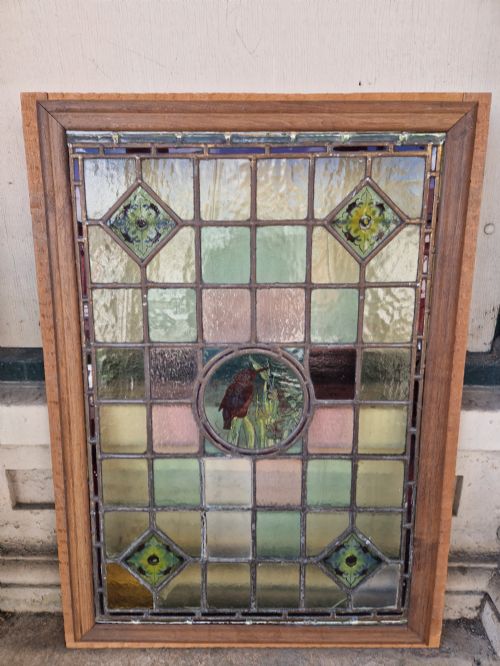


Coloured Glass Window
A coloured glass window transforms ordinary daylight into rich colour, offering historic charm and decorative warmth for any interior space.
Coloured Glass Window
A coloured glass window brings together structural glazing and ornamental design, with pieces spanning from the Victorian and Edwardian eras into the twentieth century. Buyers encounter architectural salvage panels, church windows, and domestic leaded glass featuring landscapes, floral motifs, and figurative scenes.
The selection here encompasses Gothic Revival church arches, Art Nouveau curves, and simple geometric panels framed in timber, pine, or lead. Many examples incorporate hand-painted details depicting country farmhouses, birds, castles, and Dutch folk art designs.
Victorian and Edwardian domestic panels dominate the available selection, frequently featuring amber bullseyes, multicoloured borders, and heraldic shields. Larger multi-section windows and pairs provide substantial architectural presence for interior partitions or exterior framing.
How these windows were constructed
Glaziers built each coloured glass window by joining individual glass segments with flexible lead cames, soldering the joints to create a secure matrix. Artisans frequently applied enamel pigments to the glass surface before firing, fixing hand-painted details like flowers, birds, and pastoral landscapes permanently.
Frames constructed from timber, pine wood, or reinforced lead provided necessary structural support for heavier panels during installation. Coloured glass varieties, including fired glass and amber bullseyes, were selected to manipulate incoming light and create varied visual textures across the design.
Coloured Glass Window Retail Price Guide 2026
Typical asking prices for coloured glass window among the pieces listed under this phrase on Sellingantiques today, from the lower quarter to the upper quarter. They describe what is for sale here now, not the wider market.
A solitary Dutch boy and girl share window space with hand-painted countryside scenes, pastoral cows, and watchful glass parrots.
What determines quality in these panels
Quality rests upon the skill of the hand painting, the complexity of the leaded composition, and the depth of the coloured glass. Superior panels display finely detailed brushwork on figural or landscape scenes, alongside harmonious colour palettes that catch light effectively.
The integrity of the lead cames and the original timber or pine frames dictates the structural merit of each piece. Intricate stylistic elements, such as Gothic Revival tracery or cohesive Art Nouveau and Arts and Crafts designs, elevate specific panels above standard domestic glazing.
Sir Edward Burne-Jones
The Coloured Glass Window Glossary
- Lead came
- The flexible lead strip used to hold individual pieces of glass together in a window panel. These strips form the structural grid of the design.
- Bullseye
- A small, rounded centre of glass formed during the blowing process, often displaying concentric rings and rich amber tones. Glaziers placed these elements to catch and refract light.
- Architectural salvage
- Building components rescued from older structures slated for demolition or alteration. This category includes church windows, doors, and decorative panels.
- Enamel
- A vitrescible paint applied to glass surfaces and fired in a kiln to achieve permanent colour and detail. It allowed artists to depict intricate faces, foliage, and shading.
- Gothic Revival
- An architectural and decorative style drawing inspiration from medieval design. Pieces often feature pointed arches and heavy stone or timber framing.
Coloured Glass Window: Frequently Asked Questions
How do I hang a stained glass window?
Most panels require secure fixing points attached to the outer frame rather than relying on the lead came structure alone. Hanging brackets fixed into window reveals or wall studs ensure the weight is properly supported.
Larger panels, particularly multi-section architectural salvage pieces, benefit from professional joinery support to prevent bending or stress on the historic lead matrix.
Were these windows meant for interior or exterior use?
Historic leaded panels served both internal partition purposes and exterior openings depending on the building type and era. Victorian and Edwardian domestic examples often appeared in hallways, transoms, and external reception rooms.
Church windows and large architectural salvage pieces were engineered for substantial exterior masonry openings, requiring weatherproof installation when reused today.
How do I date an antique leaded glass window?
Dating relies upon stylistic clues, subject matter, and framing materials characteristic of specific periods like the Victorian era, Edwardian period, or the 1930s. Art Nouveau curves, Gothic Revival arches, and specific hand-painted motifs point toward particular decades of manufacture.
The presence of original pine framing, specific glass textures, and construction techniques also help narrow down the production period.
Can damaged lead work be repaired?
Traditional leaded windows can be carefully restored by specialists who replace deteriorated lead cames and stabilise cracked glass segments. Skilled restorers match the original materials to preserve the aesthetic and structural integrity of the panel.
Routine maintenance involves checking the rigidity of the panel and ensuring the surrounding timber or pine frame remains stable.