


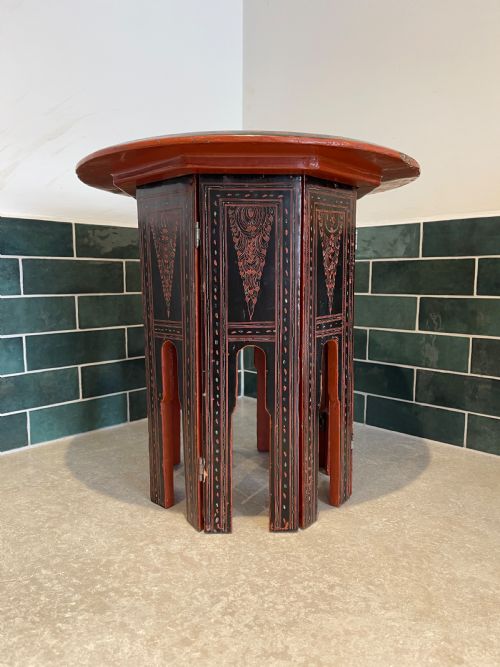
Colonial Folding Occasional Table
A colonial folding occasional table brings portable versatility and intricate craftsmanship to a room, offering a clever blend of travel utility and decorative presence.
Colonial Folding Occasional Table
A colonial folding occasional table is a portable piece designed for easy transport and compact storage, frequently appearing in forms such as side tables, lamp tables, and tea tables. These versatile items served administrative and domestic functions across British colonial outposts, requiring a clever collapsible mechanism that allowed surfaces to fold flat when movement was necessary.
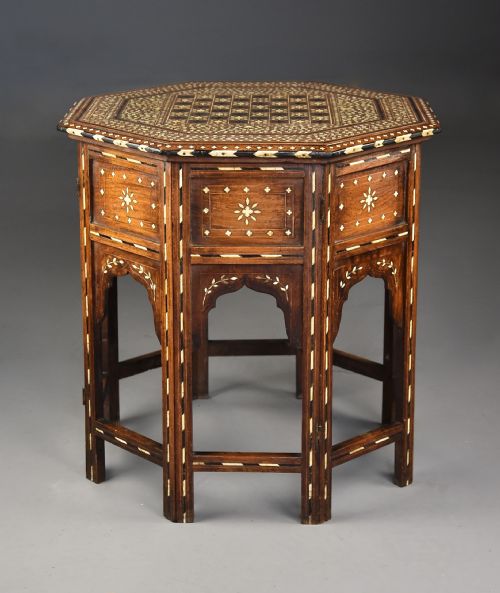
The pieces on this page emerge from several periods, ranging from the Victorian era and the late nineteenth century through to the 1930s. Makers produced these tables primarily within Anglo-Indian, Anglo-Indian Colonial, and Anglo-Burmese stylistic traditions, creating portable furniture that bridged utilitarian travel needs with elaborate indigenous woodworking techniques.
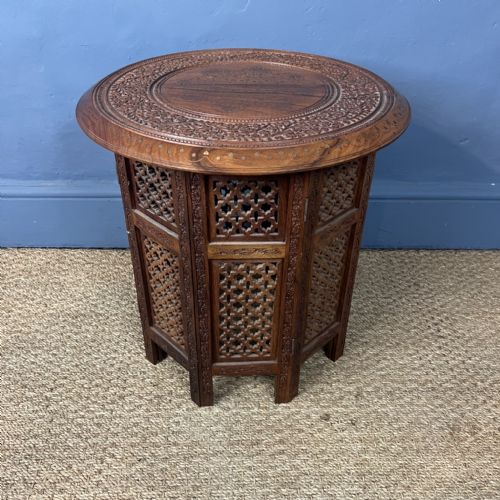
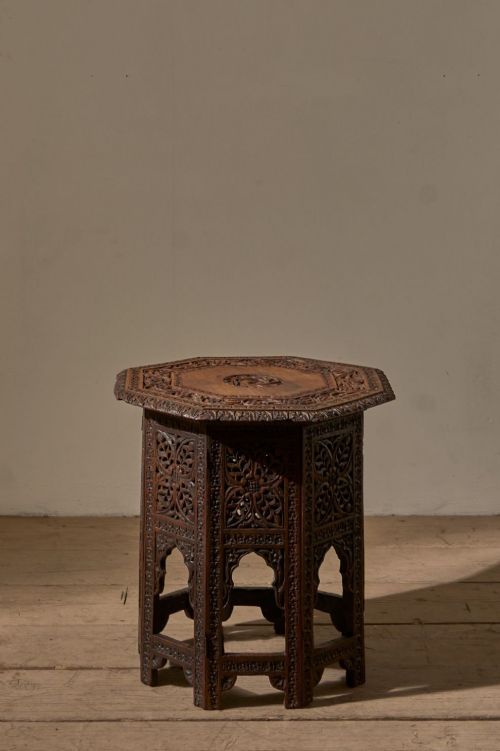
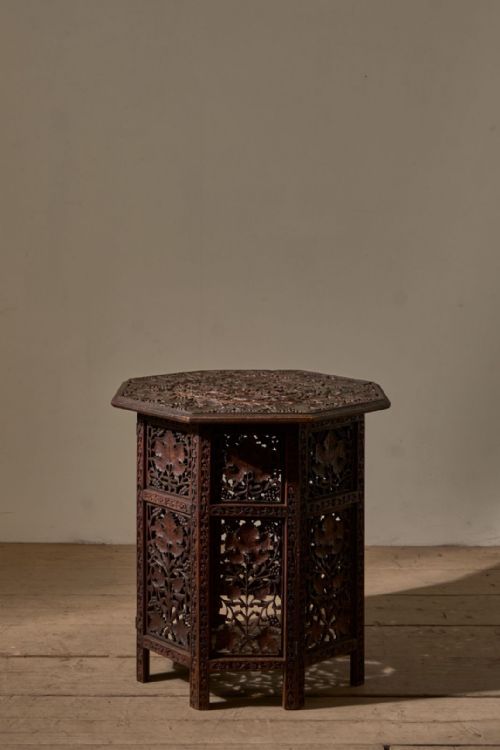
Buyers encounter distinctive geometric configurations, notably octagonal and circular tops, alongside square folding formats. These occasional tables bridge the gap between functional stands and decorative focal points, utilising traditional hinges, pins, and interlocking cross-frames to achieve stability without permanent assembly.
How they were made
Artisans constructed these tables using dense tropical timbers such as teak, padauk, rosewood, ebony, and assorted hardwoods. These robust woods provided the structural integrity necessary for pieces subjected to frequent folding and relocation.
Craftsmen enriched the timber surfaces through varied decorative techniques, notably intricate hand-carving displaying leaf and dragon motifs. Workshops also applied contrasting inlay work utilising bone, brass, and copper to create elaborate geometric and floral patterns across the table tops.
Some tables feature carved dragons glaring up from the tea service, proving that Victorian practicality had a sense of humour.
What varies in quality
Quality rests significantly on the precision of the folding mechanism and the rigidity of the assembled frame. Superior examples maintain tight joints and smooth folding actions despite decades of movement, whereas lesser pieces suffer from loose hinges and wobbly legs.
The depth and intricacy of the carving alongside the completeness of the metal or bone inlay dictate the upper tiers of the range. Master carvers achieved crisp relief work and secure inlay placement that remained flush with the surrounding hardwood, distinguishing finer workshop production from simpler commercial outputs.
The Colonial Folding Occasional Table Glossary
- Anglo-Indian
- A descriptive term for furniture made in India during the British colonial period, combining European furniture forms with traditional Indian craftsmanship. These pieces often feature dense carving and intricate inlay.
- Campaign table
- Portable furniture designed for military officers and travellers on the move, engineered to pack flat or fold easily. They utilise collapsible frames and removable tops for efficient transport.
- Hoshiarpur
- A region in Punjab renowned for intricate woodwork and inlay, particularly tables featuring dense geometric bone and brass patterns set into dark hardwoods. Pieces from this centre display remarkable intricacy.
- Padauk
- A heavy, durable tropical hardwood with a reddish-brown hue that darkens with age, frequently utilised in colonial furniture making. Its density makes it suitable for detailed carving.
- Occasional table
- A small, light table intended for subsidiary use in a room, such as holding a lamp or book. They provide versatile surface space without dominating a room's layout.
Colonial Folding Occasional Table: Frequently Asked Questions
What is a colonial folding occasional table?
A colonial folding occasional table is a portable piece of furniture designed to fold flat for travel while serving as a decorative surface in a home. These items combine British furniture forms with traditional craftsmanship from regions like India and Burma.
Craftsmen utilised dense tropical timbers and often added intricate carvings or metal inlay to the folding frames. They function primarily as side, lamp, or tea tables.
How do you fold these tables?
Most folding tables utilise an interlocking wooden base that collapses into a flat frame once the top is removed or tilted. The hinges and pins allow the supports to pivot smoothly.
Careful handling of the joints ensures the mechanism operates without straining the surrounding hardwood. Users simply lift the top and fold the crossing legs inward.
Where were these tables made?
These pieces originated in workshops across the Indian subcontinent and Burma during the nineteenth and early twentieth centuries. Local artisans produced them for colonial administrators, military officers, and export markets.
Design traditions varied by region, ranging from the bone inlay work of Hoshiarpur to the carved padauk surfaces associated with Anglo-Indian production.
How do you care for teak and padauk?
Tropical hardwoods require minimal maintenance, benefiting from occasional dusting with a dry cloth to protect the polished surface. Avoiding excessive moisture and direct sunlight preserves the natural oils in the timber.
Inlaid sections require gentle cleaning around the brass, copper, or bone details to prevent debris accumulation. Natural wax can be applied sparingly to maintain the sheen of the hardwood.