






Colonial Ebony Box
A colonial ebony box brings dense, dark grain and heavy brass mounts straight from nineteenth-century campaigns and traders' desks into a modern room.
Colonial Ebony Box
A colonial ebony box spans writing slopes, strong boxes, trinket boxes, and large trunks created across nineteenth-century outposts. These pieces emerge predominantly in Anglo-Indian, Dutch Colonial, and Ceylonese workshops, reflecting trade and administration hubs.
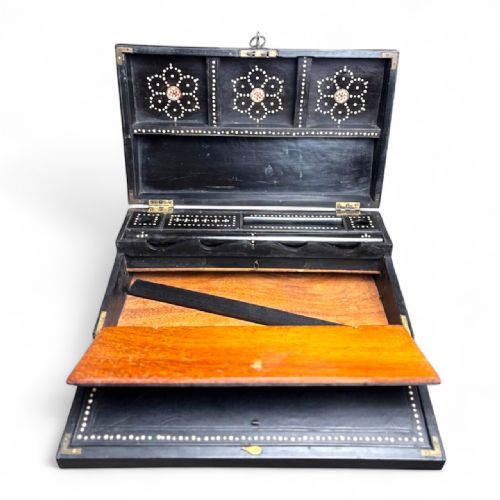
Writing boxes and writing slopes dominate the selection on this page, often fitted with internal compartments and secret drawers. Alongside them appear larger coffers, chests, and smaller trinket containers built from dense tropical hardwoods.
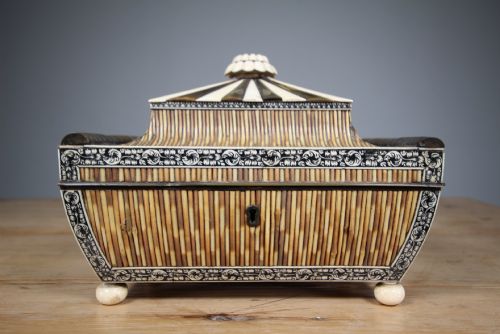
The aesthetic bridges European interior tastes of the Regency and Victorian eras with local craftsmanship. Makers utilised heavy timber combined with contrasting inlay, porcupine quill work, or bright brass mounts to secure and decorate each container.
Materials and construction
Solid ebony and padouk provide the heavy, dark structure of these pieces, sometimes paired with secondary timbers like camphor wood or satinwood. These dense woods resist tropical insects and wear, allowing artisans to carve crisp mouldings and reeded decoration directly into the solid material.
Brass banding and mounts reinforce the corners and edges, serving both a structural purpose for campaign travel and a decorative contrast against the black wood. Artisans also integrated delicate bone, ivory inlay, or natural porcupine quill panels into specific regional boxes.
Colonial Ebony Box Retail Price Guide 2026
Typical asking prices for colonial ebony box among the pieces listed under this phrase on Sellingantiques today, from the lower quarter to the upper quarter. They describe what is for sale here now, not the wider market.
Victorian travellers trusted porcupine quills to decorate their stationery boxes, proving that even a rodent's defensive armour makes a splendid writing companion.
Distinguishing quality
Quality rests on whether the box uses solid ebony throughout or relies on thin veneers applied to secondary woods. Solid construction yields heavier weight and cleaner carving of reeded borders and moulded details.
The precision of the brass work and internal fittings dictates the tier of the piece. Superior examples feature flush-fitting hardware, tight mitres on inlay work, and complete internal writing surfaces or velvet linings.
The Colonial Ebony Box Glossary
- Ebony
- A dense, heavy heartwood known for its deep black colour and fine texture. It takes a high polish without needing artificial stains.
- Writing slope
- A portable desk featuring an angled, hinged lid that folds down to reveal a writing surface and internal stationery compartments. These were essential for travellers and colonial administrators.
- Porcupine quill
- Quills sorted and arranged in geometric patterns beneath glass or open frames, particularly associated with nineteenth-century Ceylonese boxes. They create a textured, pale and dark striped mosaic.
- Reeded decoration
- Parallel convex mouldings carved directly into the solid wood surface. This technique adds linear texture to box lids and sides.
- Campaign
- Furniture and boxes built for military officers or travellers, typically fitted with recessed brass handles and reinforced corners for harsh transit.
Colonial Ebony Box: Frequently Asked Questions
How were these boxes used?
These boxes functioned primarily as portable desks, storage chests, and secure receptacles for correspondence or personal items. Writing slopes contained dedicated slots for inkwells, pens, and paper alongside hidden compartments for sensitive documents.
Larger coffers and trunks held clothing and valuables aboard ships or during overland journeys. Smaller trinket boxes sat on dressing tables to store jewellery and keepsakes.
How do I care for antique ebony?
Ebony requires stable indoor humidity levels to prevent the dense wood from splitting or warping over decades. Keep the boxes away from direct heat sources and strong sunlight that can fade the finish.
Dust the carved surfaces and brass mounts gently with a dry, soft cloth. Avoid harsh chemical polishes and feed the dry wood sparingly with appropriate conservation wax if needed.
How do I tell regional styles apart?
Regional characteristics often appear in the secondary materials and decorative motifs used alongside the ebony. Ceylonese pieces frequently incorporate intricate porcupine quill panels or contrasting satinwood interiors, while Anglo-Indian examples lean toward heavy reeded carving and bold ivory inlay.
Dutch Colonial chests tend to feature robust brass strapwork mounted onto massive timber carcasses, reflecting strong maritime and domestic storage traditions.