


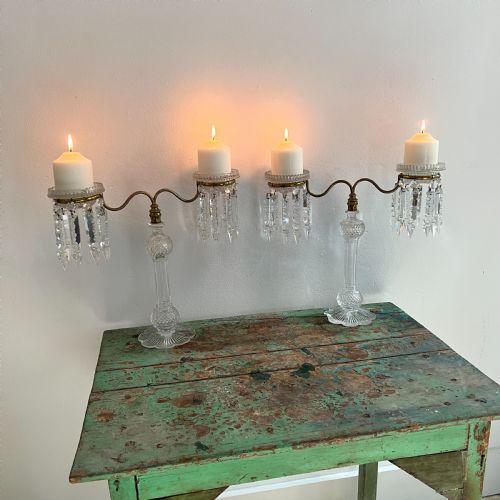

Clear Crystal Lustres
Clear crystal lustres combine heavy optical glass with hanging glass drops that catch and scatter candlelight across the room.
Clear Crystal Lustres
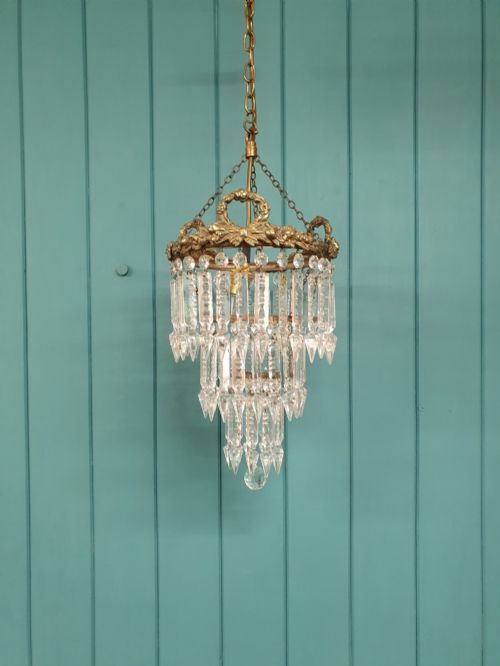
Clear crystal lustres are decorative lighting accessories and mantel ornaments designed to hold candles while multiplying the flame's output through suspended glass prisms. When you search for clear crystal lustres, you encounter table candelabra, mantel pieces, wall lights, and small chandeliers spanning the Victorian, Edwardian, Regency, and early twentieth-century periods.
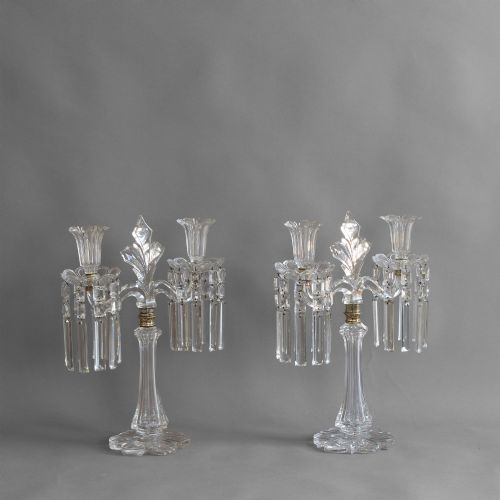
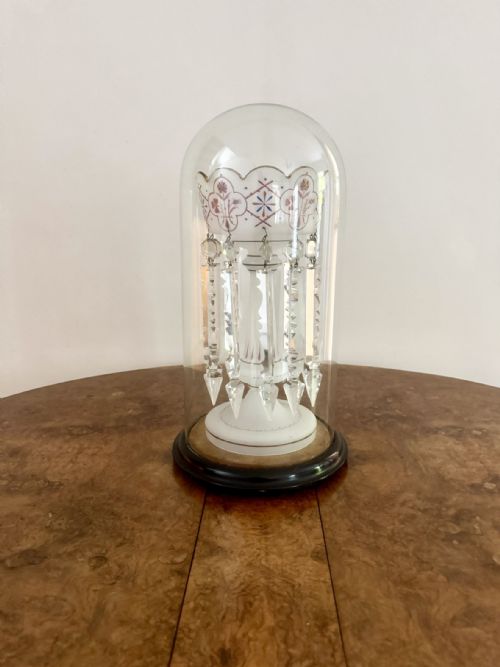
The most frequently seen examples on this page are pairs of table mantel lustres, often fashioned with cut glass bodies and long pendant drops. These domestic ornaments sit upon mantelpieces or side tables, functioning as both candleholders and sparkling focal points for a room.
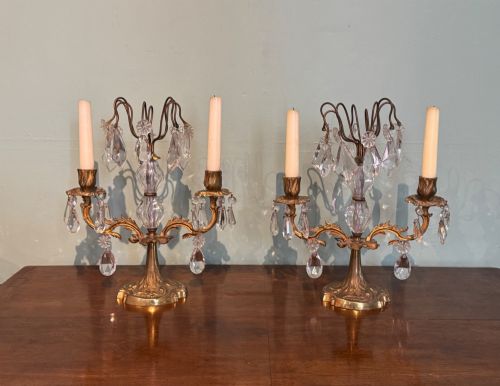
Origins stretch from English workshops to French neoclassical and rococo revival designs, alongside nineteenth-century Scandinavian interpretations. Makers utilised brass and gilt brass mounts to support the heavy glass stems and bobêches from which the crystal drops depend.
Materials and construction
The primary bodies comprise cut glass, crystal glass, and clear cut crystal, shaped by hand-blowing and wheel-cutting to create sharp facets. These refractive surfaces are engineered to maximise the play of light from candles or early electric bulbs.
Metal components in brass, gilt brass, and metal wire provide the structural armature that holds the central stems, candle nozzles, and hanging loops together. Glass pendants, commonly known as drops or prisms, are attached to these metal frameworks using looped wire connectors.
Certain early twentieth-century lustre wall lights include playful cherub figures holding the crystal-laden branches.
Judging quality and execution
Quality rests upon the depth and crispness of the glass cutting, where sharper, cleaner facets produce brighter refraction than softer, rounded press-moulded edges. The weight and clarity of the crystal glass itself determine how purely the piece transmits light.
The integration of the metal mounts dictates the stability and proportion of the object. Heavier brass casting and secure, well-matched wire suspension for the drops separate standard domestic wares from finer decorative examples.
The Clear Crystal Lustres Glossary
- Lustre
- A decorative tabletop or mantel ornament featuring glass drops hung around a candle socket to refract light. They are traditionally found in matched pairs.
- Bobêche
- A collar or drip pan placed beneath the candle nozzle to catch melting wax. It frequently serves as the attachment point for hanging crystal prisms.
- Prism
- A cut glass pendant suspended from the upper body of a lustre or chandelier. These drops split candlelight into spectral highlights.
- Cricklite
- A specialised brand of table candelabra and candle lamp utilising cut glass and brass frames. Clarkes produced these patented designs during the late nineteenth century.
Clear Crystal Lustres: Frequently Asked Questions
What is a lustre?
A lustre is an ornamental candleholder decorated with hanging glass pendants designed to catch and multiply light.
They were placed on mantelpieces and tables to brighten rooms before electric lighting became common.
How do I clean clear crystal lustres?
Cleaning requires removing the delicate glass drops individually and washing them in warm soapy water. Metal mounts need careful dusting to avoid disturbing the wire fixings that hold the prisms.
Reassembly should happen slowly to ensure every pendant returns to its correct hanging loop.
Where were lustres placed?
Lustres sat principally on mantelpieces above fireplaces, where candle glow reflected in the mirror glass behind them. They also stood on side tables and consoles in formal reception rooms.
Pairs maintained symmetry in traditional nineteenth-century interior decoration.
How do I date an antique lustre?
Dating relies on examining the cutting style of the crystal, the composition of the metal frame, and the shape of the candle sockets. Victorian and Regency pieces often feature heavier hand-cut components.
Twentieth-century examples tend toward lighter construction and different chandelier proportions.