
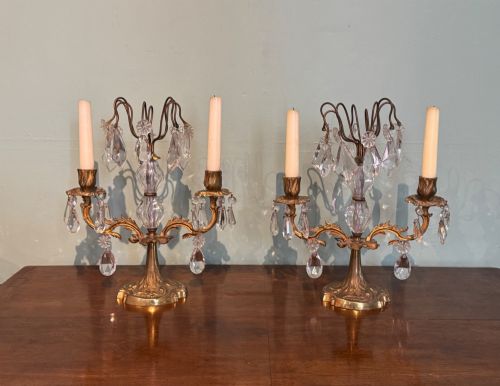


Two Arm Gilt Candelabra
These two arm gilt candelabra bring the warm radiance of French Rococo and Neoclassical revival design into a room.
Two Arm Gilt Candelabra
When you search for two arm gilt candelabra, you find pairs of candle-holders finished in gold tones, originating primarily from the nineteenth and early twentieth centuries. These pieces take the form of table candelabra, wall sconces, and converted lamps, often pairing metal with marble or cut glass.
The versions you are most likely to meet on this page lean heavily towards French aesthetic traditions, particularly French Rococo Revival and Louis XVI styles. They employ two branches or arms to hold candles or electric fittings, reflecting the decorative tastes of the eighteen-eighties, eighteen-nineties, and nineteen-twenties.
How They Were Made
Maker's workshops cast these pieces in bronze, brass, or ormolu, applying gilding to create a lustrous golden finish. Skilled artisans combined these metal elements with carved marble bases or incorporated cut crystal details to catch and refract the light.
Some examples utilise carved gilt wood or feature cast bronze figural components, such as cherubs, integrated into the structural design. The assembly relies on traditional mechanical fastening methods appropriate to each period, from the nineteenth century through to nineteen-thirty.
Listings on this page span from eighteen-sixty to nineteen-thirty, incorporating materials such as cut crystal, marble, and gilt bronze.
What Varies in Quality
The refinement of the casting work sets finer examples apart from simpler productions, with crisp detail in the foliage, scrolls, or figural elements indicating superior craftsmanship. The quality of the underlying metal, whether bronze, brass, or ormolu, dictates how well the gilding ages and holds its depth of colour.
Integration of secondary materials such as marble or cut crystal also marks the distinction between standard and higher-grade pieces. Heavier, more substantial metalwork and balanced proportions demonstrate the skill of the original workshop.
Claude Clodion
The Two Arm Gilt Candelabra Glossary
- Ormolu
- A gilded bronze technique used extensively in French decorative arts. It provides a rich, gold-coloured finish that requires careful cleaning.
- Gilt Bronze
- Bronze metal that has been coated with a thin layer of gold leaf or gold paint. This material offers durability alongside a bright metallic sheen.
- Louis XVI Style
- An eighteenth-century classical revival style characterised by straight lines, symmetry, and classical motifs. It experienced revivals throughout the nineteenth and twentieth centuries.
- French Rococo
- A decorative style known for asymmetrical designs, C-scrolls, and naturalistic plant motifs. It creates an ornate and flowing visual effect on lighting fixtures.
Two Arm Gilt Candelabra: Frequently Asked Questions
Where should I place these wall lights?
These two arm gilt candelabra and wall sconces suit flanking positions on either side of a fireplace, mirror, or doorway. Their branch configuration projects light outward to create an ambient glow.
Ensure they are installed at a suitable eye-level height when wired as wall fixtures, or place table versions on stable surfaces where their metallic finishes catch the natural room light.
How do I identify the period?
Look to the combination of materials, casting sharpness, and stylistic cues to determine the era. Pieces from the nineteenth century often feature heavier bronze casting and classical marble bases.
Twentieth-century examples from the nineteen-twenties and nineteen-thirties may show sleeker lines or different interpretations of earlier French chateau and Rococo revival motifs.
Can these be used with candles?
Many of these pieces were originally designed for wax candles, though numerous surviving examples have been adapted over time into table lamps or wired wall lights. You should check the current fittings of each individual piece to see if it retains candle cups or holds electrical components.
When utilised with candles, ensure the pair is placed away from draughts and on steady surfaces to maintain safety while displaying them in your home.
What maintenance do gilt surfaces need?
Gilt bronze, brass, and gilded wooden surfaces require gentle dusting with a soft, dry cloth to prevent the accumulation of grime. Avoid harsh chemical cleaners or abrasive pads that can strip away the thin gold finish over time.
Treating the metal with care preserves the integrity of the original gilding and maintains the soft lustre intended by the maker.