
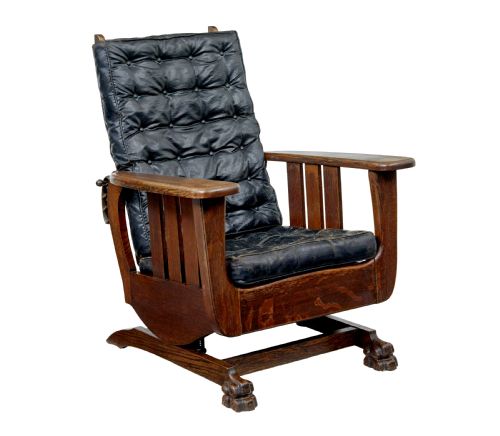


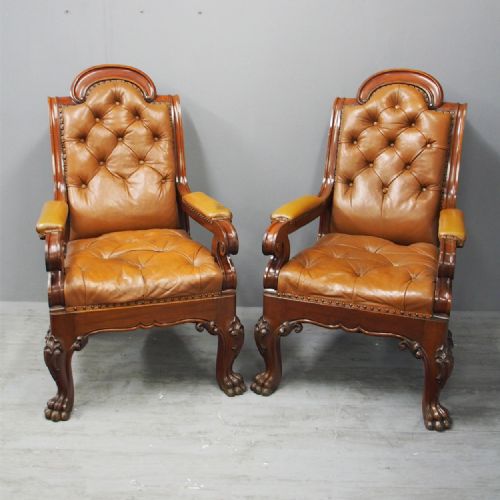
Claw Foot Leather Chairs
Claw foot leather chairs combine solid wood frames with supple hides and robust supports, offering lasting comfort and distinctive character for any room.
Claw Foot Leather Chairs
When you search for claw foot leather chairs, you are looking at substantial seating built from periods ranging through the nineteenth and twentieth centuries.
The versions you are most likely to meet on this page include library armchairs, club armchairs, and dining chairs originating from Victorian, George IV, and country house traditions.
These pieces draw on styles such as French Empire, Regency, and Georgian Revival, bringing heavy timber frames and upholstered leather together in various forms of armchairs and dining sets.
Construction and materials
Frames rely on sturdy timbers such as mahogany, walnut, and general hardwoods, providing the structural backbone necessary to support heavy upholstery.
Brass fittings often accent the woodwork, while upholstery uses leather combined with substantial padding to form the seat and backrest.
Carved wooden or cast metal feet take the specific form of claws, gripping the floor at the base of each leg.
Listings feature items spanning the Victorian era, the nineteenth century, and the early twentieth century up to nineteen thirty.
Judging quality and execution
The refinement of the carving on the feet separates standard production from exceptional pieces, with detailed claws showing superior craftsmanship.
The grade of the leather and the integrity of the timber frame dictate the longevity and overall finish of the chair.
Attribution to notable workshops or specific stylistic execution elevates certain examples above ordinary commercial seating.
Howard & Son's·C Hindley & Sons
The Claw Foot Leather Chairs Glossary
- Claw and ball
- A foot carved to resemble a bird's talon gripping a ball, popular across various historical furniture styles. This motif anchors the leg visually and adds decorative weight.
- Library armchair
- A large, comfortable seat designed for reading rooms, typically upholstered in leather with generous armrests. These chairs prioritize ergonomic support over formal posture.
- Chesterfield
- A style of upholstery featuring deep buttoning and rolled arms of equal height to the back. Originally associated with leather sofas and chairs, it remains a hallmark of traditional seating.
- Mahogany
- A durable reddish-brown tropical hardwood prized for furniture framing and visible cabinetwork. Its dense grain allows for sharp carving details on legs and feet.
Claw Foot Leather Chairs: Frequently Asked Questions
What periods do these chairs come from?
The pieces span the nineteenth and twentieth centuries, including Victorian examples and items from around nineteen ten and nineteen thirty. You will also find pieces referencing earlier Georgian and Regency designs.
Production methods shifted slightly over these decades, yet the combination of timber frames, leather upholstery, and carved feet remained consistent.
Are these chairs suitable for daily use?
These robust library and club chairs were built for heavy reading room and domestic service. Their sturdy mahogany and walnut frames accommodate regular sitting.
Proper leather maintenance ensures the upholstery handles everyday wear while retaining its supple texture.
How do I identify claw and ball feet?
Look at the base of the leg where the timber or metal forms a distinct taloned grip around a spherical shape. This decorative feature appears frequently on Victorian and revival seating.
The execution of the carving reveals the skill of the maker.
What timber types are used?
Makers relied on strong hardwoods such as mahogany and walnut for the visible frames and legs. These woods provided the necessary strength to support heavy leather upholstery.
Secondary woods occasionally appear in hidden structural parts.