
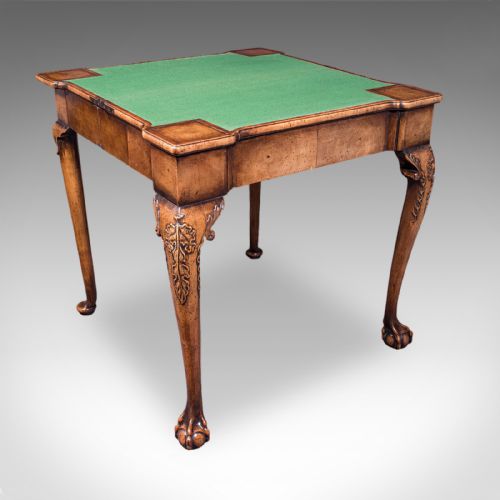
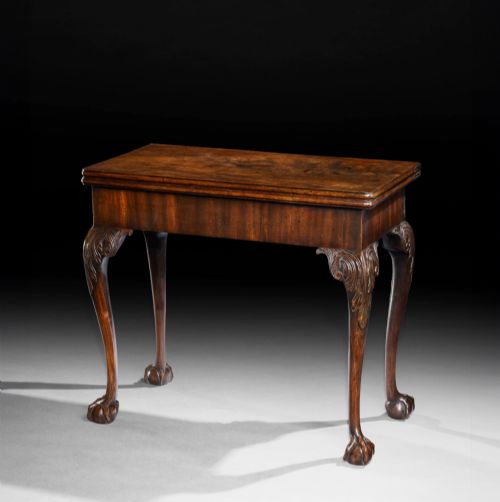
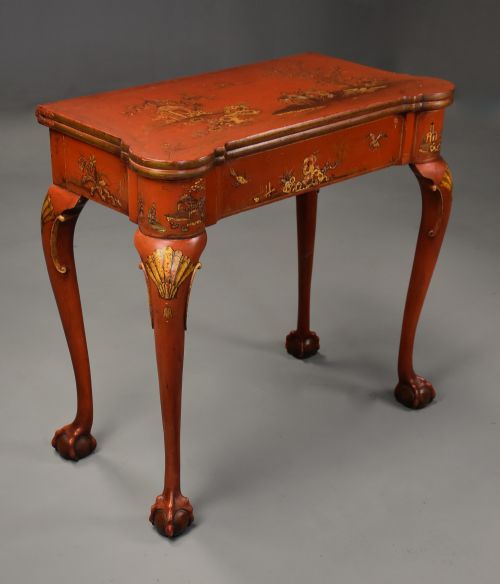
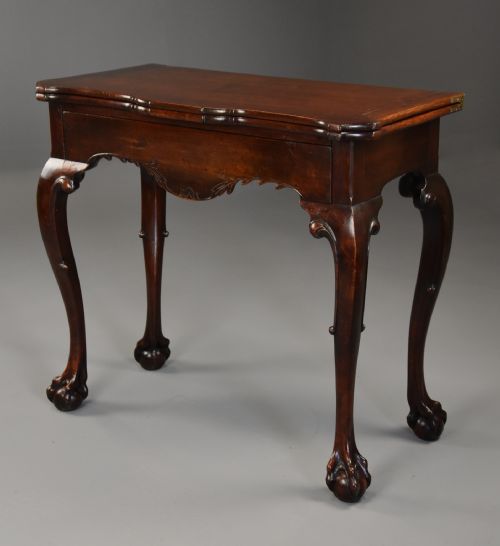


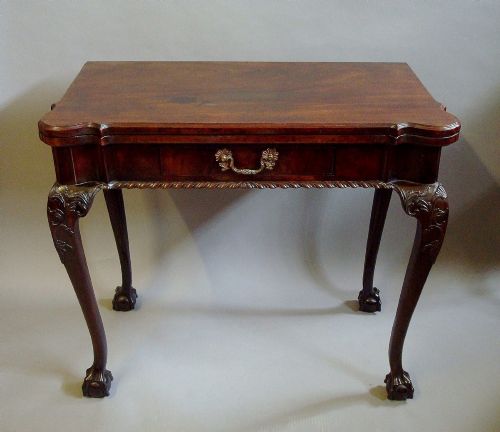
Claw and Ball Foot Games Table
A claw and ball foot games table brings centuries of social entertainment into your home with sturdy wooden forms and clever folding tops.
Claw and Ball Foot Games Table
A claw and ball foot games table provides a dedicated surface for card playing and social evenings, appearing across periods from the eighteenth century to the twentieth century. These pieces usually feature a fold-over top supported by concertina actions or swing legs, designed to save space when not in use.
The versions most commonly met on this page span Georgian eras alongside later Chippendale and Queen Anne revivals. Makers of the past constructed these tables primarily as card, bridge, or tea tables, adapting them for domestic leisure.
Meticulous woodworking defines the surviving examples, which often incorporate rich timber grains and carved structural elements. Collectors value them as functional furniture that retains historical presence within a modern interior.
How they were made
Cabinetmakers utilised dense timbers such as mahogany and walnut, frequently selecting burr walnut veneers or applying red lacquer for decorative impact. These primary woods provided the necessary structural integrity to support heavy folding tops and intricate leg carvings.
Surfaces often incorporate baize inserts for card play, alongside brass hardware and occasional gilt or inlaid bird designs. The craftsmanship relies on traditional joinery methods that allow concertina actions and hinged leaves to function smoothly over centuries of use.
What varies in quality
The depth and crispness of the carved detail on the knees and feet distinguish finer examples from standard production. Superior tables display well-proportioned silhouettes and high-grade timber with rich patination, rather than purely decorative surface additions.
The precision of the mechanical action, whether concertina or swing leg, separates master cabinetwork from simpler constructions. Higher-quality pieces maintain structural stability in both closed and open positions without relying on modern reinforcement.
The Claw and Ball Foot Games Table Glossary
- Concertina action
- An expanding frame mechanism that allows a folding table to open fully on four legs rather than relying on swing legs. This sophisticated engineering distributes weight evenly across the entire structure when extended.
- Baize
- A coarse woollen felt fabric used to line the playing surfaces of card tables. It provides a soft, non-slip texture designed to protect playing cards and reduce noise during games.
- Chippendale
- A furniture style originating in the eighteenth century, characterised by elaborate carving and ball and claw feet. It takes its inspiration from the designs published by Thomas Chippendale.
- Chinoiserie
- A decorative style reflecting European interpretations of Chinese art and motifs. It frequently appears on lacquerwork furniture featuring painted figures and landscapes.
- Patina
- The surface sheen and mellowing of colour that develops on wood over decades of handling and exposure to light. Experienced collectors prize a deep, natural patina as an indicator of age and authenticity.
Claw and Ball Foot Games Table: Frequently Asked Questions
What is a claw and ball foot games table used for?
These tables served primarily for card games, social gatherings, and tea service in period homes. The folding top allowed households to clear away gaming equipment when entertainment finished.
Today, they function well as console tables against a wall, opening up when extra surface space is required for guests.
How do I tell an 18th century table from a revival piece?
Examining the timber construction, secondary woods, and hand-cut joinery helps determine the true age of a piece. Eighteenth-century examples show natural wear patterns and tool marks consistent with period workshop practices.
Revival pieces from later eras often exhibit more uniform machine manufacturing methods and different secondary framing timbers beneath the surface.
How do I live with a antique games table?
Positioning the table away from direct heat sources and strong sunlight protects the delicate mahogany or walnut veneers from drying and cracking. Maintaining stable room humidity preserves the old timber and prevents warping in the folding leaves.
Using the piece gently without overloading the extended flaps ensures the historical joints and hinges remain secure for daily use.
Why do some tables have concertina actions?
A concertina action expands the table frame uniformly in all directions, allowing all four legs to support the open top. This engineering feat prevents the table from tipping when weight rests on the corners.
Master cabinetmakers employed this complex mechanism on top-tier commission pieces to showcase their technical skill and provide superior stability.