
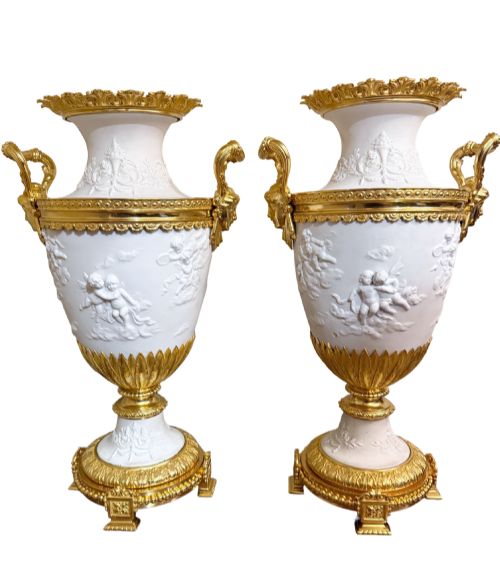


Classical Porcelain Mantel Vases
Classical porcelain mantel vases bring stately neoclassical symmetry and rich gilding to a room, offering an immediate focal point for a mantelpiece.
Classical Porcelain Mantel Vases
Classical porcelain mantel vases encompass pairs and garniture sets designed to sit prominently upon fireplace mantels. The listings feature Victorian and nineteenth-century examples alongside French Sevres style, Empire, and Vienna style pieces.
Buyers will encounter single urns, pairs, and multi-piece garnitures that frequently incorporate lidded designs and sculptural mounts. These decorative vessels draw heavily upon French Neoclassical, Rococo Revival, and Regency traditions.
Originating largely from European centres of production, the pieces combine glazed ceramic bodies with ornate metal mounts. They serve primarily as decorative mantel furniture, often originating as components of larger clock garniture sets.
What varies in quality
The precision of the porcelain moulding and the delicacy of the hand-painted enamel decoration dictate the primary tier of craftsmanship. Finer pieces display crisp botanical or figural scenes executed with exceptional control.
The weight, channelling, and mercury gilding of the bronze or ormolu mounts separate standard production from superior examples. Heavy, meticulously chased metalwork indicates a higher grade of manufacture than lightweight brass fittings.
Listings feature nineteenth-century porcelain and ormolu mantel vases spanning French Neoclassical, Empire, and Rococo Revival styles.
Thomas Steel·Minton·KPM
The Classical Porcelain Mantel Vases Glossary
- Garniture
- A set of matched decorative vases or urns designed to be displayed together on a mantelpiece or sideboard. They often comprise three or more pieces centred around a clock.
- Ormolu
- Gilded bronze used for decorative mounts and handles on furniture and porcelain. The technique involves applying a mercury and gold amalgam to cast bronze before heating.
- Hard-Paste Porcelain
- A true ceramic composition fired at very high temperatures to create a dense, vitrified body. It resists scratching and takes enamels and gilding exceptionally well.
- Majolica
- Opaque tin-glazed earthenware decorated with brightly coloured metal oxide paints. The technique produces vibrant, glossy surfaces found on nineteenth-century continental urns.
Classical Porcelain Mantel Vases: Frequently Asked Questions
What is a mantel garniture?
A mantel garniture is a matched set of decorative vessels designed to sit together across a fireplace shelf. They often include a central clock flanked by matching lidded urns.
These sets created a balanced, symmetrical display that dominated nineteenth-century formal interiors. Individual pieces from broken sets frequently circulate independently on the market.
Where were these vases made?
These decorative vessels originated primarily in major European ceramic centres during the nineteenth century. Prominent production hubs included France, Germany, Austria, and Italy.
French workshops specialised in ornate ormolu-mounted Sevres styles, whilst German and Austrian factories produced hard-paste porcelain urns. Italian makers contributed distinct regional interpretations such as Capodimonte majolica.
How do I clean antique porcelain?
Antique porcelain requires gentle cleaning with a soft, dry cloth to remove accumulated dust. Avoid using abrasive cloths or chemical cleaners that might damage delicate enamel and gilt surfaces.
Water and harsh soaps should be kept away from gilt bronze mounts and painted details to prevent corrosion or flaking. Professional conservation is recommended for heavily soiled or damaged pieces.
How are periods identified?
Periods are identified through a combination of paste composition, mounting style, and factory marks on the base. Nineteenth-century pieces frequently display impressed or painted maker ciphers specific to European manufactories.
Stylistic cues such as Empire proportions or Rococo Revival asymmetry help narrow the manufacturing decade. Comparing the weight of the porcelain and the crispness of the bronze mounts further aids dating.