

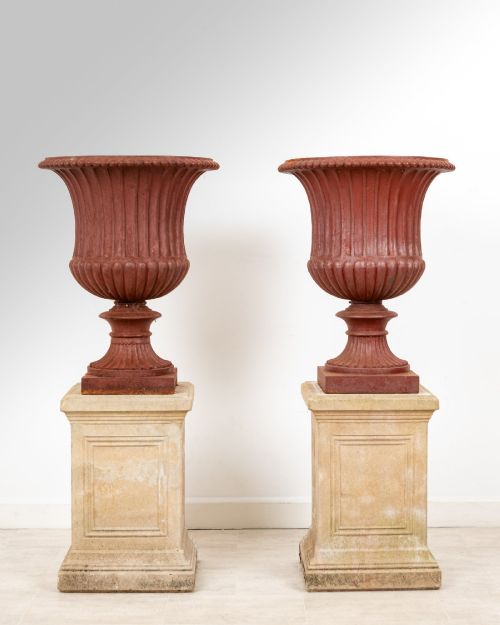


Classical Garden Vases
Classical garden vases anchor an outdoor scheme with timeless stone, iron and terracotta forms.
Classical Garden Vases
Classical garden vases draw on ancient forms, most commonly appearing as campana urns and pedestal planters across nineteenth-century and early twentieth-century examples. These pieces bring architectural presence to terraces and lawns through enduring silhouettes modelled on antiquity.
Buyers meet cast iron, marble, stone and terracotta versions, ranging from substantial pairs to individual grand tour jardinieres. The selection balances nineteenth-century metalwork with carved marble and composition stone copies of ancient models.
Materials and Construction
Foundry work dominates the metal pieces, utilising heavy cast iron to achieve crisp acanthus leaf detailing and classical proportions. Workshops also cast lead and iron into robust campana shapes designed to weather outdoors.
Carved marble and reconstituted stone provide the sculptural weight seen in classical garden vases. Masons and mould-makers shaped these materials into robust garden ornaments, often applying paint finishes over stone or terracotta surfaces.
The listings feature nineteenth-century cast iron, carved marble, lead and terracotta forms.
Assessing Quality
Quality rests upon the crispness of the casting and the depth of the carved detail. Superior iron and stone pieces retain sharp acanthus motifs and clean rim profiles rather than soft or blurred lines.
The choice of material elevates a piece, distinguishing heavy carved marble or early lead from standard composition stone. Proportion and the integrity of the associated pedestal complete the distinction between ordinary and exceptional examples.
Coalbrookdale
The Classical Garden Vases Glossary
- Campana urn
- A bell-shaped garden vase with an everted rim, looping handles and a pedestal base. This form descends directly from ancient bronze and marble vessels.
- Acanthus leaf
- A stylised foliate ornament carved into stone or cast into iron, modelled on Mediterranean plant forms. It frequently decorates the lower body of classical urns.
- Jardiniere
- An ornamental container designed to hold plants or flowers, often taking the form of a heavy terracotta or ceramic urn. These vessels sit upon terraces or garden paths.
- Grand Tour
- A nineteenth-century journey through Italy undertaken by collectors who acquired classical antiquities and smaller copies. Pieces from this tradition emulate ancient Roman sculpture.
- Neoclassical
- An artistic revival drawing on the architecture and ornamentation of ancient Greece and Rome. This style informs the strict symmetry and classical motifs of these garden vases.
Classical Garden Vases: Frequently Asked Questions
What is a campana urn?
A campana urn is a bell-shaped classical garden vase featuring an everted rim and twin handles. It takes its name from the Italian word for bell.
These vessels were designed to sit upon stone pedestals along garden paths or terrace walls, holding architectural plantings.
Can cast iron urns stay outside?
Cast iron garden vases withstand outdoor conditions successfully due to their heavy metal construction. Iron develops a stable oxidized surface over decades in the garden.
Historically, workshops cast these robust vessels specifically for year-round exposure on nineteenth-century lawns and terraces.
How do I date a stone vase?
Dating relies upon observing the tooling marks, weathering patterns and the specific neoclassical style of the casting. Nineteenth-century examples often display deep patination and hand-finished details.
Comparing the proportions to documented classical models helps distinguish earlier iron and stone pieces from twentieth-century reproductions.
Where should I place a heavy urn?
Heavy marble, iron and stone urns require a stable foundation such as a paved terrace, stone plinth or brick wall. Their considerable weight demands a level base to prevent shifting over time.
Positioning them as focal points at the end of a gravel path or framing a doorway highlights their classical symmetry.