

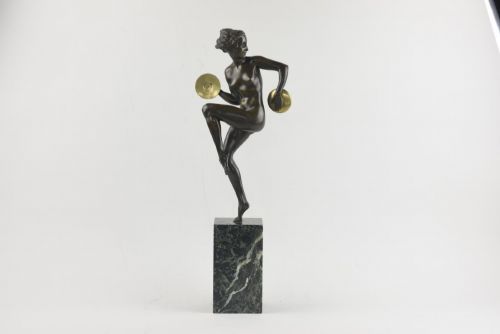
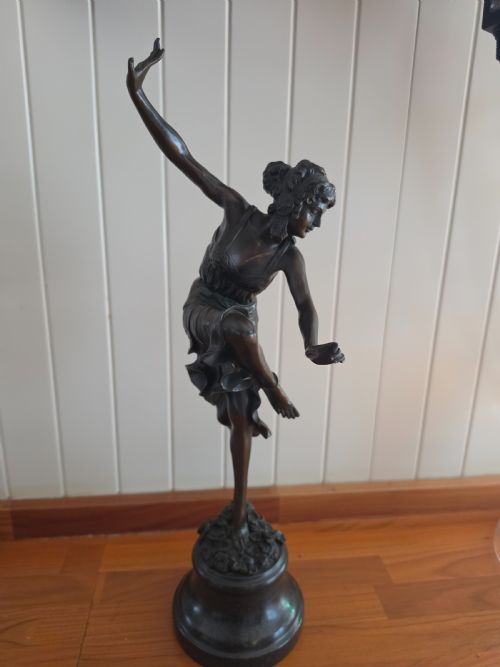


Classical Dancer Sculpture
A classical dancer sculpture brings dynamic movement and the elegance of antiquity into a room.
Classical Dancer Sculpture
A classical dancer sculpture depicts figures in motion, drawing on ancient forms through the lenses of the nineteenth century, Art Nouveau, and Art Deco periods. These pieces take the form of freestanding sculptures and figurines.
The versions most commonly met on this page originate from French workshops and date from the nineteenth century up to the 1930s. They capture subjects such as harvest dancers, hoop dancers, and figures from classical mythology.
Makers rendered these subjects in distinct stylistic movements, ranging from Victorian Classical Revival and Neoclassical ideals to the streamlined geometry of Art Deco.
How they were made
Foundries cast these figures primarily in bronze, sometimes employing silvered bronze, parcel-gilt, or cold paint to accentuate the details of costume and form.
Many of the bronze figures are mounted onto heavy marble bases, providing a stable foundation and a contrasting textural element to the metalwork.
Several dancers balance perilously on tiny toes, defying gravity with permanent poise.
What varies in quality
The finesse of the chasing and the crispness of the casting separate the finest sculptures from simpler productions, particularly in the rendering of drapery and anatomy.
The application of surface finishes, such as cold paint, silvering, or patination, dictates the visual depth and preservation of the intended artistic expression.
Pierre le Faguays·Aurore Onu·C J R Colinet·Rousseau·Eugène Désiré Piron·Claire Colinet·Jean Jacques Pradier·Mario Korbel·Francisque Joseph Duret
The Classical Dancer Sculpture Glossary
- Cold Painted
- A method where non-fired paint is applied to a bronze surface after casting. This technique allows for vibrant polychrome details on garments and hair.
- Patinated
- Treated with chemicals, heat, or acids to produce a coloured surface layer on metal. This process protects the bronze and adds visual richness.
- Parcel-Gilt
- Partially gilded with gold leaf or gold wash. It highlights specific areas like jewellery or borders of clothing against a darker bronze body.
- Silvered Bronze
- Bronze that has been coated with a thin layer of silver or a silver-like alloy. It gives the sculpture a bright, reflective finish popular in twentieth-century works.
- Neoclassical
- An artistic movement drawing inspiration from the art and culture of classical antiquity. It emphasises proportion, restraint, and classical themes.
Classical Dancer Sculpture: Frequently Asked Questions
What materials are used?
These sculptures utilise bronze as a primary medium, frequently paired with marble bases for stability and aesthetic contrast. Other versions incorporate porcelain and enamel.
Surface treatments such as cold paint, silvering, and parcel-gilt further enrich the primary materials.
How do I style them?
Place a bronze dancer on a mantelpiece, sideboard, or dedicated pedestal where the silhouette can be viewed clearly against a neutral wall.
Ensure the piece is positioned away from direct moisture to protect patinated or cold-painted surfaces over time.
How are periods told apart?
Nineteenth-century works often reflect Victorian Classical Revival or Neoclassical sensibilities through traditional poses and heavy patination. Twentieth-century pieces shift towards Art Nouveau and Art Deco styles.
Art Deco examples frequently feature stylised geometry and are mounted on contrasting marble plinths.
What subjects are depicted?
The subjects range from mythological figures like the dancer of thyrsus to harvest dancers and modern hoop dancers.
Each depiction captures a moment of motion, whether through graceful balletic poses or rhythmic cultural dances.