
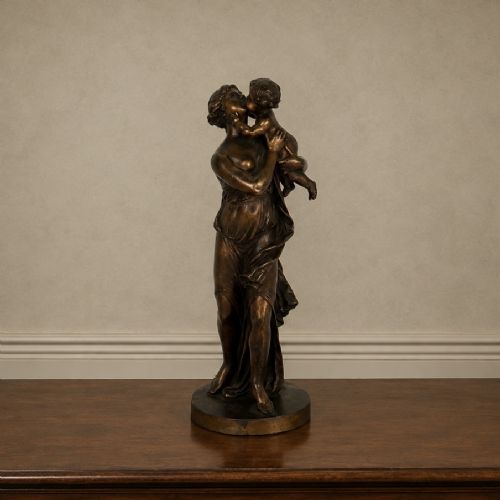


Classical Child Bronze Statue
A classical child bronze statue brings domestic grace to a room, capturing youthful form through enduring metal.
Classical Child Bronze Statue
A classical child bronze statue draws upon antiquity, depicting youths and children in sculptural form. Buyers meet nineteenth century French works alongside neoclassical revival pieces.
The subjects range from solitary figures eating grapes to mothers with children. Many examples originate from nineteenth century France and early twentieth century foundries.
Forms include standalone sculptures, table lamps, and terracotta busts. These objects reflect both grand tour souvenirs and domestic art of the period.
Materials and construction methods
Foundries cast these figures in bronze, frequently finishing them with dark patina or silvered bronze. Some examples incorporate marble bases or green marble plinths.
Alternative materials appear in terracotta busts and gilt brass variants. Paint accents highlight specific details on select pieces.
Styles span neoclassical, realism, and French nineteenth century works.
Assessing quality in bronze sculpture
Casting precision distinguishes the finer examples, particularly in the rendering of facial expressions and drapery. Sharp detail in hair and fingers indicates skilled execution.
The depth and consistency of the dark patina or silvered finish affect visual appeal. Signatures from recognised sculptors elevate the standing of a piece.
Auguste Moreau·Antonio Merente·Dumond·Carrier·Pigale
The Classical Child Bronze Statue Glossary
- Patina
- The surface treatment or chemical coloration applied to bronze. It protects the metal and defines the tonal quality.
- Grand Tour
- A traditional trip through Europe undertaken by upper class scholars. Souvenirs often included small classical sculptures.
- Neoclassical
- A style inspired by the art of classical antiquity. It emphasises proportion, restraint, and classical themes.
- Terracotta
- Fired clay used for sculptural busts and figures. It provides a warm, matte alternative to cast metal.
Classical Child Bronze Statue: Frequently Asked Questions
What periods do these statues date from?
The pieces span the nineteenth century through to the mid twentieth century. Victorian and early twentieth century examples predominate.
Specific dates such as eighteen eighty and nineteen fifty appear alongside broader periods like the French Second Empire.
How were these statues displayed originally?
Sculptures of children and mother figures stood on mantelpieces, desks, and dedicated pedestals within domestic interiors. Some double as table lamps.
Their scale suited rooms designed for entertaining and private family spaces alike.
Are all these pieces solid bronze?
Bronze is the primary metal, often shown with dark patina, silvered bronze, or gilded brass. Other materials like marble form the bases.
The record also includes terracotta busts and painted finishes alongside the cast metal works.
What subjects are most common?
Depictions of children feature prominently, often gathering grapes, dancing, or interacting with animals like cats and dogs. Mother and child groups are also frequent.
Classical dress and mythological references, such as Bacchus, recur throughout the designs.