
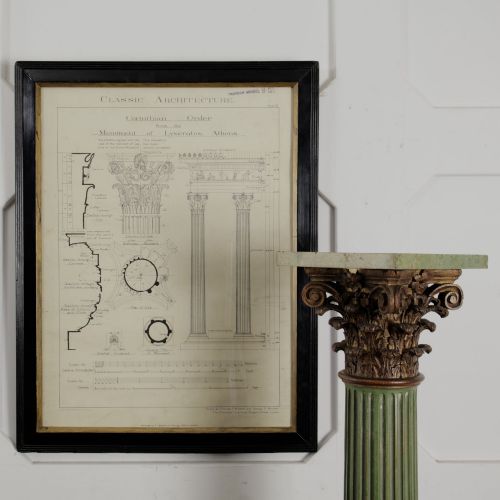


Classical Architecture Print
A classical architecture print captures the grandeur of antiquity through detailed plates, elevation drawings, and coloured engravings for your walls.
Classical Architecture Print
A classical architecture print represents historical buildings, ancient ruins, and grand palatial designs captured on paper through etching and engraving. These works document ancient Greek and Roman structures, including facades, capitals, and monumental arches.
The pieces on this page span several distinct periods, reaching from mid-eighteenth-century plates through nineteenth-century revivals up to early twentieth-century examples. Buyers encounter individual framed plates alongside sets of four coloured engravings depicting grand scenes and architectural orders.
Forms range from simple architectural prints to complex drawings produced for design schools and framed works incorporating wood, glass, and gold leaf. Many items focus on specific classical elements, such as the Corinthian order or Greek temple porticos.
Materials and construction techniques
These works are executed on paper using ink, watercolour, and paint to delineate precise geometrical elevations and picturesque ruin scenes. Engravers used metal plates to press fine lines into the paper, creating sharp architectural details that were sometimes enhanced with hand colouring.
Many historical examples are presented in period frames constructed from wood and gilt wood, occasionally protected by glass and accented with gold leaf. These framing materials complement the neoclassical aesthetic of the prints and drawings housed within.
Listings feature paper, ink, watercolour, and wood, spanning periods from seventeen-fifty through the nineteenth century to nineteen-twenty.
Factors determining quality
Quality in a classical architecture print rests upon the crispness of the line work, the accuracy of the architectural draughtsmanship, and the preservation of the paper. Engravings that retain fine details in capitals, entablatures, and sculptural figures demonstrate superior execution by the original maker.
The presence of contemporary or period hand colouring alters the visual impact, with carefully applied pigments elevating the depth of architectural scenes. Furthermore, the integration of original framing materials such as gilt wood contributes to the overall integrity of the piece.
The Classical Architecture Print Glossary
- Engraving
- A printmaking process where an artist cuts a design into a metal plate using a sharp tool to hold ink. This technique allows for exceptionally fine lines and precise architectural rendering.
- Neoclassical
- A Western cultural movement drawing inspiration from the art and culture of classical antiquity. It dominates the aesthetic of these prints, focusing on symmetry, proportion, and classical orders.
- Corinthian Order
- One of the classical orders of architecture, characterised by slender columns and ornate capitals decorated with acanthus leaves. Plates depicting this order focus on detailed structural elements.
- Portico
- A porch leading to the entrance of a building, enclosed by a roof supported by columns. Architectural engravings frequently record these structures from ancient sites such as Athens.
Classical Architecture Print: Frequently Asked Questions
What is a classical architecture print?
A classical architecture print is an engraved or drawn representation of ancient buildings, ruins, and architectural elements like columns and arches. These works record historical structures from Greece and Rome.
They serve as decorative wall art and historical documentation, originating from periods between the eighteenth and early twentieth centuries.
How were these prints used historically?
Historically, these plates and drawings served as educational tools for students of design and architecture, as well as souvenirs for travellers on the Grand Tour. They allowed scholars and enthusiasts to study ancient proportions and ornamentation.
Today, they function primarily as framed wall art that brings historical depth and neoclassical elegance to interior spaces.
How do I date an architectural print?
Dating relies on the paper type, printing technique, plate marks, and stylistic indicators associated with periods like the eighteenth century or the nineteenth-century revival. Inscriptions naming specific draughtsmen or publishers also provide chronological context.
Examining the framing materials, such as early wood or gilt frames, can offer additional clues regarding the age of the presentation.
How should I display framed architectural prints?
Display these works away from direct sunlight to protect the paper, ink, and any watercolour pigments from fading over time. Hanging them in dry interior environments preserves both the paper and the wooden frames.
Sets of four prints look balanced when arranged together on a wall, echoing the symmetrical composition of neoclassical design.