



Edwardian Architectural Print
These edwardian architectural print works bring historic buildings and collegiate charm directly to your walls, offering a distinct slice of early twentieth-century draftsmanship.
Edwardian Architectural Print
When searching for an edwardian architectural print, you encounter framed plates, engravings, and lithographs depicting notable academic and historic structures. The pieces on this page span the Edwardian era, the nineteenth century, and the early twentieth century, alongside related wall art.
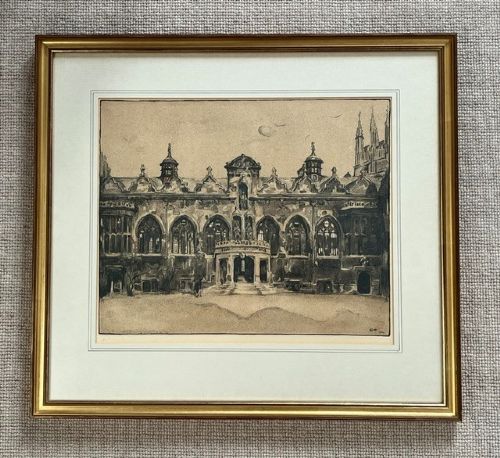
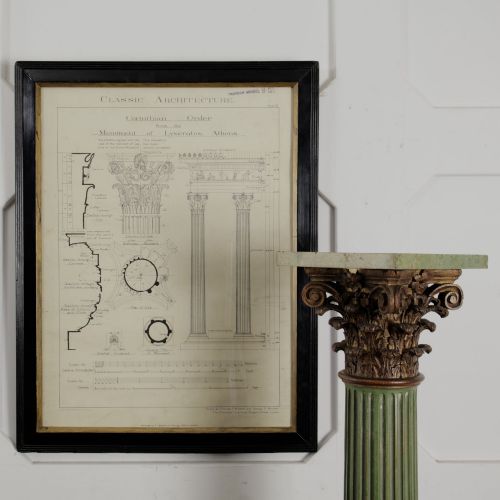
Subjects range from Oxford colleges like Oriel and Christ Church to country houses, ecclesiastical plates such as the Corinthian Order, and Venice street scenes. These works appear in varied formats, including ink on paper, watercolours, and detailed engravings after artists like Tom M. Hemy.
Most items are housed in period frames featuring materials such as glass, wood, and gold leaf. Alongside wall art, the selection occasionally includes related storage items like pine collectors cabinets, filing drawers, and plan chests.
How they were made
The works rely primarily on paper, ink, and watercolour, utilising traditional printing and painting techniques of the period. Engravings and lithographs capture fine lines and structural details with precision.
Frames are constructed from pine and other woods, frequently incorporating glass to protect the delicate paper surfaces. Some pieces incorporate gold leaf highlights to accentuate the framing or the artwork itself.
Listings feature works spanning the Edwardian period, Victorian era, and the early twentieth century up to nineteen twenty.
What varies in quality
Quality depends heavily on the clarity of the lines and the fidelity of the architectural representation. Engravings and lithographs by documented artists show superior draftsmanship compared to anonymous plates.
The preservation of the paper and the integrity of the period framing significantly influence the overall character of each piece. Original framing materials, including glass and wood, preserve the historical context more effectively than later replacements.
Sir William Nicholson·Thomas Ellison·Tom M Hemy·CB Prescott
The Edwardian Architectural Print Glossary
- Engraving
- A printmaking technique where an image is incised into a metal plate, producing fine, crisp lines on paper. This method was widely used for architectural plates and collegiate views.
- Lithography
- A planographic printing process based on the repulsion of oil and water, enabling detailed tonal gradations. Artists utilised this to reproduce collegiate scenes and townscapes.
- Watercolour
- A paint medium where pigments are suspended in a water-soluble vehicle, applied to paper for fluid colour effects. It appears in topographical views and architectural paintings.
- Corinthian Order
- One of the classical architectural orders, characterised by ornate capitals decorated with acanthus leaves. Plates depicting this order serve as educational or design references.
- Plan chest
- A heavy piece of furniture with wide, shallow drawers designed originally for storing large architectural plans and maps flat. Examples in pitch pine provide functional storage for paper collections.
Edwardian Architectural Print: Frequently Asked Questions
What is an edwardian architectural print?
An edwardian architectural print is a framed work on paper depicting historic buildings, academic colleges, or classical architectural elements from the early twentieth century.
These pieces capture structural details through engraving, lithography, or etching, offering a glimpse into historic design and institutions.
How were these prints used originally?
Originally, these prints served as educational plates, commemorative college views, or decorative wall art for studies and libraries.
Publishers produced them to document historic architecture, classical orders, and notable British landmarks for students and collectors.
How do I hang a framed print safely?
Hang these works using appropriate wall fixings that match the weight of the wood frame and glass. Position them away from direct sunlight to protect the ink and paper from fading over time.
Ensure the hanging wire or brackets are securely attached to the reverse of the frame before mounting.
How do I distinguish Edwardian from Victorian prints?
Edwardian prints date from the reign of Edward VII between 1901 and 1910, while Victorian pieces originate from the preceding nineteenth-century period.
Stylistic cues in the typography, subject matter, and framing techniques often help identify the specific era of production.