
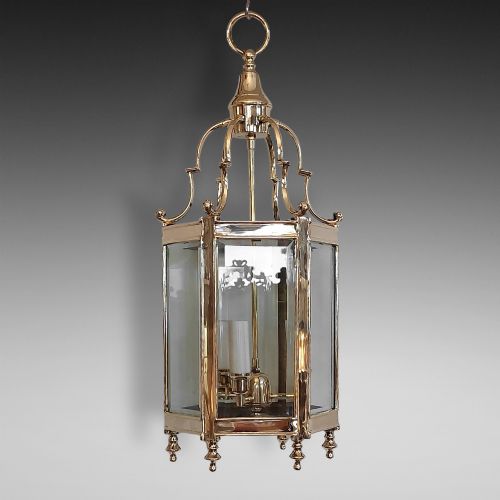
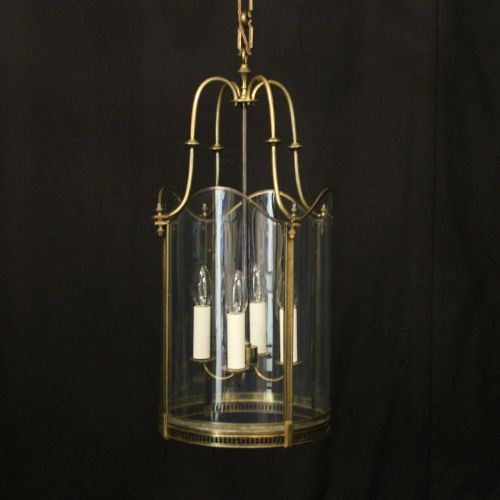
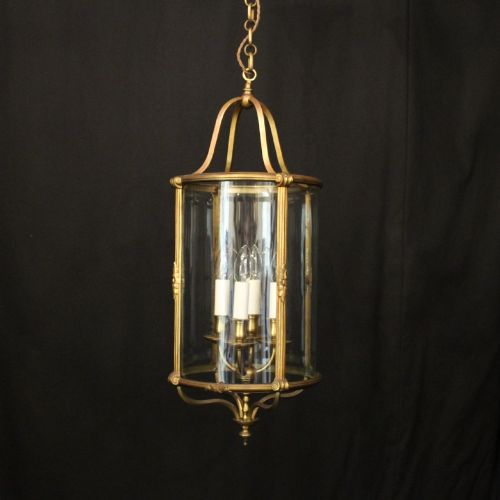
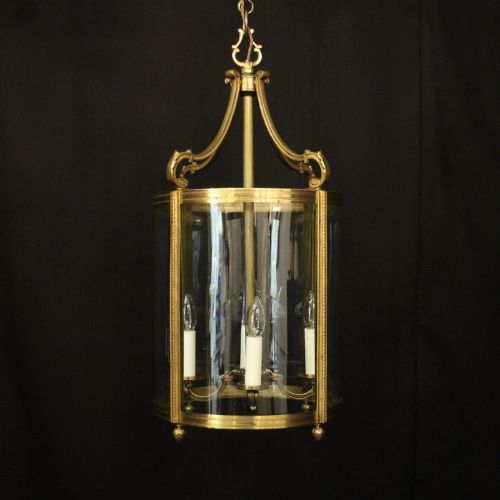
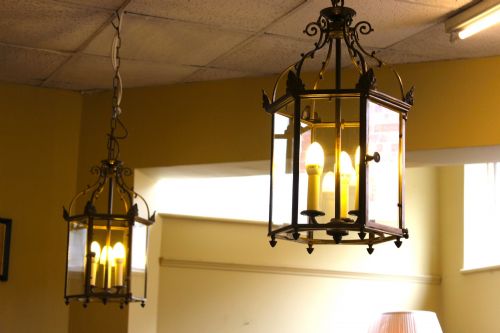


Classic Hall Lantern Light
A classic hall lantern light sets the tone for an entrance, casting warm illumination through glass panes held in metal frames.
Classic Hall Lantern Light
A classic hall lantern light serves as the primary overhead fixture in an entryway or vestibule, designed to distribute light downwards and across narrow spaces. The selection here comprises hanging pendant lights and ceiling lanterns spanning the Edwardian period, the nineteenth century, and the nineteen-twenties and thirties. French chateau and neoclassical styles dominate the offerings, alongside simpler brass and steel designs.
Buyers encounter hexagonal, oval, and larger multi-light configurations suspended from chains or rods. The forms range from restrained early twentieth-century brass frames to ornate French gilded bronze and gilt brass examples holding multiple bulbs. These pieces provide functional illumination while establishing the decorative character of a hallway.
Materials and construction
Makers constructed these lanterns using cast and sheet metals including brass, bronze, gilt bronze, steel, and silver gilt metal to form the structural frames. Glass panels, occasionally convex, fit securely within the metal frameworks to enclose the light sources. The combination of brass and steel appears in twentieth-century examples, while earlier pieces rely on heavier bronze and gilt brass castings.
Surface treatments involve gilding and patination to achieve varied metallic finishes, from bright gilt bronze to aged bronze and silvered metal. Artisans joined the metal components through soldering, riveting, and screwing, ensuring the frames could support the weight of the glass panels and internal light fittings.
Represented styles include French Chateau, Edwardian, French Neoclassical, French Rococo, French Louis XVI, French Classical, Gothic Revival, and Italian Rococo Revival.
Assessing quality and finish
Quality in a classic hall lantern light reveals itself in the weight and thickness of the metal frame and the crispness of any cast ornamentation. Finer examples display meticulous detailing in the bronze or brass work, with tight joints and well-fitted glass panes that show no undue rattling. Simpler designs rely on clean lines and solid proportions rather than surface decoration to achieve their presence.
The sophistication of the metal finish and the preservation of the original gilding or patination also distinguish superior items. Heavier castings and complex assemblies, such as multi-light configurations within French neoclassical frames, demonstrate a higher tier of workshop production compared to basic utilitarian hanging fixtures.
The Classic Hall Lantern Light Glossary
- Hall lantern
- A hanging ceiling light specifically scaled for corridors, vestibules, and entrance halls. These fixtures combine protective glass panels with an internal light source.
- Gilt bronze
- Bronze that has been coated with a thin layer of gold or gold-coloured alloy. This technique provides a durable metallic finish with a warm sheen.
- Convex glass
- Glass manufactured with a curved outward surface. This profile alters light refraction and adds depth to the lantern silhouette.
- Gothic revival
- An architectural and decorative style drawing inspiration from medieval forms. Pieces in this idiom often feature pointed arches and tracery details.
- Pendant light
- A light fixture suspended from the ceiling by a chain, cord, or metal rod. Hall lanterns operate as a specific subtype of pendant lighting.
Classic Hall Lantern Light: Frequently Asked Questions
How do I hang a hall lantern?
These lanterns suspend from ceilings using chains or rods attached to a mounting canopy. Professional installation ensures the fixture secures safely to ceiling joists.
Consider the height of your hallway ceiling when determining drop length to ensure clearance for walking beneath the fixture.
What periods do these lanterns represent?
The pieces span the Edwardian era, the nineteenth century, and the decades of the nineteen-twenties and nineteen-thirties. Stylistic influences include French neoclassical, rococo, and Gothic revival designs.
Earlier nineteenth-century examples often feature heavier bronze castings, while nineteen-thirties pieces introduce steel and brass combinations.
How do I clean the glass panels?
Carefully remove dust using a soft dry cloth before applying a mild glass cleaner to the interior and exterior panes. Avoid harsh chemical sprays that might damage adjacent metal finishes.
Support fragile glass panels securely if you remove them from the metal frame for thorough cleaning.
Where should I place a lantern?
These fixtures function best in entrance halls, corridors, and stairwells where overhead illumination and decorative impact are required. Their design directs light outwards and downwards to brighten transitional spaces.
Ensure the scale of the lantern matches the proportions of the room and the height of the ceiling.