
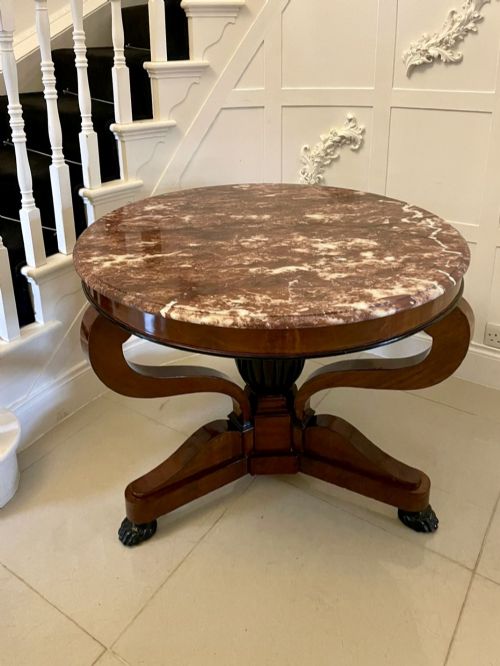
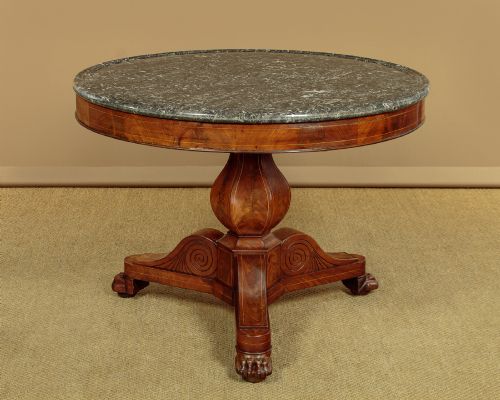
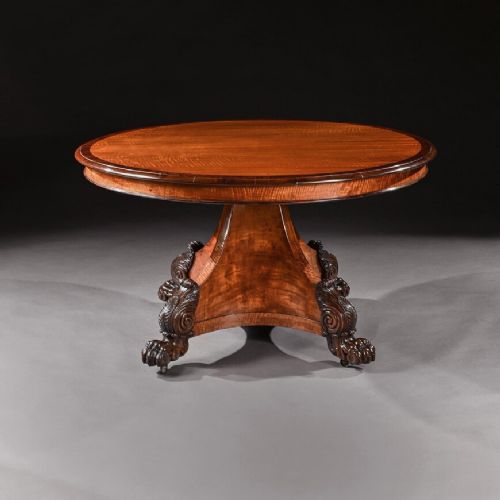


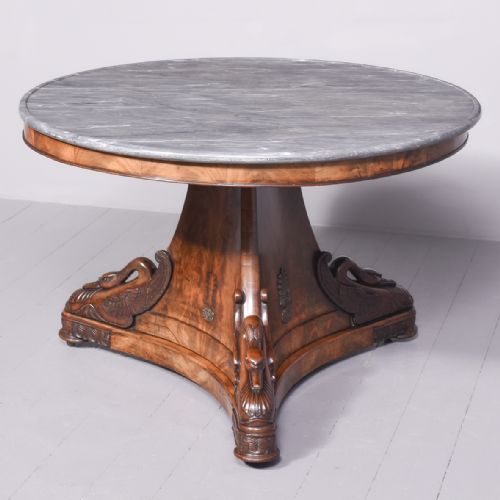


Circular Foyer Entry Table
A circular foyer entry table anchors a hall with presence, offering a surface for a central display and a focal point for the room.
Circular Foyer Entry Table
A circular foyer entry table takes the form of a round centre table designed to stand free in a space, often greeting visitors in a hallway or landing. These pieces frequently appear as French gueridons, Italian tables, or English round hall tables from the nineteenth century.
The selections span distinct historical periods, including Regency, Victorian, and 1920s examples, reflecting diverse stylistic interpretations from French Empire to Scandinavian Art Deco. Buyers will encounter both modest timber designs and grander specimens topped with marble or detailed with inlay.
While formally catalogued as centre tables, these items serve admirably in modern entrance halls where a round silhouette softens the geometry of a narrow corridor or square landing. The variety ranges from heavy mahogany constructions to lighter birch and satinwood variants.
Distinctions in construction and material quality
The calibre of a circular foyer entry table depends heavily on the selection of timber veneers and the precision of any inlaid decoration. Pieces utilising flame mahogany, satinwood, or figured birch display superior cabinetmaking ambition compared to plain structural surfaces.
The integration of heavy materials like marble tops dictates the robustness of the underframe, where heavier mouldings and substantial pillar supports separate standard workshop output from finer cabinet work. Furthermore, the presence of painted decoration or specialist brass mounts elevates the decorative complexity of the piece.
Listings feature circular foyer entry table examples spanning the nineteenth century through the 1920s, incorporating mahogany, marble, brass, walnut, and birch veneer.
Peters of Genoa
The Circular Foyer Entry Table Glossary
- Gueridon
- A small French round table, typically supported by a central pillar or three legs, frequently utilised as a centre or display table. These pieces often feature marble tops.
- Veneer
- A thin layer of finely figured wood applied to a secondary timber base to create decorative exterior surfaces. This technique allowed makers to utilise expensive grains efficiently.
- Inlay
- The insertion of contrasting woods, metals, or stone into a recessed wooden surface to form decorative patterns. It defines the ornament on several nineteenth-century and Art Deco examples.
- Centre table
- A freestanding piece designed to be viewed from all sides, traditionally placed in the middle of a room rather than against a wall.
Circular Foyer Entry Table: Frequently Asked Questions
Where should I place a circular foyer entry table?
These tables suit spacious hallways, grand entryways, and central landings where they can be approached from multiple directions. Their round footprint allows foot traffic to flow smoothly around the perimeter.
Positioning one in the middle of a room creates a natural focal point for displaying a central bronze, lamp, or floral arrangement.
Are these tables suitable for daily hallway use?
Nineteenth-century and early twentieth-century centre tables were built from robust timbers like mahogany, oak, and walnut, making them structurally sound for holding everyday objects. Their heavy tops and solid frames provide natural stability.
Care should be taken with polished wood surfaces and unsealed marble tops to prevent water rings or scratches from keys and post.
What distinguishes Regency tables from Victorian ones?
Regency designs often draw on classical neoclassical restraint, favouring clean architectural lines, dark timbers, and minimal brass ornamentation. They reflect the early nineteenth-century fascination with Greek and Roman forms.
Victorian pieces tend toward heavier proportions, richer carving, and varied material combinations including elaborate inlay and marble slabs.