
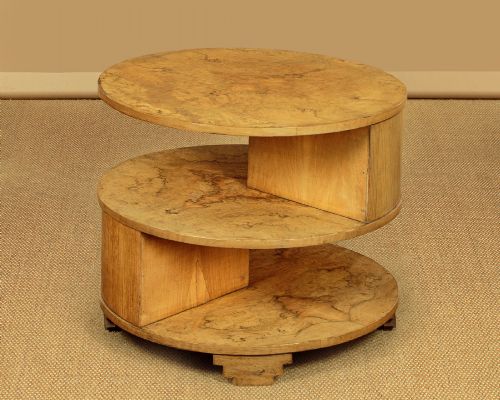

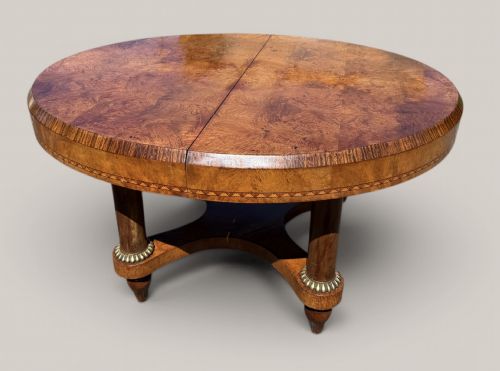


Circular Burr Veneer Table
A circular burr veneer table brings rich, swirling wood grain into a room, offering both practical surface space and a striking focal point.
Circular Burr Veneer Table
A circular burr veneer table relies on timber harvested from tree growths such as burls, which produce intricate, swirling patterns across the surface. These pieces span several distinct eras, appearing in forms ranging from compact coffee tables to larger breakfast and centre tables.
The selection on this page leans heavily toward twentieth-century production, particularly Art Deco coffee tables from the 1920s and 1930s. Alongside these, buyers encounter nineteenth-century examples and revival pieces representing Victorian, Edwardian, and Biedermeier styles.
Function dictates form among these pieces, as dining, occasional, and tilt-top versions serve very different spaces within a home. The common thread uniting them is the distinctive figure of the burr timber, whether executed in walnut, elm, oak, or general burr veneer.
Materials and construction
Cabinetmakers constructed these tables by applying thin slices of decorative burr veneer over more stable secondary timbers. This technique allowed craftsmen to display dramatic, figured grain patterns across expansive circular surfaces without risking the severe warping inherent in solid burr wood.
The underlying structure frequently utilises walnut or elm, while specific examples incorporate brass details or tripod bases. Segmented top designs require precise geometry to ensure the radiating grain patterns align symmetrically from the centre outwards.
Tri-pod tables occasionally need a steady hand during tea time, lest a wobbly leg remind everyone of nineteenth-century dining dynamics.
Assessing quality and craftsmanship
Quality in a circular burr veneer table rests primarily on the depth and symmetry of the grain pattern chosen by the maker. Highly figured walnut or elm veneers carefully matched across a segmented top indicate superior craftsmanship compared to randomly applied sections.
The stability of the pedestal base and the crispness of the revival or period styling also separate standard production from finer pieces. Construction integrity determines how well the thin veneer has adhered to the core timber over decades of use.
The Circular Burr Veneer Table Glossary
- Burr veneer
- A thin slice of wood cut from a tree growth or burl, prized for its complex, swirling grain patterns. It provides a decorative surface on furniture tops.
- Centre table
- A freestanding table designed to be viewed from all sides, traditionally placed in the middle of a room rather than against a wall.
- Tilt-top table
- A table featuring a mechanism that allows the circular top to pivot to a vertical position when not in use, saving space.
- Biedermeier revival
- A nineteenth or twentieth-century style inspired by the functional, restrained elegance of Germanic interior design from the early eighteen-hundreds.
- Tripod base
- A support structure resting on three feet or legs, commonly found beneath smaller occasional and breakfast tables.
Circular Burr Veneer Table: Frequently Asked Questions
How do I style a circular burr veneer table?
The dramatic grain pattern of the wood means these pieces naturally draw the eye, making them effective centrepieces in a room. Pairing them with understated seating lets the circular top remain the focal point without visual clutter.
Depending on the height, these tables function well as central surfaces for displaying a single object or as low coffee tables in a living space. Their curved outline also softens rooms dominated by linear architecture and rectangular furniture.
What is the difference between burr walnut and burr elm?
Walnut burr typically displays a deep, dark brown coloration with tight, intricate knots and swirling patterns that create a luxurious appearance. Elm burr tends to feature a lighter, more golden tone with broader, sweeping grain formations.
Both materials were chosen for their decorative impact, but the underlying species changes the overall colour palette of the piece. Examining the tone and tightness of the figure helps distinguish between the two woods on various table tops.
How do I date a burr veneer table?
Dating relies on observing the combination of the overarching style, such as Art Deco or Regency, alongside construction methods and secondary timbers. Pieces from the 1920s and 1930s often present clean, geometric lines typical of Art Deco coffee tables. Nineteeth-century examples usually show heavier pedestal bases or distinct revival influences like William IV or Queen Anne. Comparing the leg architecture and edge profiles against known period characteristics narrows down the likely decade of manufacture.
Are these tables suitable for everyday use?
These tables served practical functions historically as dining surfaces, breakfast tables, or low coffee tables for daily living. Their sturdy timber frames and substantial pedestals provide the stability needed for normal domestic placement.
Care should be taken with moisture and heat, as veneer surfaces require appropriate protection during use. Placing coasters and placemats on the circular top preserves the finish of the wood over time.