


Blonde Wood Centre Table
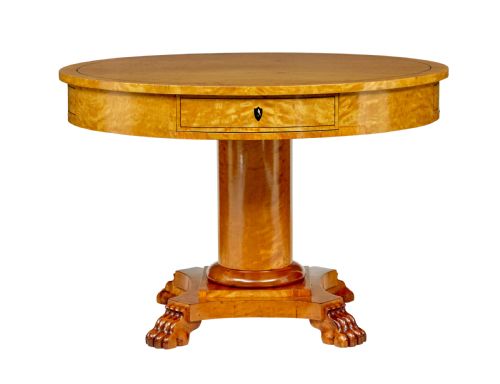
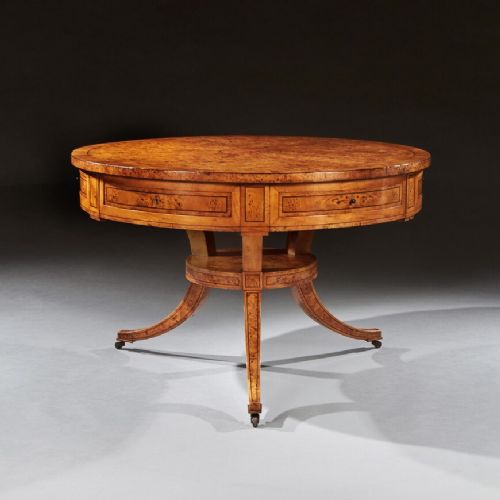
A blonde wood centre table brings luminous grain and warmth to a room, offering a striking anchor for an interior.
Blonde Wood Centre Table
A blonde wood centre table encompasses nineteenth-century Scandinavian pieces alongside twentieth-century Art Deco forms designed to stand freely in a room. These tables serve multiple functions across domestic spaces, appearing as dining tables, sofa tables, and occasional tables.
The variant most frequently encountered on this page is the circular or oval Swedish birch centre table dating from the nineteenth century. Alongside these, buyers find walnut, burr maple, and birds-eye maple iterations spanning the Victorian era into the nineteen-thirties.
Forms range from pedestal drum tables to radially veneered dining pieces and low coffee tables. Their light natural tones and varied grain patterns allow them to function within both traditional and modern decorative schemes.
Materials and construction methods
Accents of brass and ebonised wood frequently contrast against the pale surfaces, defining structural edges and inlay work. Joinery techniques from the nineteenth and early twentieth centuries ensure stability for these freestanding centre pieces.
Listings feature nineteen-century Swedish birch alongside nineteen-thirties Art Deco walnut and birds-eye maple forms.
Distinctions in quality and execution
The choice and matching of timber veneers dictate visual depth, with symmetrical burr patterns and continuous grain orientation marking superior cabinetmaking. Exhibition quality pieces demonstrate meticulous inlay work and sophisticated geometric veneering.
Proportion and structural integrity separate standard utility pieces from exceptional examples of Biedermeier and Art Deco design. The crispness of ebonised detailing and the integration of brass mounts reveal the maker's precision.
Jackson and Graham
The Blonde Wood Centre Table Glossary
- Biedermeier
- A dominant style in Central Europe during the nineteenth century characterised by utilitarian comfort and clean architectural lines that emphasised blonde wood veneers. This aesthetic favoured warm domestic interiors over ornate revivalism.
- Burr maple
- A decorative timber harvested from tree growths that produces intricate, swirling grain patterns filled with knots and eyes. Cabinetmakers prized this material for tabletops to create striking visual movement.
- Radial veneer
- A technique where veneer segments are arranged outwards from a central point like the spokes of a wheel. This method creates a symmetrical, sunburst pattern across circular tables.
- Sofa table
- A narrow rectangular table traditionally placed in front of a sofa or freestanding in the middle of a room. These pieces often incorporate drop leaves or small drawers.
- Satin birch
- A pale Northern European timber with a lustrous, reflective surface that catches the light. It was widely used in Swedish cabinetmaking for its bright appearance.
Blonde Wood Centre Table: Frequently Asked Questions
How do I style a blonde wood centre table?
These tables act as natural focal points in a room due to their luminous grain and pale colour. You can place them on patterned rugs or beneath central lighting fixtures to highlight their timber surfaces.
Their neutral tones allow them to complement both antique and contemporary surrounding furnishings without overwhelming the space.
What periods do these tables come from?
The pieces span the nineteenth century through the early twentieth century, incorporating Victorian, Edwardian, and Art Deco eras. Nineteenth-century examples often originate from Scandinavia.
Later pieces from the nineteen-thirties showcase streamlined geometric shapes characteristic of the Art Deco period.
How do I identify Biedermeier tables?
Biedermeier tables typically feature minimal ornamentation, allowing the natural grain of blonde woods like birch and maple to take visual precedence. Their construction focuses on clean architectural lines and functional elegance.
Many examples incorporate dark contrasting details such as ebonised borders to frame the lighter wood fields.