




Church Landscape Oil Painting
A church landscape oil painting captures the historic architecture of village and city places through pigment and brush.
Church Landscape Oil Painting
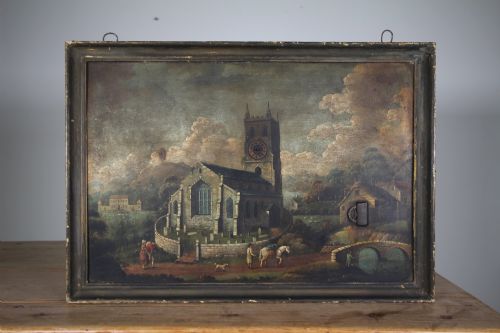
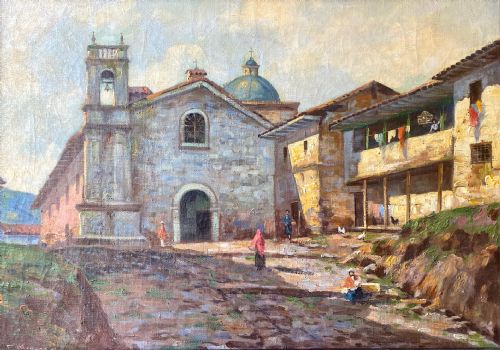
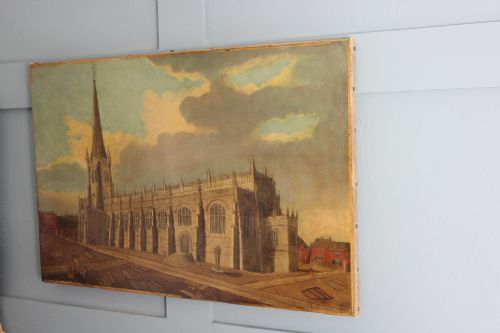
A church landscape oil painting depicts rural sanctuaries, urban cathedrals, and village churches set within surrounding fields, rivers, and streets. These works range from naive folk art depictions to structured 19th Century compositions and mid 20th Century impressions.
Buyers frequently encounter Victorian and early 20th Century canvases depicting specific English, Yorkshire, and London parish churches. The steeple or tower serves as a focal point within an expansive pastoral or urban view.
Earlier examples place ecclesiastical buildings within Georgian or Regency landscapes, while later mid century pieces explore looser brushwork and varied regional topography.
Materials and construction
Painters used oil paint applied to woven canvas or rigid wooden boards, often supported by a wood frame. The medium allowed for layered application, from smooth glazes in earlier works to thick impasto in later examples.
Substantial period frames, sometimes finished with a gilt slip, accompanied many of these works from the Victorian era onward, protecting the edges of the canvas or board.
One unexpected canvas captures a church landscape complete with a flying Red Duster flag.
Evaluating quality and execution
Quality rests in the handling of light and perspective, where the integration of the church building into the surrounding landscape feels resolved and balanced. Finer examples display confident brushwork that defines architectural detail alongside atmospheric depth.
The relationship between the maker and the subject influences the character of the piece, distinguishing observant topographical recording from generalized scenic formula.
Joan Gillchrest·William Greaves·Walter Meegan·Kershaw Schofield·John Cawthorn·Jeffrey Pratt·John Jaques·Henri Therme·Frederick Underhill·Stephanie Cooper·Daniel Sherrin·William Marlow·James Hardaker·AF de Breanski·Rosa Branson·Eugène Galien-Laloue·Everhardus Koster·Clement Morris·Gerhard Graf·Thomas James Soper·R Percy
The Church Landscape Oil Painting Glossary
- Oil paint
- A slow-drying paint made by combining pigment particles with a drying oil, most commonly linseed oil. This medium allows artists to blend colours smoothly and build up thick textures known as impasto.
- Canvas
- A heavy woven fabric stretched across a wooden stretcher frame to provide a firm surface for painting. It remains one of the primary supports utilised by artists across the centuries.
- Board
- A rigid wooden or composite panel used as a painting support instead of stretched fabric. Many smaller landscape works utilise this practical surface.
- Impasto
- A technique where paint is laid onto a surface in thick layers that stand out visibly from the canvas. This method adds a tactile, three-dimensional quality to the painted surface.
- Gilt slip
- A narrow, gold-coloured interior frame moulding placed between the canvas and the main outer frame. It serves to separate the artwork visually from the heavy surrounding wood.
Church Landscape Oil Painting: Frequently Asked Questions
What periods do these paintings date from?
The works span from the 18th Century through the Victorian era and into the mid 20th Century. They reflect evolving artistic movements including impressionism and naive folk art.
Victorian and early 20th Century examples appear frequently, alongside occasional Regency and mid century modern interpretations.
Are these paintings signed by the artists?
Many examples bear signatures, inscriptions, or attribution details identifying the creator or the specific church depicted. Some works remain attributed to particular schools of painting.
Signatures often appear in the lower corners of the canvas or board, occasionally accompanied by dates.
What surfaces were used for these artworks?
Artists utilised both stretched canvas and rigid wooden board as primary supports for their pigments. Canvas pieces are frequently housed in period wood frames.
Board supports tend to appear in smaller scale or earlier naive works.