
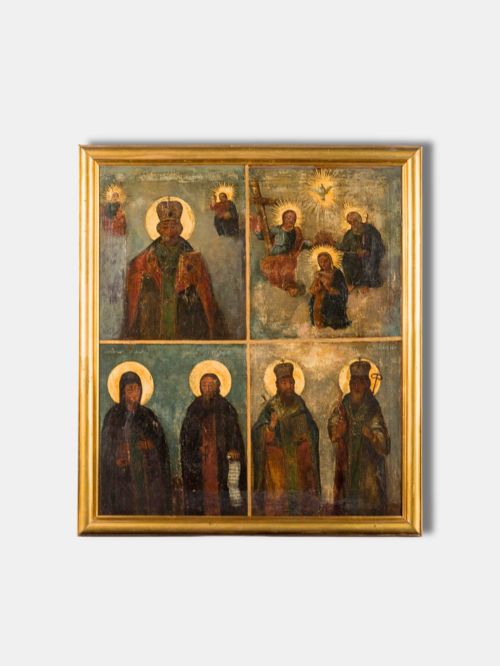


Christian Panel Painting
These christian panel painting works are devotional religious artworks on wood, canvas, and metal, bringing centuries of sacred history into a modern interior.
Christian Panel Painting
When you search for christian panel painting, you encounter sacred devotional works spanning multiple centuries and European traditions. The selection includes Russian Orthodox icons, Italian oil paintings, French enamel plaques, and framed saints from various historical periods.
You are most likely to meet pieces from the seventeenth, eighteenth, and nineteenth centuries, often rendered in tempera, oil, or enamel upon wooden panels or copper supports. These works range from small personal icons to larger arched architectural panels and painted windows.
The objects cross several distinct artistic movements, including Gothic Revival, Baroque, and traditional Russian icon painting. Each piece serves a primarily religious function, depicting sacred figures, biblical scenes, and theological narratives.
Materials and Construction
These works rely heavily on traditional supports such as wood, copper, and canvas, providing a rigid foundation for intricate pigments and metal leaf. Artisans applied layers of preparation before executing detailed painting in egg tempera, oil, or enamel.
Gilt wood and gold leaf frequently illuminate the backgrounds and halos of religious icons and panels, catching candlelight in liturgical spaces. Enamel plaques utilise fused glass powder on metal substrates, fired at high temperatures to achieve permanent colour.
Among religious artwork and icons, a soft-paste teapot manages to slip in under the Christian name.
Judging Quality and Execution
Quality in these works resides in the precision of the brushwork, the depth of theological expression in human faces, and the preservation of original ground layers. Superior pieces demonstrate exceptional draughtsmanship and harmonious colour relationships that remain intact beneath surface age.
The integrity of the original material support, whether wood panel, copper plate, or canvas, dictates the structural merit of the piece. Finer examples retain their original gilding and pigments without extensive overpainting or structural distortion.
Philip Christian Liverpool
The Christian Panel Painting Glossary
- Tempera
- A permanent, fast-drying painting medium consisting of coloured pigments mixed with a water-binder agent, such as egg yolk. It produces a matte surface that lasts for centuries.
- Gold Leaf
- Gold beaten into extremely thin sheets, used historically to gild backgrounds and ornamentation on panels and icons. It provides a reflective, luminous quality.
- Enamel
- A material made by fusing powdered glass to a substrate by firing, usually between eight hundred and nine hundred degrees Celsius. The powder melts, flows, and hardens to a smooth, durable coating.
- Icon
- A religious work of art, most commonly painted on a wooden panel, from the Eastern Orthodox Church and certain Eastern Catholic churches. They are venerated objects rather than mere decoration.
Christian Panel Painting: Frequently Asked Questions
What is a christian panel painting?
A christian panel painting is a sacred artwork executed on a rigid support such as wood, copper, or canvas, depicting religious figures or biblical narratives.
These pieces were created for devotional purposes, serving as focal points for prayer in churches, homes, and monastic settings across different European traditions.
How do I care for a panel painting?
Panel paintings require stable environmental conditions with moderate humidity and temperature to prevent the wood or support from warping or cracking.
Keep them away from direct sunlight, heating vents, and damp areas, dusting them gently with a soft dry brush when necessary.
How do I identify the age of an icon?
Dating an icon involves examining the style of painting, the preparation layers of gesso on the wood, and the method of construction of the panel itself.
Inscriptions, metal rizas, and the specific pigments or gold leaf employed also offer reliable clues to the period of origin.
Where were Russian icons made?
Russian icons were produced in monastic workshops, specialised guild centres, and villages across Russia, often following strict canonical guidelines for composition.
Master iconographers passed down techniques through generations, utilising traditional materials like egg tempera and gold leaf on prepared wooden boards.