





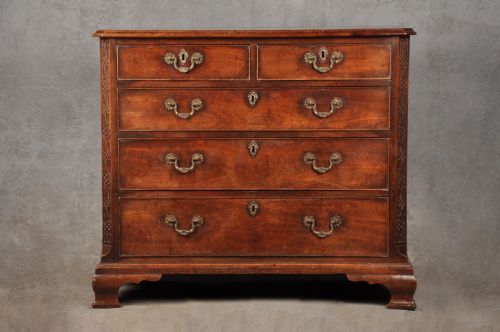
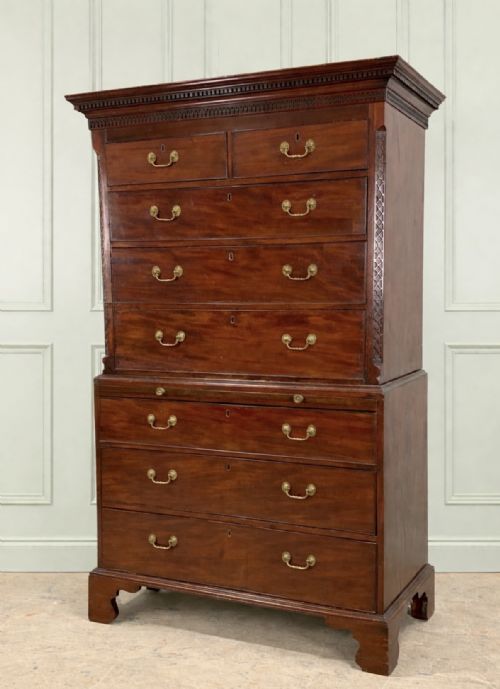
Chippendale Period Tallboy
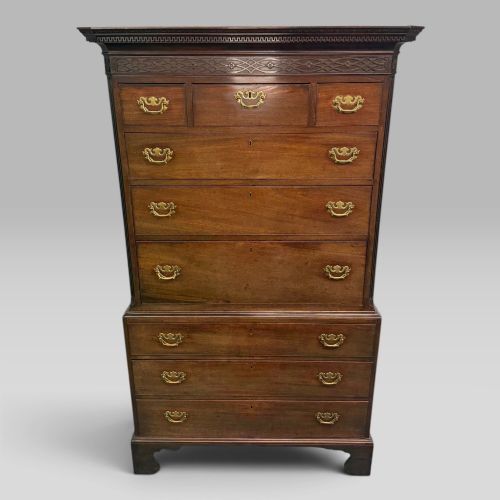
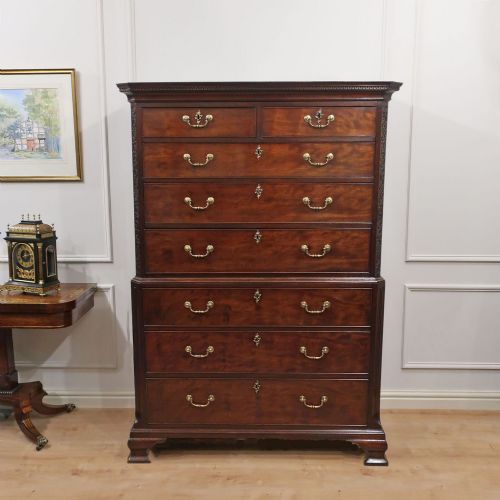
These chippendale period tallboy chests stand as monuments of eighteenth-century cabinet-making, offering towering storage and exquisite proportion for the serious interior.
Chippendale Period Tallboy
These pieces encompass both standard chest-on-chest forms and sophisticated secretaire tallboys containing fitted writing drawers. The selection on this page bridges the George II and George III eras, showcasing the enduring influence of Thomas Chippendale's design vocabulary across the mid to late eighteenth century.
Materials and Construction
Cabinet-makers relied heavily on dense Cuban mahogany and occasional red walnut, selecting timber with deep grain patterns and natural warmth. Secondary timbers such as oak frequently appear in drawer linings and internal framing to ensure structural longevity.
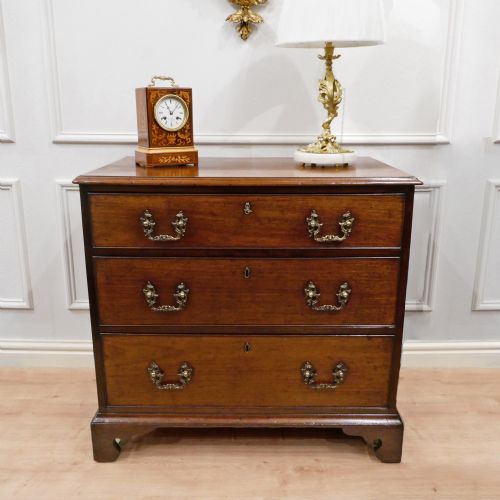
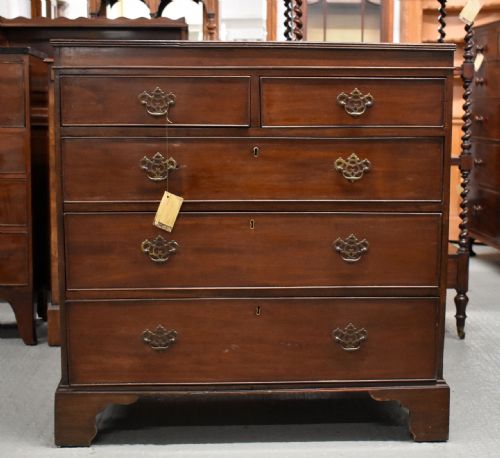
Master craftsmen integrated brass swing handles and escutcheons to secure the heavy timber drawers, while intricate details like boxwood inlay and carved cornice mouldings reveal the meticulous hand-work characteristic of the period.
Chippendale Period Tallboy Retail Price Guide 2026
Typical asking prices for chippendale period tallboy among the pieces listed under this phrase on Sellingantiques today, from the lower quarter to the upper quarter. They describe what is for sale here now, not the wider market.
Some secretaire tallboys hide tiny secret compartments behind dummy pigeonholes, designed for stashing private letters or small family fortunes.
Judging Quality and Craftsmanship
The division between standard workshop production and superior cabinet-making rests in the handling of timber selection and proportion. Finer tallboys exhibit continuous grain matching across drawer fronts and crisp, uncompromised carving on the cornice and canted corners.
Internal integrity also dictates value, where hand-cut dovetailing on the drawer carcases and original brass hardware distinguish an untouched antique from a heavily restored or later compiled example.
The Chippendale Period Tallboy Glossary
- Tallboy
- A tall chest of drawers made in two sections, stacking a smaller upper chest upon a deeper lower base.
- Secretaire
- A cabinet or chest featuring a fitted pull-out drawer with a drop-front writing surface and small pigeonholes.
- Brushing slide
- A pull-out shelf positioned at waist height, historically utilised for dusting clothes or writing correspondence.
- Serpentine front
- A furniture front characterised by a wavy contour with a convex centre flanked by concave curves.
- Bracket foot
- A simple structural foot supporting case furniture, shaped like a bracket and extending outward from the corner.
Chippendale Period Tallboy: Frequently Asked Questions
What is a tallboy?
A tallboy is a large storage furniture piece consisting of one chest stacked directly on top of another. This double-carcase design maximises vertical storage capacity while maintaining a compact floor footprint.
Originating in the eighteenth century, these towering chests provided elite households with substantial wardrobe capacity before fitted closets became common in domestic architecture.
How do I date a tallboy?
Dating relies on examining secondary woods, construction methods, and stylistic cues such as handle hardware and foot design. Pieces from the mid-eighteenth century often display robust George II proportions and rich mahogany patination.
Later examples from the George III period lean towards refined elegance, incorporating delicate inlay work and more slender bracket feet that reflect changing neoclassical tastes.
Where should I place a tallboy?
These tall proportions demand rooms with generous ceiling heights, making them well-suited to spacious bedrooms, grand hallways, or traditional drawing rooms. Their commanding presence anchors a wall visually and balances heavy architectural mouldings.
Ensure adequate clearance around the piece so that lower drawers and any integrated brushing slides or secretaire compartments can open without obstruction.
How do I care for mahogany?
Maintain eighteenth-century mahogany by keeping the timber away from direct sunlight and strong heat sources, which cause the wood to dry out and split. Apply occasional traditional beeswax rather than modern silicon polishes to nourish the grain.
Handle original brass hardware with care and lift rather than drag the heavy carcase whenever repositioning the furniture within your room.