


Chinoiserie Writing Desk
A chinoiserie writing desk brings together practical workspace and decorative lacquer work, offering a distinctive focal point for a room.
Chinoiserie Writing Desk
A chinoiserie writing desk combines functional workspace with decorative surface finishes, encompassing forms such as bureau bookcases, writing tables, and pedestal desks. These pieces span multiple eras, with examples appearing across the Georgian, Regency, Victorian, and Edwardian periods.
The most common formats on this page include bureau bookcases and writing tables finished in lacquer. Buyers encounter items ranging from compact side tables to large bureau bookcases.
Origins represented in the evidence stretch from the eighteenth century through to the early twentieth century. Each piece carries stylistic influences ranging from Chinese Chippendale to French Rococo and Queen Anne styles.
Materials and Techniques
Construction relies heavily on wood, painted wood, and lacquer, often enhanced with gold leaf and gilt details. Artisans applied successive layers of lacquer to achieve deep black or red surfaces before decorating them with pictorial scenes.
Secondary materials such as brass feature in hardware, escutcheons, and handles. Selected pieces also incorporate glass elements within bookcase doors or fitted desk interiors.
Listings incorporate items from the eighteenth, nineteenth, and early twentieth centuries, featuring wood, lacquer, brass, and gold leaf.
Judging Quality
Quality rests upon the execution of the lacquering and the depth of the gilding. Superior examples display intricate pictorial detail and well-preserved surface decoration.
The choice of underlying timber and the joinery of drawers and fall-fronts indicate the standard of craftsmanship. Better pieces maintain structural integrity alongside well-balanced proportions.
Liberty·Moser·Viardot
The Chinoiserie Writing Desk Glossary
- Bureau bookcase
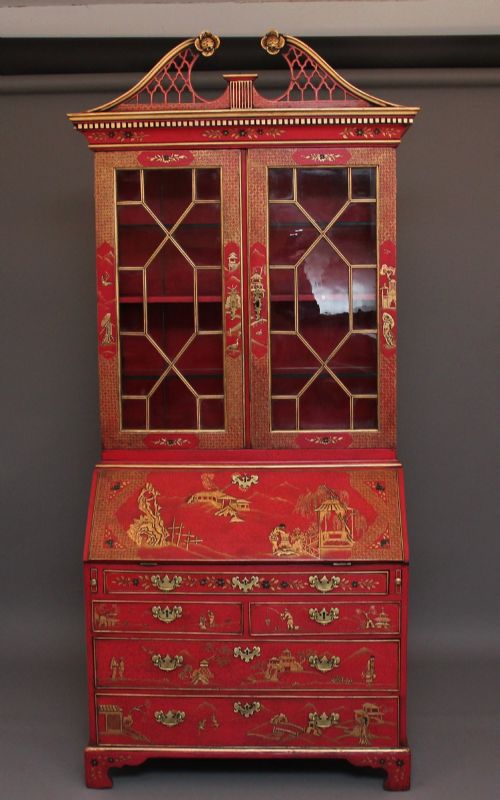
- A writing cabinet featuring a sloping desk flap above or below shelving enclosed by doors. This form combines storage and writing space within a single tall item.
- Japanning
- A European imitation of East Asian lacquerwork popular on furniture. This technique involves layering varnishes and resins, often cured by heat and decorated in gold.
- Chinese Chippendale
- A mid-eighteenth-century style drawing on Chinese architectural motifs. Furniture in this style frequently employs fretwork, pagoda tops, and lattice patterns.
- Escritoire
- A small writing cabinet or desk fitted with drawers and pigeonholes. These portable or standalone units often include a fall-front writing surface.
- Kidney-shaped
- A curved desktop contour resembling a kidney bean. This profile appears on dressing tables and writing desks designed to wrap slightly around the user.
Chinoiserie Writing Desk: Frequently Asked Questions
What is a chinoiserie writing desk?
A chinoiserie writing desk is a form of workspace furniture decorated with European interpretations of Chinese motifs, typically executed in lacquer and gold leaf.
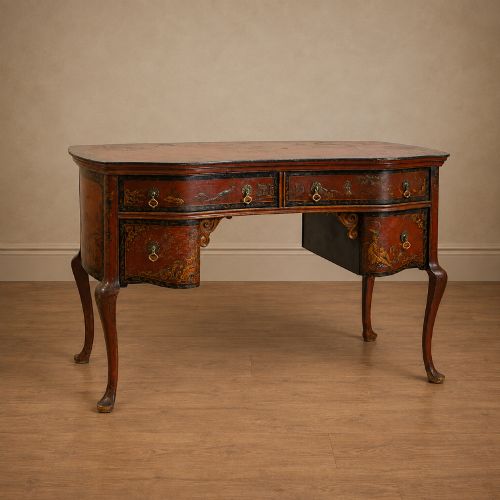
These desks appear in various configurations, including bureau bookcases, kidney-shaped dressing tables, and pedestal desks across multiple historic periods.
How do I identify the period of a desk?
Dating relies on examining the structural form, timber types, and decorative hardware. Georgian and Regency pieces show distinct proportions compared to later Victorian and Edwardian interpretations.
Stylistic markers such as Queen Anne cabriole legs or Chinese Chippendale fretwork provide further chronological clues.
Were these desks used for daily writing?
Yes, these pieces served as functional furniture for correspondence, record-keeping, and estate management. Fitted interiors with pigeonholes and small drawers accommodated inkwells, paper, and letters.
Writing tables provided open surfaces, whereas bureaus and escritoires offered lockable compartments to keep documents private.
How should I care for a lacquered desk?
Lacquered surfaces require protection from direct sunlight and excessive humidity to prevent warping or cracking of the finish. Dusting with a soft, dry cloth maintains the surface without abrasive polishes.
Avoid placing hot or wet items directly on the lacquer or gilt decoration.