


Chinese Sofa Console Table
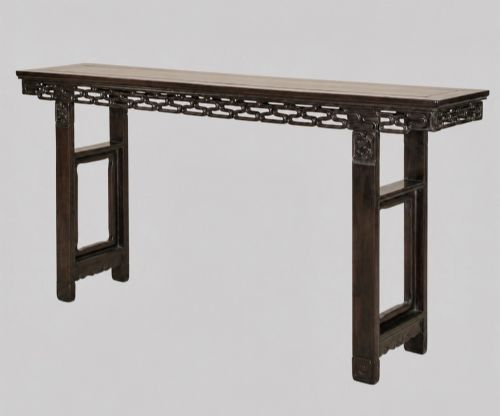
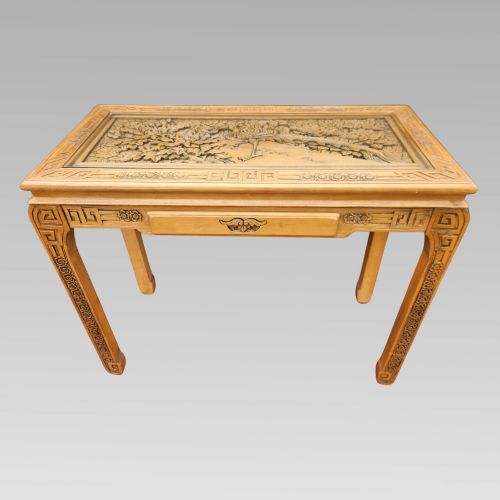
These Chinese sofa console table examples bring substantial hardwood form and centuries of Qing Dynasty or regional craftsmanship into a modern interior.
Chinese Sofa Console Table
A Chinese sofa console table encompasses narrow altar tables, side tables, and hall pieces originating from periods between the eighteenth century and the early twentieth century. Buyers seeking this category typically encounter elm and dense hardwood constructions shaped by traditional joinery and Qing Dynasty aesthetics.
The pieces present various forms, including black lacquered surfaces with marble inserts, carved hall tables, and long altar designs suited for placement against walls or behind seating. Most examples date from the nineteenth century, reflecting regional Chinese woodworking traditions alongside occasional export and revival interpretations.
Materials and construction
Makers utilised dense Asian hardwoods and domestic elm, selecting timber for grain pattern and structural durability in narrow console formats. Brass mounts, glass elements, and deep black lacquer finishes appear alongside marble table inserts, particularly in eighteenth-century and nineteenth-century examples.
Carving techniques define the decorative surfaces, ranging from subtle linear details to deep relief work seen on hall tables and altar forms. Traditional joinery methods secured the slender legs and long frames without relying on modern metal fixings.
Some work tables moonlight as altars, proving that eighteenth-century furniture was remarkably flexible about career paths.
Judging quality in these pieces
Quality rests upon the density and selection of the hardwood or elm, alongside the crispness of any carved detailing on the apron and legs. Pieces retaining intact original lacquer or fitted marble tops demonstrate higher workshop standards than simpler utility tables.
Proportion and structural integrity distinguish finer examples, where the balance between long console tops and supporting framework remains stable over centuries of use.
The Chinese Sofa Console Table Glossary
- Altar table
- A traditional rectangular form featuring an elevated stretcher or flanged ends, historically used for display in domestic halls. These pieces now function as narrow console tables.
- Qing Dynasty
- The final imperial dynasty of China, spanning from the seventeenth to the early twentieth century. Pieces from this era display characteristic regional carving styles and robust joinery.
- Hardwood
- A dense timber classification encompassing slow-growing Asian species utilised for structural durability and fine finish. It resists heavy wear on narrow table surfaces.
- Lacquer
- A durable resin finish applied in multiple layers to wooden substrates, often achieving a deep black sheen. It protects the timber while providing a smooth decorative surface.
- Chinoiserie
- European artistic interpretation of Chinese decorative motifs and forms. This style influenced revival furniture production during the nineteenth and early twentieth centuries.
Chinese Sofa Console Table: Frequently Asked Questions
Where do I place a Chinese console table?
These narrow tables suit placement in hallways, entryways, or positioned directly behind a sofa in a living space. Their shallow depth allows them to occupy circulation areas without obstructing movement.
They function effectively as display surfaces for lamps, ceramics, or books while anchoring vertical wall space with their linear presence.
How do I identify a Qing Dynasty piece?
Examination of the joinery, timber weight, and carving depth offers clues to age and origin. Qing Dynasty examples typically employ dense hardwoods or elm with traditional mortise and tenon construction.
Surface wear, patina development, and traditional regional design motifs further distinguish authentic period production from later revivals.
What is the difference between an altar table and a console?
Altar tables originally served ceremonial or display functions in domestic interiors, often featuring distinctive upturned flanges at the ends of the top board. Standard console tables generally present flat rectangular surfaces designed specifically to stand against walls.
Both forms share the elongated, narrow proportions that make them desirable for modern interior placement.
How do I care for antique hardwood furniture?
Maintain stable indoor humidity levels and avoid placing wooden tables in direct sunlight or near heat sources to prevent timber splitting. Dust regularly with a dry cloth and apply appropriate natural wax sparingly.
Protect lacquered and polished surfaces from moisture by using coasters or mats beneath objects placed on the table top.