




Chinese Rose Medallion Vases
Chinese rose medallion vases bring rich palette enamels and panelled court scenes into rooms, prized for their vibrant narrative decoration.
Chinese Rose Medallion Vases
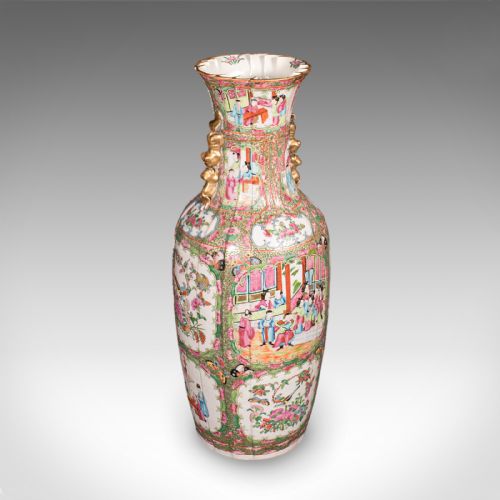
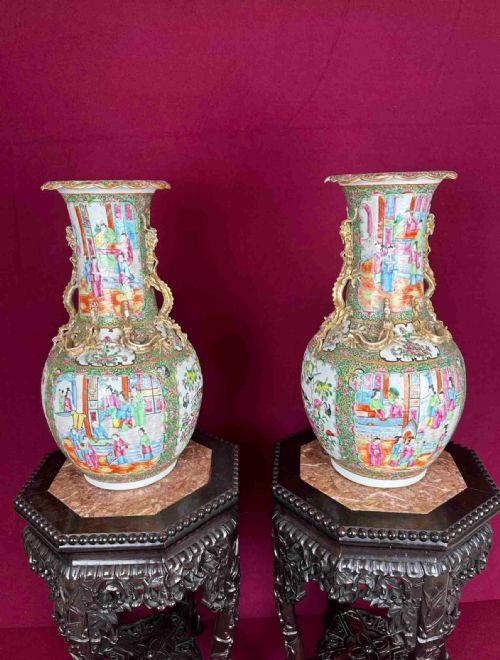
When you search for chinese rose medallion vases, you encounter distinctive porcelain vessels shaped as baluster vases, lidded containers, centrepieces, and tall umbrella stands. These objects originate primarily from the nineteenth century, spanning Victorian and Qing Dynasty periods.
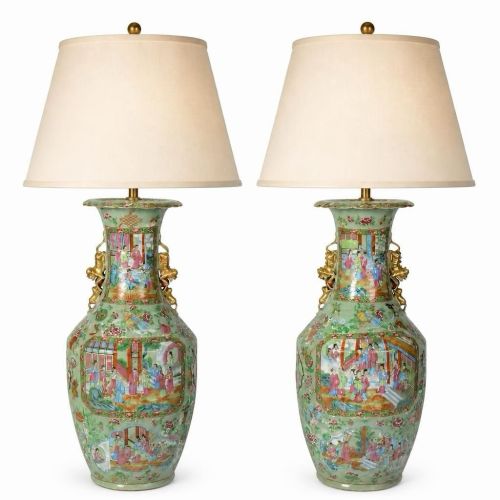
The version you are most likely to meet on this page is a nineteenth century Cantonese piece, often paired as lamps or standing large upon ceramic or gilt mounts. Many examples reflect Chinese Export porcelain traditions destined for Western interiors.
Makers and workshops produced these pieces using traditional methods, resulting in forms that function equally as decorative vases or converted table lamps. Collectors find individual lamps and monumental pairs spanning the 1870 to 1910 eras.
Materials and methods
Potters shaped the ceramic body from fine porcelain before applying detailed enamel decoration by hand. Artisans utilised rich gilding, gold leaf, and gilt bronze mounts to enhance the visual weight of the porcelain.
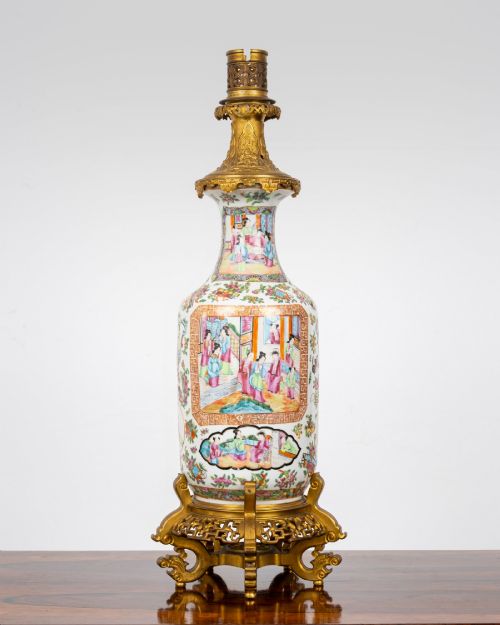
Canton workshops combined intricate enamel painting with characteristic medallion panels depicting figures and birds. Metalwork mounts in brass or ormolu frequently accompany the porcelain when converted into lamps.
Materials recorded include porcelain, enamel, brass, fabric, gold leaf, and gilt bronze.
Quality and execution
The finesse of the enamel painting determines the upper tier of these pieces, where finely rendered court scenes and balanced compositions distinguish superior works. Dense, crisp brushwork in the medallion panels separates exceptional vases from simpler production.
The presence of original matching covers, paired symmetry, and substantial scale elevate specific examples. Integration with period gilt bronze mounts or ormolu hardware also indicates higher ambition in the original workshop.
The Chinese Rose Medallion Vases Glossary
- Canton
- A style of Chinese export porcelain decorated in Guangzhou featuring segmented panels of figures, birds, and flowers.
- Famille Rose
- A palette of Chinese porcelain enamels dominated by opaque pink introduced during the Qing Dynasty.
- Baluster
- A vase form with a rounded body that tapers toward the base and flares at the neck.
- Ormolu
- Gilt bronze mounts applied to furniture, clocks, and porcelain bases during the nineteenth century.
- Qing
- The final imperial dynasty of China, reigning from the seventeenth century until the early twentieth century.
Chinese Rose Medallion Vases: Frequently Asked Questions
How were chinese rose medallion vases used originally?
These vessels served as decorative centrepieces and display containers within elite households and export markets.
Many examples remained purely ornamental, while others formed part of garniture sets displayed on mantelpieces or tables.
Are these vases usually found as pairs?
Surviving examples frequently appear as matching pairs, which suited symmetrical nineteenth-century interior display.
Single vessels also occur, alongside pieces subsequently converted into electrified table lamps during later decades.
How do you date nineteenth century porcelain?
Dating relies upon stylistic markers, enamel characteristics, and the nature of the porcelain body itself.
Nineteenth-century pieces often display specific Cantonese export motifs associated with the Victorian and Qing periods.
Can these vases be used safely as lamps?
Numerous pieces feature professional conversion into table lamps, incorporating wiring and fabric shades.
Buyers often select these converted items to integrate traditional porcelain into modern lighting schemes.