
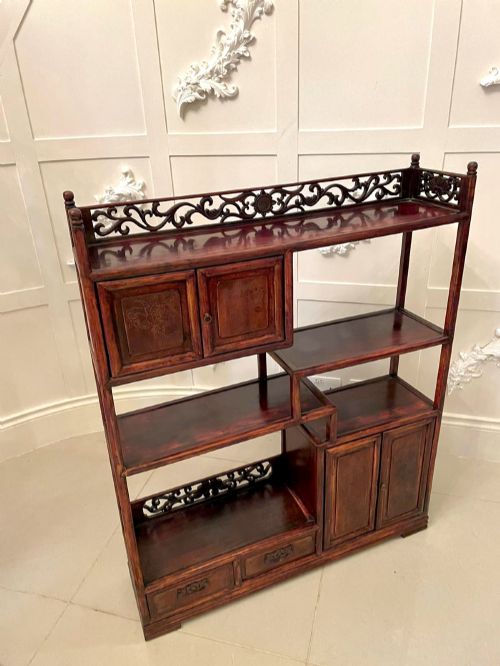
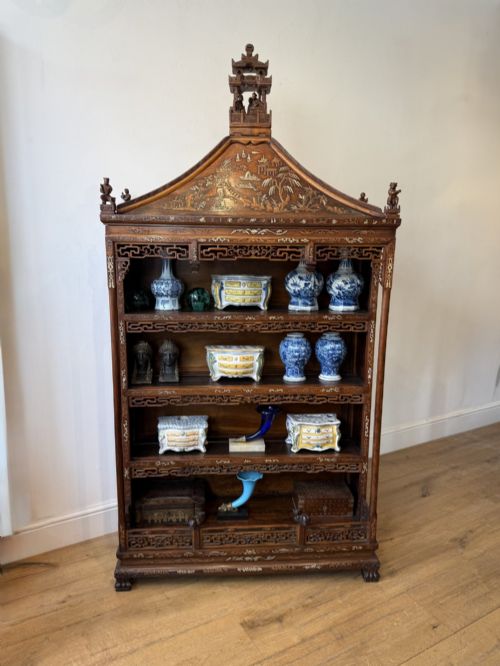


Chinese Display Shelves
Chinese display shelves bring intricate joinery and rich timbers into a room, offering a structured surface for treasured objects.
Chinese Display Shelves
Chinese display shelves comprise freestanding cabinets, wall-hanging structures, and table-top stands designed to showcase decorative objects. These pieces range from open frameworks to glazed cabinets and side-cabinets.
The versions most frequently met on this page span the nineteenth century into the early twentieth century, reflecting periods such as the Qing Dynasty and late Qing Dynasty.
How they were made
Construction relies heavily on dense timbers such as hardwood, rosewood, hongmu, and elm, providing a robust structural framework for intricate carving.
Many examples incorporate decorative elements like brass fittings, bone inlay, mother of pearl inlay, and red lacquer finishes applied to timber surfaces.
Joinery methods allow for complex compartmentalised shelving layouts, often termed shodana, which accommodate varied decorative objects.
Listings feature hardwood, rosewood, hongmu, and elm alongside decorative elements like mother of pearl and bone inlay across the nineteenth and early twentieth centuries.
What varies in quality
Quality rests upon the depth and precision of the carving across the hardwood or rosewood structure, alongside the integrity of timber selection.
The intricacy and preservation of inlaid materials, such as bone and mother of pearl, distinguish finer examples from simpler vernacular pieces.
The sophistication of the overall joinery and the balance of compartmentalised shelves determine the success of the design.
The Chinese Display Shelves Glossary
- Hongmu
- A dense tropical hardwood prized in Chinese furniture making for its deep colour and durability. It provides a heavy, stable frame for carved display cabinets.
- Shodana
- A style of multi-tiered display cabinet featuring asymmetric shelving compartments. This form originated in Japan and influenced nineteenth-century export pieces.
- Qing Dynasty
- The final imperial dynasty of China, spanning from sixteen-forty-four to nineteen-twelve. Pieces from the late nineteenth and early twentieth centuries reflect this heritage.
- Bone Inlay
- A decorative technique where small pieces of bone are set into carved recesses in the timber. It creates contrasting pale geometric or floral patterns.
- Whatnot
- A piece of furniture consisting of a series of open shelves for displaying ornaments. These tiered stands were popular throughout the nineteenth century.
Chinese Display Shelves: Frequently Asked Questions
How were they used?
They functioned primarily in formal rooms to display ceramics, bronzes, and scholarly items. The varied compartment sizes accommodated objects of differing scales.
Table-top versions sat upon larger furniture, while tall cabinets stood directly on the floor as central focal points.
How do i date chinese display shelves?
Dating relies on stylistic clues, timber characteristics, and structural methods. Pieces linked to the late Qing Dynasty often display profuse carving and dense hardwoods.
Later examples from the early twentieth century shift slightly in proportion while maintaining traditional joinery techniques.
How do i live with them?
Place them away from direct heat sources and strong sunlight to protect the timber and inlay work. Their open or glazed shelves suit the display of ceramics and small sculptures.
Keep the timber clean with a soft dry cloth and avoid excessive moisture.