
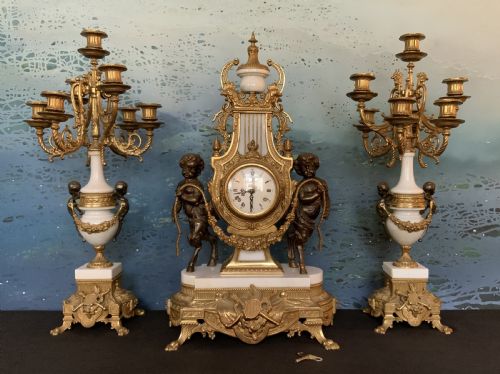


Cherub Brass Mantel Clock
A cherub brass mantel clock brings nineteenth-century French and English figural metalwork into a room.
Cherub Brass Mantel Clock
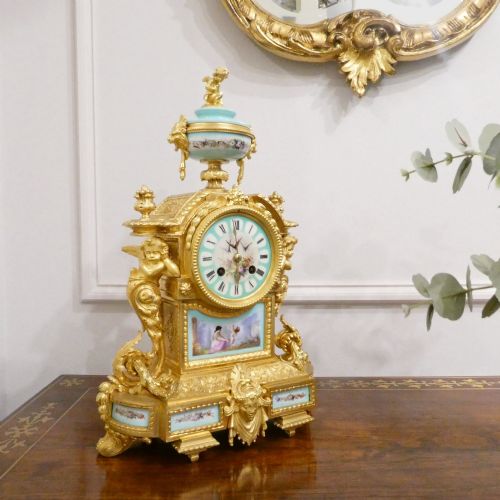
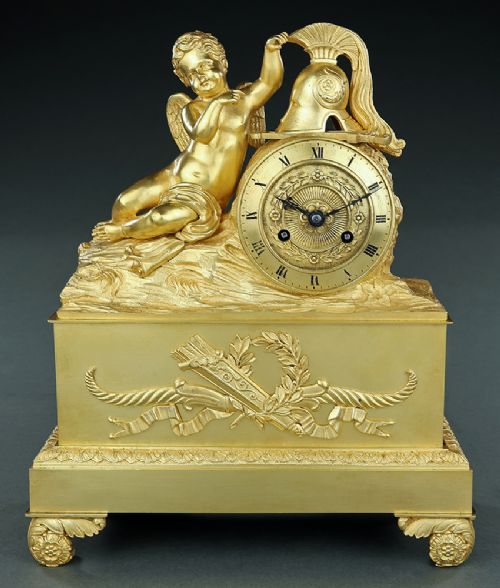
A cherub brass mantel clock unites timekeeping with sculptural figural casting, typically centred around putti, cupid, or cherubic motifs. The pieces available span nineteenth-century Victorian, Regency, and French revival periods.
Most examples originate from French workshops or London makers, taking the form of mantel clocks, desk timepieces, or multi-piece garniture sets with matching candelabras.
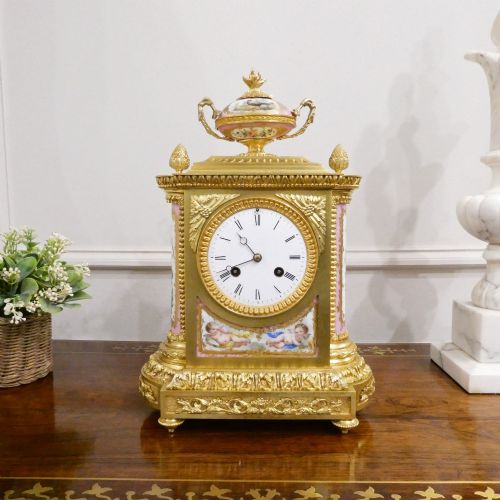
Buyers encounter freestanding gilt metal figures, porcelain-mounted cases, and architectural marble designs incorporating cast brass or bronze cherubs.
Materials and construction methods
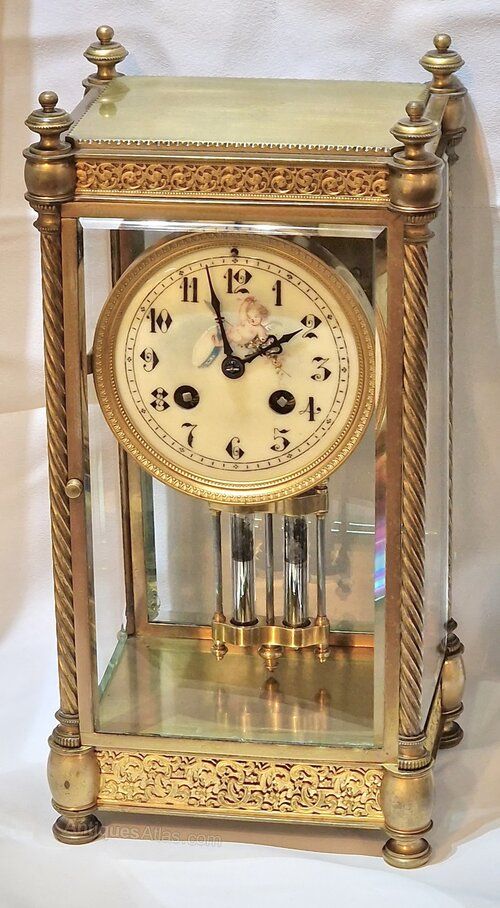
Cases combine cast brass, gilt bronze, and ormolu, often paired with contrasting white marble, glass panels, or hand-painted porcelain plaques.
Dial faces utilise enamel with painted numerals, while movements rely on mechanical eight-day mechanisms, pendulum regulation, and chain fusee systems.
Several cherubs are caught red-handed reaching for birds in trees or nursing stray dogs rather than simply holding clock faces.
Factors determining quality
Quality rests upon the crispness of the bronze or brass chasing and the depth of the gilding across the figures and foliage.
Maker attribution and the complexity of the internal movement, such as signed French mechanism plates or London fusee escapements, elevate the standard.
Jean-Baptiste Delettrez·Samuel Marti·P.H. Mourey·Japy Freres
The Cherub Brass Mantel Clock Glossary
- Ormolu
- Gilded bronze produced through a mercury amalgamation technique, common in nineteenth-century French clock cases. This surface treatment yields a warm, distinct golden lustre.
- Garniture
- A matching set consisting of a central clock flanked by decorative objects such as candelabras or vases. These suites were designed to sit symmetrically on a mantelpiece.
- Fusee
- A conical pulley connected to the mainspring by a chain or cord to ensure even tension as the spring unwinds. This mechanical device improves timekeeping accuracy.
- Champleve
- An enamelling technique where troughs are dug into a metal surface and filled with vitreous paste before firing. The resulting coloured patterns decorate the clock body.
- Putto
- A plump, winged child figure frequently depicted in classical art, commonly referred to as a cherub or cupid on these clock dials and cases.
Cherub Brass Mantel Clock: Frequently Asked Questions
How do I wind the clock?
Most mechanical movements require a specific key inserted into the dial holes to tension the mainspring barrels.
Care must be taken not to overwind the mechanism, stopping as soon as resistance is felt.
What is a garniture set?
A garniture set includes a central clock accompanied by matching side pieces like candelabras or urns.
These were arranged together on a fireplace mantel to create a balanced decorative display.
How do I identify the period?
Periods are determined by stylistic cues, casting techniques, and maker marks stamped on the movement backplates.
Victorian and nineteenth-century French designs often display distinct revivalist motifs and signature stamps.
Where should I place the clock?
Mantel clocks require a stable, level surface away from direct sunlight, draughts, and damp walls.
Placement on a sturdy mantelpiece or sideboard ensures the pendulum swings evenly without interference.