
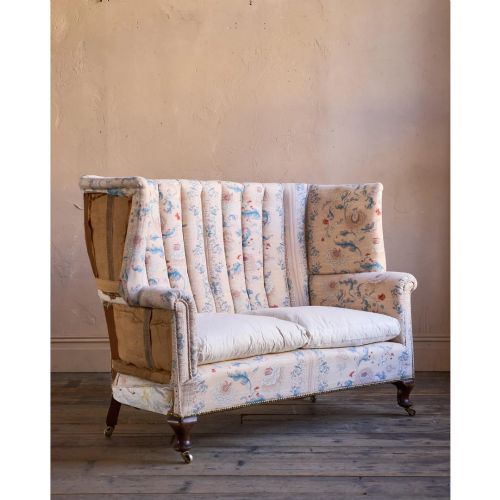


Channel Tufted Chair
A channel tufted chair offers deep vertical cushioning and structural comfort, spanning periods from the Georgian era through to the Art Deco decades.
Channel Tufted Chair
A channel tufted chair is defined by its vertically stitched upholstery channels that run along the backrest, creating a distinct ribbed appearance. When buyers search for a channel tufted chair, they encounter variations such as barrel back armchairs and expansive wingback sofas.
The pieces seen here stretch across the nineteenth century, Edwardian period, and into the nineteen-twenties, showing how makers adapted the vertical fluting across different seating forms. Barrel back designs dominate the selection, wrapping the sitter in a continuous curved upholstered frame.
Origins span formal English country house aesthetics to specific Victorian and George III iterations. Whether upholstered in blue ribbed fabric, red textiles, or brown leather, these seats combine substantial timber frames with pronounced vertical padding.
Materials and construction
Frames rely on traditional hardwoods like mahogany, walnut, and general timber to provide a rigid structural skeleton for the upholstered components. Joinery is concealed beneath dense padding and heavy outer coverings.
Upholstery deployment utilises fabrics such as velvet, linen, and hessian, alongside durable leather for heavy-duty suites. Internal padding supports the vertical channels, while brass details occasionally accent the structural framework.
Materials across the inventory include solid hardwoods like mahogany and walnut, paired with soft coverings such as velvet, linen, hessian, and leather.
Assessing quality
The distinction between standard examples and superior pieces rests on the precision of the vertical fluting and the integrity of the underlying timber frame. Finer items maintain uniform channel tension and crisp lines that do not sag under pressure.
Materials dictate the upper tier, where substantial mahogany or walnut framing meets dense, high-grade leather or heavy velvet. Lesser examples employ simpler timber species and lighter textiles that lack the robust presence of large Victorian or Edwardian suites.
The Channel Tufted Chair Glossary
- Channel tufted
- Upholstery style featuring vertical stitched ridges or tubes running down the backrest. This technique provides both visual rhythm and structured back support.
- Barrel back
- A seating form where the backrest curves continuously around into the armrests in a circular shape. It creates an enclosed, cocoon-like posture for the sitter.
- Wingback
- An armchair or sofa with side panels attached to the back frame, historically designed to shield the occupant from drafts. The evidence records nineteenth-century variants utilising this silhouette.
- Mahogany
- A durable, reddish-brown tropical hardwood utilised extensively for quality furniture framing. It offers exceptional strength for load-bearing chair legs and internal structures.
- Hessian
- A coarse woven fabric, often made from jute or hemp fibres, traditionally employed as an internal upholstery foundation and webbing base.
Channel Tufted Chair: Frequently Asked Questions
What is a channel tufted chair?
A channel tufted chair is a seating piece featuring vertically stitched fabric or leather ribs along the backrest. This design creates distinct cushioned channels that offer both structural support and a tailored appearance.
Examples on this page span from Georgian and Victorian periods up to the nineteen-twenties, frequently appearing as barrel back armchairs.
What materials were used in these chairs?
Makers constructed the internal frames using traditional timbers such as mahogany, walnut, and general wood. Brass elements occasionally appear on structural or decorative fittings.
Upholstery materials range from velvet, linen, and hessian to heavy brown leather on larger nineteenth-century suites.
Which periods are represented?
The pieces span multiple eras, including Georgian, nineteenth-century, Edwardian, nineteen-tens, and Art Deco styles from the nineteen-twenties. Each period brings subtle shifts in frame shaping and upholstery choice.
Victorian iterations often lean towards large proportions and substantial leather finishes, while later Edwardian and nineteen-twenties pieces utilise refined barrel forms.
How were these chairs used historically?
These armchairs and sofas served as primary seating in formal parlours, libraries, and drawing rooms. The enclosed barrel and wingback designs were prized for comfort and draft exclusion in large country houses.
Suites combining matching sofas and armchairs accommodated guests for extended periods of relaxation and conversation.