


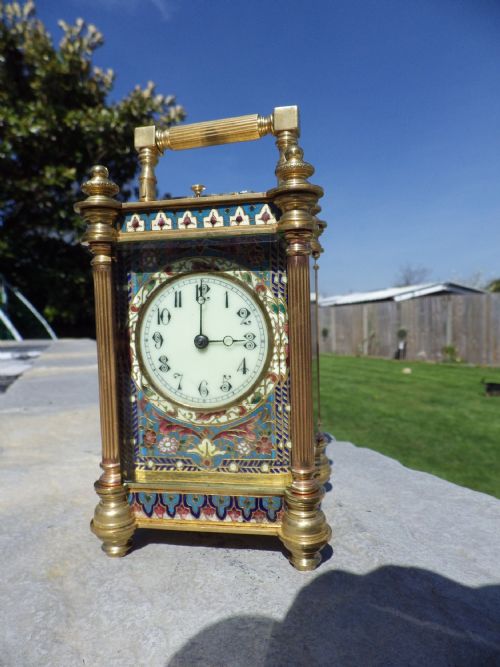


Champleve Carriage Clock
A champleve carriage clock brings together heavy cast metal and vibrant coloured glass to sit on a mantel or bedside table.
Champleve Carriage Clock
When you search for a champleve carriage clock, you are looking at portable timekeepers housed in glazed metal cases decorated with recessed enamel work. These pieces originate predominantly from late nineteenth-century France and the Victorian era, appearing in formats from simple timepieces to repeating clocks.
The versions you are most likely to meet on this page date from the 1890s and around 1900, often styled in the French Belle Epoque or Rococo Revival manner. They take the form of carriage clocks and miniature bedside clocks, featuring glazed panels and intricate enamel bandings or flower designs.
How they were made
Makers formed the structural cases using brass, gilt brass, gilded brass, ormolu, and gilt bronze, casting the metal to create robust frames fitted with glass panels. Onto these metallic frameworks, artisans applied enamel into recessed channels to build up colourful floral and geometric patterns.
The mechanical movements inside were housed alongside these decorated frames, requiring precise gear cutting and spring assembly. Glass was cut to fit the top, sides, and back of the brass housing, allowing the internal escapement and dial to remain visible.
The listings here span the Victorian era, the 1890s, and 1900, utilising materials such as brass, gilt bronze, enamel, and glass.
What varies in quality
The distinction between tiers of these clocks lies in the depth and complexity of the cast metal mountings and the precision of the enamel work. Finer examples display crisp chasing in the ormolu or gilt bronze and deeply fired enamel without surface pitting.
Another factor is the sophistication of the movement itself, where repeating mechanisms and fully restored escapements distinguish more elaborate pieces from standard timepieces. The integration of the enamel bandings with the surrounding brass structure also determines the overall visual harmony.
The Champleve Carriage Clock Glossary
- Champleve
- An enamelling technique where artists scoop troughs or cells into a metal surface, fill them with vitreous enamel powder, and fire the piece until the glass melts smooth. This method creates bold, colourful patterns flush with the surrounding metal.
- Ormolu
- A method of applying finely ground high-carat gold to a bronze or brass object using mercury amalgamation or modern electroplating. It gives the metal base a rich, warm golden lustre.
- Repeater
- A mechanical complication that strikes the hours and quarters on demand when a lever or button is pressed. This allows the user to hear the time in the dark.
- Carriage clock
- A small, spring-driven timekeeper originally designed for travel by officers and wealthy individuals during the nineteenth century. They typically feature a swinging handle on top and glass panels on all sides.
Champleve Carriage Clock: Frequently Asked Questions
How do I wind a carriage clock?
Most of these clocks require a small matching key inserted into winding squares on the backplate. Turn the key gently until you feel firm resistance, taking care not to overwind the mainspring.
Keep the clock stationary while winding to avoid disturbing the delicate balance wheel inside. Setting the time should be done by moving the minute hand forward rather than backward.
Where should I place a carriage clock?
Position your clock on a stable, level surface such as a wooden mantelpiece, chest of drawers, or bedside table. A solid foundation ensures the escapement beats evenly and keeps accurate time.
Avoid placing the piece in areas subject to direct sunlight, high humidity, or heavy vibrations from passing traffic, as these conditions can affect both the brass case and the internal lubricants.
What is the difference between a timepiece and a clock?
In horological terms, a timepiece is a device that simply tells the time without any striking mechanism. They are straightforward to maintain and generally feature fewer internal parts.
A clock, by contrast, includes a striking train that chimes the hours or quarters, or incorporates a repeating function. These models contain extra gear trains and hammers to produce the audible sound.
How can I tell the period of a carriage clock?
Examining the style of the brass case, the shape of the handle, and the type of dial helps narrow down the era of manufacture. Pieces from the 1890s and 1900s often display French Belle Epoque or Rococo Revival design elements.
Signatures or patent marks stamped on the backplate of the movement can also provide specific clues about the maker and the exact decade of production.