


Ceylon Blue Sapphire Jewellery
Ceylon blue sapphire jewellery unites vibrant cornflower blue corundum with fine platinum, gold and diamond settings across Victorian to mid-century periods.
Ceylon Blue Sapphire Jewellery
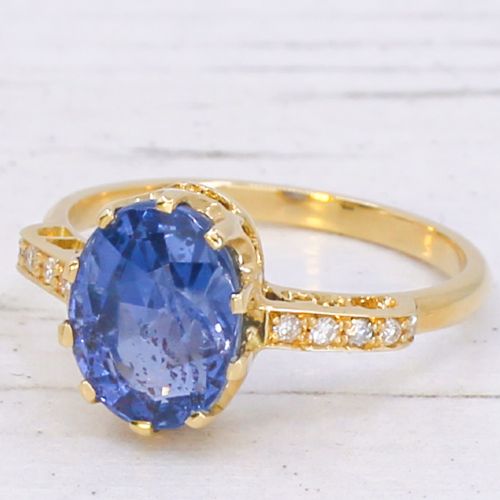
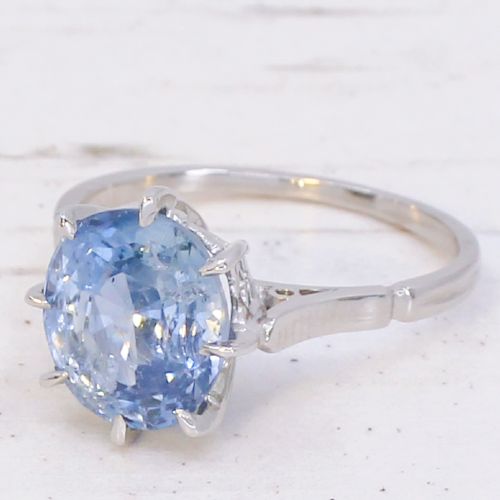
Ceylon blue sapphire jewellery brings together precious stones of distinct Sri Lankan origin, set into rings, pendants and bracelets spanning Victorian, Edwardian, Art Deco and mid-century eras.
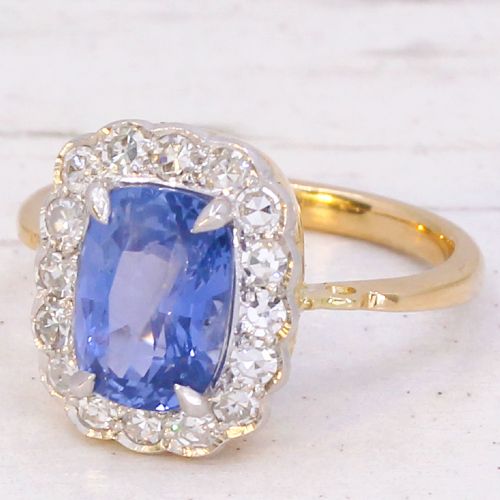
Cluster rings and substantial cocktail rings dominate the selections here, frequently paired with sparkling diamond borders and mounted in platinum or yellow gold.
Pieces range from delicate early twentieth-century trilogy designs to heavy mid-century solitaire and cabochon mountings that showcase exceptional stone size and natural depth of colour.
Materials and Construction
Goldsmiths and platinumsmiths constructed these mountings by hand or through early twentieth-century casting methods, securing principal gems with claw or bezel settings.
Precious metals such as platinum and 18ct white or yellow gold provide the structural support, while accompanying diamonds are typically set in pavé or cluster arrangements around the central sapphire.
Listings feature platinum, yellow gold, diamonds and natural pearls alongside sapphires spanning the Victorian era through the 1960s.
Evaluating Quality
Quality rests upon the natural saturation, clarity and unheated status of the sapphire itself, alongside the precision of the surrounding diamond work and metal fabrication.
Substantial carat weight, balanced proportions within cluster or cocktail forms, and period-authentic mounting integrity separate the finest examples from standard items.
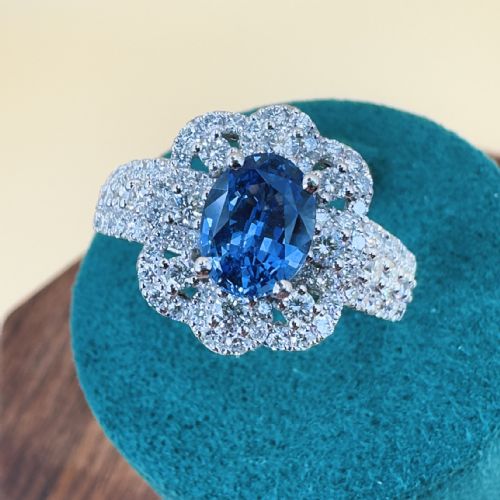
Le Vian
The Ceylon Blue Sapphire Jewellery Glossary
- Ceylon sapphire
- A corundum gemstone originating from Sri Lanka, noted for its characteristic bright and luminous blue coloration. These stones often display high clarity and lively brilliance.
- Cluster ring
- A ring design featuring a prominent central gemstone encircled by a border of smaller stones, typically diamonds. This arrangement maximises overall visual impact and light return.
- Cabochon
- A gemstone cut with a smooth, rounded, convex upper surface rather than faceted planes. This style is frequently utilised for large stones or star sapphires to display optical phenomena.
- Trilogy ring
- A ring featuring three prominent stones set in a row, traditionally symbolising the past, present and future. In these listings, they pair sapphires with natural pearls or diamonds.
- Platinum
- A dense, ductile and malleable precious metal prized for its strength and bright white lustre. It allows for delicate claw work and secure settings for heavy stones without adding undue bulk.
Ceylon Blue Sapphire Jewellery: Frequently Asked Questions
What defines a Ceylon sapphire?
A Ceylon sapphire originates from the mines of Sri Lanka, historically known as Ceylon. These stones are recognised for a vibrant and lively blue hue that often appears lighter and more luminous than stones from other origins.
Many examples retain their natural, unheated state, preserving the genuine mineral characteristics formed within the earth.
How do I care for my ring?
Clean your jewellery gently using warm water, mild washing liquid and a soft brush to remove everyday oils from beneath the settings. Avoid harsh ultrasonic cleaners, particularly if the sapphire is unheated or has natural inclusions.
Store pieces individually in lined boxes to prevent the diamonds from scratching the softer gold or platinum mountings.
Are these sapphires heat treated?
Some sapphires undergo traditional heating to improve colour and clarity, while others are explicitly described as unheated. Unheated stones have not been subjected to artificial thermal enhancement since extraction from the ground.
Checking individual listings will confirm whether a specific stone has certification or notes regarding unheated status.
How do I identify Art Deco pieces?
Art Deco jewellery relies on geometric symmetry, linear motifs and strong contrasts between white platinum and deep blue sapphires. The metalwork often incorporates precise millegrain edging and stepped shoulders.
These designs emerged during the 1920s and 1930s, moving away from the flowing floral curves of the preceding Edwardian period.