
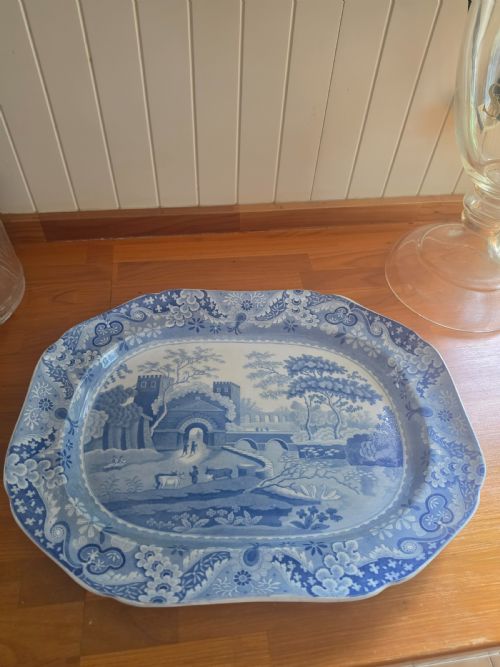

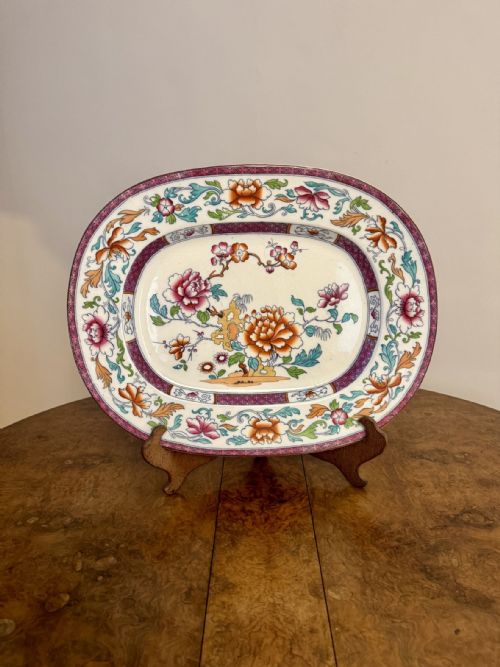
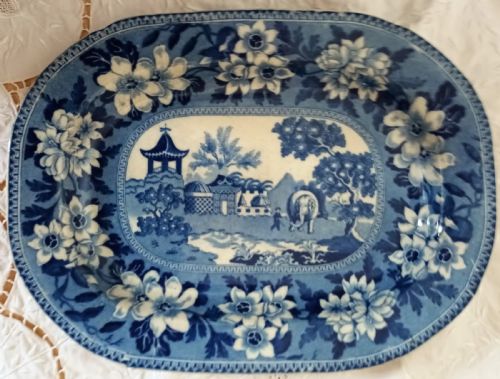
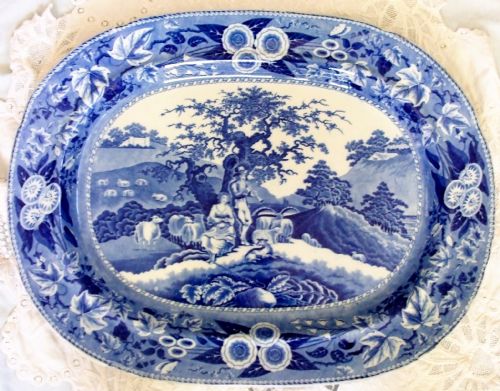


Ceramic Transferware Meat Dish
These large ceramic transferware meat dishes served grand dining tables during the Georgian and Victorian eras.
Ceramic Transferware Meat Dish
The patterns applied to these serving dishes draw heavily from landscape views, architectural scenes, and Chinoiserie motifs printed in cobalt pigment. Collectors encounter named series such as Byron Views, Shipping Series, and specific scenic titles like Tower Pattern, India Temple, and Bridge of Lucano.
Most items originate from English potteries active in Staffordshire and surrounding manufacturing centres during the nineteenth century. Forms include large platters, chargers, and serving plates fashioned from earthenware, pearlware, or ironstone.
How They Were Made
Potters formed these large dishes using earthenware, pearlware, or ironstone, shaping them to withstand the weight of heavy roasts and frequent use. Bodies were glazed and fired to provide a smooth, resilient surface suitable for holding juices during carving.
Decoration relied on copperplate transfer printing, a technique where an engraved metal plate transferred cobalt pigment onto tissue paper, which was then pressed onto the ceramic body. Enamel touches occasionally supplemented the blue and white designs before the final glaze firing.
One unfortunate pig found immortality on a nineteenth-century plate, preserved forever in blue transfer ink alongside an unsuspecting shepherd.
What Varies in Quality
Quality rests in the crispness and depth of the transfer print, where superior examples show clean lines without blurring or smudging from the tissue application. The complexity and artistic merit of the pattern, such as detailed architectural ruins or intricate landscape series, elevate certain platters above standard topographical designs.
The physical condition and weight of the ceramic body, particularly in heavy ironstone or pearlware dishes with integrated drainers and reservoirs, distinguish high-status production from utilitarian wares. Maker attribution, such as pieces bearing marks from Spode, Minton, or Mason's, marks another clear distinction in desirability.
Spode·John Rogers and Son·Copeland and Garrett·Don Pottery·Thomas Lakin·Minton·Elkin Knight and Bridgwood·Mason's Ironstone China
The Ceramic Transferware Meat Dish Glossary
- Transferware
- Pottery decorated by transferring a printed design from an engraved copper plate onto the ceramic surface using a tissue paper intermediary. This technique allowed complex pictorial scenes to be produced consistently on a commercial scale.
- Pearlware
- A refined earthenware developed by Josiah Wedgwood in the late eighteenth century, featuring a thin glaze with a slight bluish tinge that pooled in crevices. It served as a transitional ceramic body before the widespread adoption of heavy ironstone.
- Gravy well
- A sunken channel or recess built into the surface of a serving platter to collect meat juices away from the main roast. Dishes with this feature often included a separate ceramic drainer insert.
- Ironstone
- A dense, durable type of heavy earthenware patented in the early nineteenth century to imitate Chinese porcelain. It proved exceptionally resilient for large serving vessels.
- Chinoiserie
- A European stylistic interpretation of Chinese artistic motifs and architectural elements, frequently rendered in blue and white on nineteenth-century tablewares.
Ceramic Transferware Meat Dish: Frequently Asked Questions
How were meat dishes used?
These large platters sat at the centre of the dining table to hold roasted joints of meat or poultry during formal meals. Servants carved the meat directly upon the platter, allowing the wide ceramic rim and any integrated reservoir to catch the juices.
After dining, the heavy earthenware was washed and stored until the next substantial feast. Their considerable size made them impractical for everyday small-family meals, reserving them for entertaining guests.
What is a gravy well?
A gravy well is a depressed oval or channel set into one end of the platter surface. It allowed carving juices to pool away from the meat so the roast remained presentable during service.
Some platters paired this well with a pierced ceramic insert known as a drainer. The meat rested upon the raised platform of the drainer while juices fell below.
How do I date a transferware dish?
Dating relies on a combination of ceramic body type, maker marks stamped or printed on the reverse, and the specific pictorial style. Earlier pieces from the Georgian period often utilise pearlware bodies with softer blue tones, while mid-Victorian examples tend toward heavier ironstone and sharper printed details.
Series names and registered design marks provide additional chronological clues. Researching the active dates of named potteries helps narrow the window of manufacture.
How do I display a large platter?
Because of their substantial dimensions and weight, these platters require sturdy wall hangers designed for heavy ceramics or deep plate grooves on a strong dresser shelf. Positioning them securely ensures the piece remains safe while showing off the full transfer-printed landscape.
Avoid hanging them in areas with heavy foot traffic or direct, intense heat sources that might stress the antique glaze. Proper wall anchors into studs are essential for large ironstone or earthenware chargers.