


Ceramic Staffordshire Spaniels
Ceramic Staffordshire spaniels are traditional mantelpiece ornaments originating in nineteenth-century England, prized for their symmetrical pairing and charmingly watchful posture.
Ceramic Staffordshire Spaniels
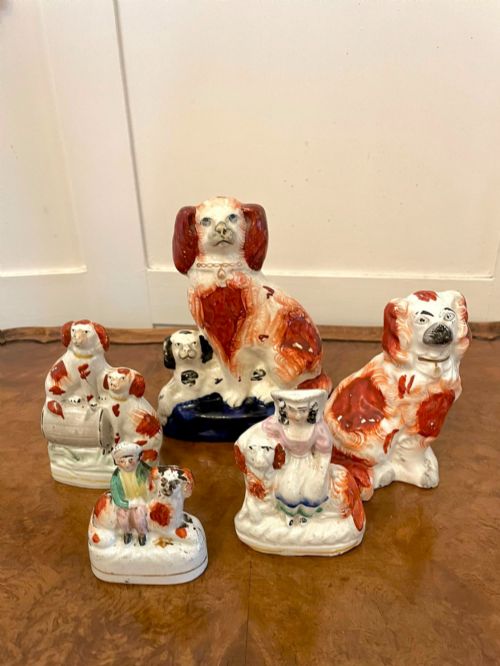
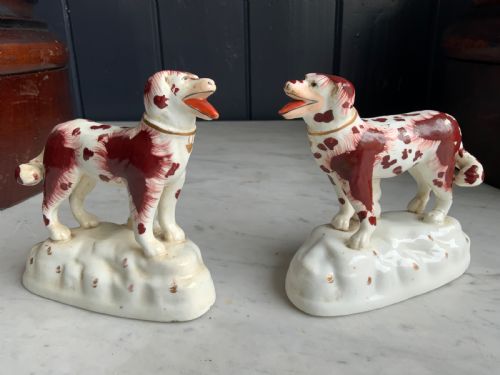
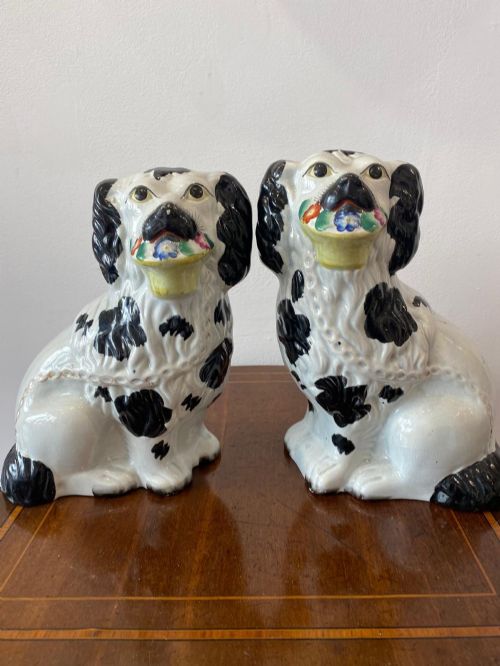
These ceramic Staffordshire spaniels span the nineteenth century, including Victorian periods, Regency eras, and early twentieth-century examples. Buyers predominantly encounter pairs of seated spaniels designed to sit symmetrically on either end of a mantelpiece.
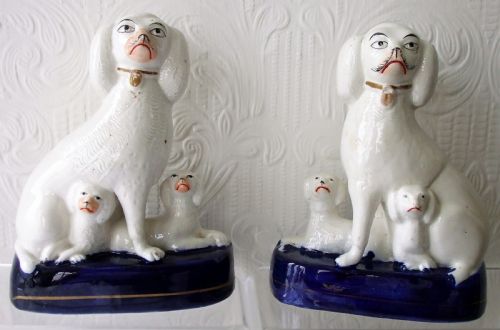
Beyond the standard seated spaniel pairs, variations include dogs with pups, money boxes, toby jugs, quill holders, and clock groups. Related figures in the listings extend to poodles, Maltese terriers, and King Charles spaniels.
The objects take several forms, from single figures to collections of several dogs, sometimes incorporating coloured cushions or gilt detailing. Most pieces date from the mid-nineteenth century, notably around eighteen-sixty and eighteen-eighty.
Materials and production techniques
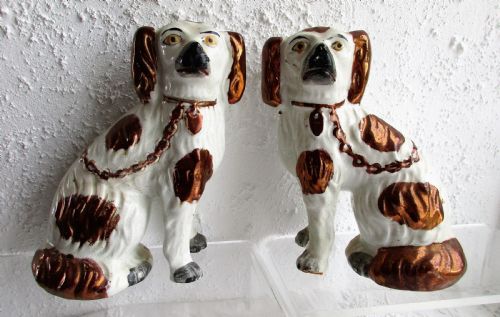
Certain pieces incorporate distinct decorative elements such as copper lustre, black and white colour schemes, red and white markings, and textured encrusting on bases. These materials result in sturdy figures designed primarily for domestic display.
The listings include earthenware and stoneware pieces decorated with enamel, glaze, and gold leaf, spanning the nineteenth and early twentieth centuries.
Assessing quality in the figures
Quality rests upon the crispness of the moulding and the delicacy of the hand-painted details on the face and coat. Superior examples maintain bright, clean enamel colours and well-preserved gilding without excessive rubbing.
The presence of secondary motifs, such as accompanying puppies, modelled cushions, or functional forms like inkwells and money boxes, distinguishes more ambitious modelling from standard pairs.
Royal Doulton·Beswick
The Ceramic Staffordshire Spaniels Glossary
- Comforter spaniels
- Staffordshire pottery figures modelled on Queen Victoria's own spaniels, traditionally placed on mantelpieces facing inward toward each other.
- Earthenware
- A porous pottery body fired at lower temperatures, serving as the standard clay base for the majority of these figures.
- Quill holder
- A hollow ceramic figure adapted with a small aperture on the back or base to hold writing feathers.
- Toby jug
- A pottery jug shaped as the full-figure depiction of a seated character or animal.
Ceramic Staffordshire Spaniels: Frequently Asked Questions
How were Staffordshire spaniels displayed?
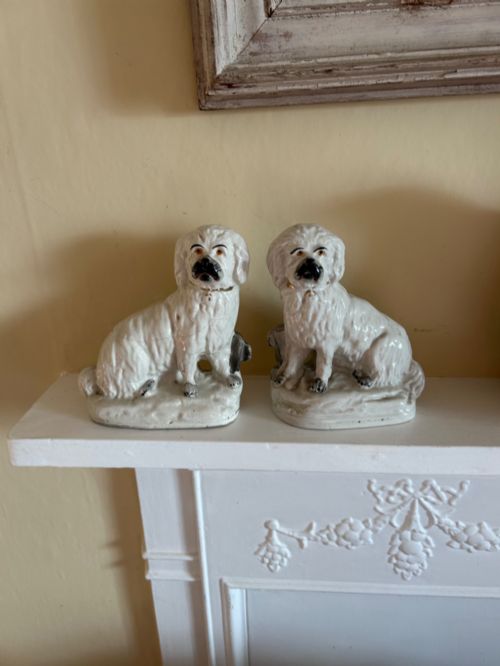
These figures were traditionally arranged as matching pairs on either end of a domestic mantelpiece or fireplace shelf. They often faced inward toward each other, guarding the hearth.
More elaborate groupings incorporated clock faces, inkwells, or quill holders positioned between or beside the dogs, combining decoration with everyday utility.
What dog breeds are represented?
While the King Charles spaniel dominates the groupings, potters also modelled poodles, Maltese terriers, and spaniels accompanied by puppies. These variations reflect the Victorian taste for domestic animal companions.
Different breeds and postures appear across the nineteenth century, ranging from simple seated dogs to complex money boxes and Toby jugs.
How do I date these ceramics?
Dating relies on stylistic clues, glaze characteristics, and recorded production periods spanning the nineteenth and early twentieth centuries. Pieces often date from the Victorian era around eighteen-sixty and eighteen-eighty.
Marked differences in the application of enamel paint, copper lustre, and gilt help distinguish mid-nineteenth-century examples from later twentieth-century studio output.
Are all these figures hollow?
Many of the standard mantelpiece figures and money boxes are slip-cast or press-moulded with hollow interiors to facilitate even firing in the kiln. Smaller items like quill holders and inkwells feature specific apertures.
Solid construction is less common in larger decorative figures, where hollow bodies prevented cracking during high-temperature firing.