



English Earthenware Mantel Dogs
English earthenware mantel dogs bring domestic Victorian charm to a room, offering pairs of pottery spaniels, poodles, and greyhounds that sit proudly on the shelf.
English Earthenware Mantel Dogs
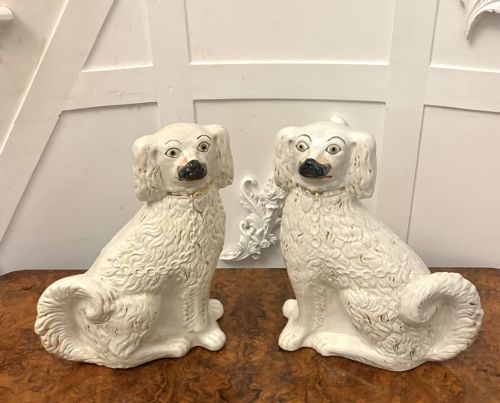
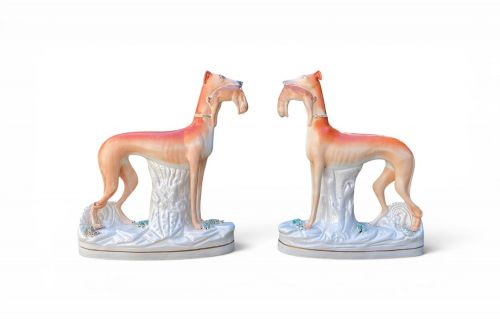
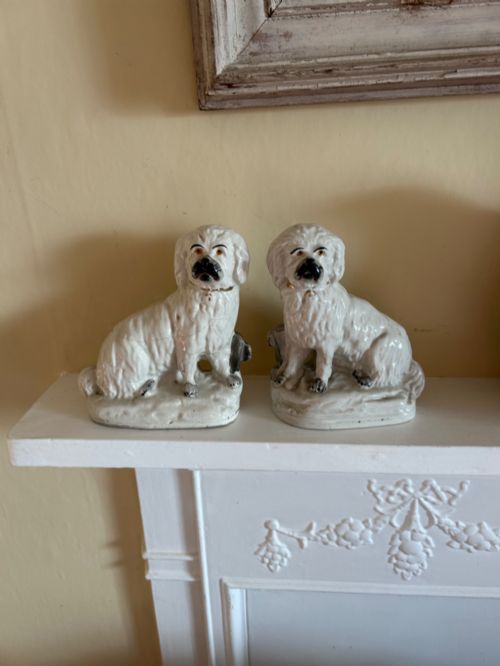
These English earthenware mantel dogs comprise figures of spaniels, poodles, greyhounds, Maltese terriers, and hunting dogs with hares, mostly shaped as pairs for symmetrical fireplace display. They originate from the nineteenth century, including specific dates such as eighteen fifty, eighteen sixty, and eighteen eighty, firmly placing them within the Victorian era.
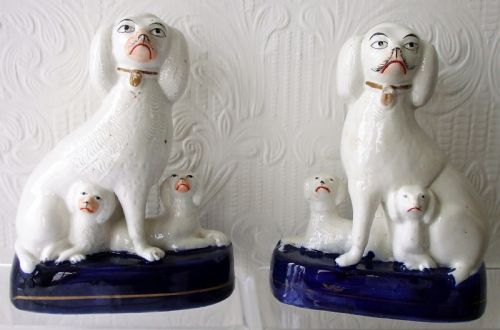
The objects take the form of decorative figurines and pottery figure groups, often depicting seated animals or mothers with pups. Buyers will encounter both standard pairs and single figures, with spaniels and poodles appearing frequently among the inventory.
These pieces represent the heart of Victorian country pottery and domestic ornamentation, designed to gaze outwards from the mantelpiece. Their presence reflects the Victorian affection for animal companions rendered in ceramic form.
Materials and production methods
Potters shaped these figures from ceramic earthenware, employing traditional moulding techniques to achieve the characteristic forms of spaniels, greyhounds, and poodles. The resulting clay bodies provided a stable base for subsequent surface decoration.
English Earthenware Mantel Dogs Retail Price Guide 2026
Typical asking prices for english earthenware mantel dogs among the pieces listed under this phrase on Sellingantiques today, from the lower quarter to the upper quarter. They describe what is for sale here now, not the wider market.
Judging the quality
Quality rests in the crispness of the moulding and the delicacy of the enamel paintwork, which distinguishes finely modelled figurines from simpler country pottery. Details like the rendering of fur texture, facial expressions, and the application of gold leaf separate the standard productions from superior examples.
The preservation of the original glaze and the vibrancy of the enamel colours dictate the visual impact of a pair. Stronger painting and intact lead glaze surfaces maintain the intended character of the nineteenth-century figures.
The English Earthenware Mantel Dogs Glossary
- Earthenware
- Porous pottery fired at lower temperatures than stoneware or porcelain, requiring a glaze to achieve impermeability. This material forms the primary body of nineteenth-century mantel figures.
- Lead glaze
- A glossy coating containing lead oxide applied to pottery before firing to produce a smooth, shiny surface. It gives these nineteenth-century figures their characteristic sheen.
- Enamel paint
- Opaque glass-based pigments applied over the fired glaze and subjected to a lower second firing to fix the colour. These paints provide the distinct red, white, and dark markings on the dogs.
- Comforter spaniel
- A popular Victorian Staffordshire pottery type representing the small spaniels kept by royalty and the upper classes. These figures usually face left and right to form a symmetrical pair on a mantelpiece.
- Figure group
- A ceramic composition featuring more than one subject, such as a dog with a puppy or a hunting dog with a hare. These pieces offer more complex modelling than single standing animals.
English Earthenware Mantel Dogs: Frequently Asked Questions
What are English earthenware mantel dogs?
These pieces are nineteenth-century ceramic figures depicting dogs such as spaniels, poodles, and greyhounds, modelled for display on fireplace mantels.
Potters produced them across the Victorian period in various sizes, often as facing pairs to sit at either end of a shelf.
How were mantel dogs displayed?
Victorians placed pairs of these ceramic dogs on mantelpieces above fireplaces, where they served as domestic ornaments and symbols of loyalty.
They were arranged facing inwards toward the centre of the mantel to frame the hearth.
How do I identify Victorian pieces?
Victorian attribution relies on the characteristic earthenware bodies, lead glazes, and enamel decoration typical of nineteenth-century Staffordshire production.
Stylistic markers include the specific posture of comforter spaniels and the use of gold leaf accents on collars.
What breeds are commonly found?
Spaniels and poodles appear most frequently, often accompanied by their pups in matching figure groups.
Greyhounds, Maltese terriers, and hunting dogs with hares also represent the canine subjects modelled by nineteenth-century potters.