


Ceramic Fireplace Dogs
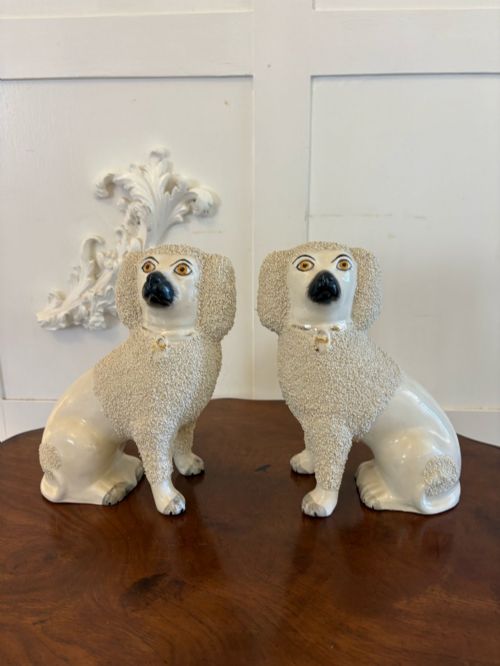
These ceramic fireplace dogs are quintessential Victorian mantelpiece ornaments that bring traditional character and symmetry to a hearth.

Ceramic Fireplace Dogs
These ceramic fireplace dogs take the form of paired mantel ornaments depicting various canine breeds, most notably spaniels, poodles, greyhounds, pugs, and hunting dogs with hares. They emerge predominantly from the Victorian period, spanning decades from the mid-nineteenth century through to nineteen hundred.
The version most commonly met on this page is the classic seated pair, designed to sit facing one another at either end of a mantelpiece or hearth. These ornamental figures reflect nineteenth-century domestic tastes and frequently appear in traditional Staffordshire pottery styles.
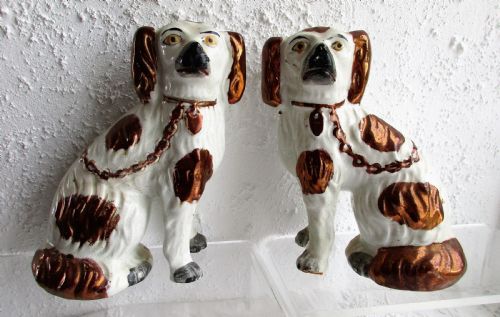
Collectors encounter groupings ranging from simple pairs to larger collections of four or five figures. They span various colourations including plain white, white with gilt highlights, black and white, red and white, and rich copper lustre.
Materials and construction
Certain later nineteenth-century figures incorporate specific manufacturing details such as inserted glass eyes, adding a lifelike quality to the ceramic surface. Copper lustre finishes provide a metallic sheen across the earthenware body, marking a distinct decorative technique seen in several pairs.
Ceramic Fireplace Dogs Retail Price Guide 2026
Typical asking prices for ceramic fireplace dogs among the pieces listed under this phrase on Sellingantiques today, from the lower quarter to the upper quarter. They describe what is for sale here now, not the wider market.
Some nineteenth-century spaniels peer back at the room with startlingly realistic glass eyes fitted directly into their ceramic heads.
Assessing quality in fireplace dogs
The visual impact of a matched pair depends on uniform sizing, balanced posture, and the depth of the glaze. Richer surface treatments, such as copper lustre or well-preserved gold leaf, elevate the overall execution of the ceramic figure.
The Ceramic Fireplace Dogs Glossary
- Earthenware
- A porous pottery body fired at relatively low temperatures, forming the structural base for these figures. It requires a glaze to become impervious to liquids.
- Copper Lustre
- A metallic glaze technique producing a warm, reflective copper-coloured sheen over the ceramic surface. It was widely utilised on nineteenth-century pottery.
- Lead Glaze
- A glossy coating applied to ceramic bodies before firing, containing lead compounds to create a smooth, shiny finish. This treatment protects the underlying earthenware.
- Comforter spaniel
- A traditional term for Staffordshire pottery spaniels modelled as household pets and mantel ornaments. They were traditionally placed on either side of a fireplace.
Ceramic Fireplace Dogs: Frequently Asked Questions
What are fireplace dogs used for?
These ceramic figures serve primarily as decorative ornaments intended to sit on a mantelpiece or hearth. Historically, they were displayed as symmetrical pairs framing a fireplace.
Beyond their traditional hearth placement, collectors display them on shelves and sideboards to introduce Victorian character into a room.
How do I identify Victorian pieces?
Victorian pieces typically display characteristic nineteenth-century moulding styles, traditional glazing techniques, and specific canine subjects like spaniels and greyhounds. Examining the weight, clay body, and hand-painted details helps determine the era.
Many examples feature distinct Victorian country pottery aesthetics, including copper lustre finishes and gold leaf accents.
Are these dogs always found in pairs?
While many examples are sold as matched pairs designed to face each other, listings also include larger collections of four or five figures. Pairs remain the most frequent configuration.
Collectors often seek out original pairs to maintain the traditional symmetry intended by the nineteenth-century makers.
What breeds are represented?
The figures predominantly depict spaniels, including the well-known comforter spaniels, alongside poodles, greyhounds, and pugs. Some examples also portray hunting dogs accompanied by hares.
Each breed reflects the popularity of specific household and sporting animals during the nineteenth century.