
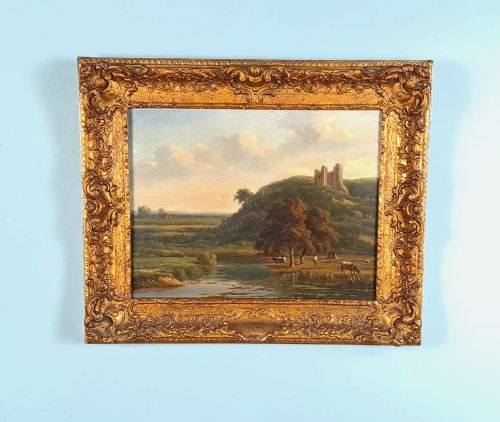


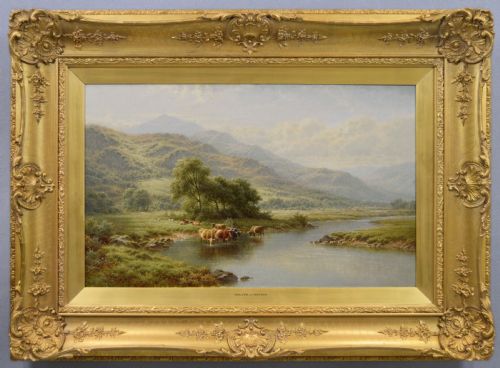

Cattle River Landscape
A cattle river landscape brings together pastoral rural scenes and waterways, capturing herds resting or watering in oil paintings and watercolours.
Cattle River Landscape
A cattle river landscape presents pastoral views of the British countryside, often showing cows or calves near streams, riversides, or valleys.
These works typically date from the nineteenth century into the early twentieth century, spanning Victorian and Edwardian periods.
Common formats include framed oil paintings on canvas or board, alongside detailed watercolours on paper.
How They Were Made
Artists applied oil paint to stretched canvas, wood panels, or milk glass, building up rich textures and pastoral light.
Watercolour painters worked on paper, often employing subtle washes to capture atmospheric river valleys and misty morning light.
Finished works found their homes inside carved and gilded wooden frames, gesso frames, or period swept frames.
Common regional subjects include Welsh river valleys, Scottish highlands, and pastoral meadows across rural English counties.
What Varies in Quality
Skill in handling natural light and water reflection distinguishes accomplished painters from more formulaic practitioners.
The anatomical rendering and positioning of animals within the broader topography reveal the hand of a trained artist.
Original frames matching the period of the painting add considerable integrity to the piece.
T C Hofland·William Sydney Cooper·Thomas Hunn·George Vicat Cole·Sidney Richard Percy·Robert Thorne Waite·Alfred Grey·Harold Lawes·Thomas Baker·Claude Cardon·William Traies·Henry Cheadle·Henry Birtles·Walter J Watson·Henry John Kinnaird·Alfred de Breanski·Thomas Pyne·Thomas Thomas·Thomas E Francis·Thomas Sidney Cooper·Etty Horton·Owen Bowen·Cornelius Pearson·Thomas Francis Wainwright·Fredrik Borgen
The Cattle River Landscape Glossary
- Oil on Canvas
- Pigment mixed with drying oil applied to a woven cloth stretched across a wooden frame. This medium allowed artists to achieve deep, luminous colours and rich surface textures.
- Watercolour
- Pigments suspended in a water-soluble vehicle applied to paper. It produces translucent washes prized for capturing light and atmospheric effects in rural scenes.
- Gesso
- A plaster-like mixture applied to wood or canvas as a base for painting or moulded onto wooden frames before gilding. It provides a smooth, stable surface for decorative details.
- Giltwood
- Wood that has been coated with a thin layer of gold leaf or gilt powder. These frames were often ornately carved to complement pastoral artwork.
- Stretcher
- The wooden frame that holds a canvas taut. Inscriptions found on this wooden support often reveal artist names, dates, or titles.
Cattle River Landscape: Frequently Asked Questions
Where were these painted?
Many scenes depict specific British and Welsh waterways, including the River Stour, Dartmoor, and the Wye Valley.
Artists frequently travelled to rural pastures to capture herds grazing near rivers and local bridges.
How do I date a piece?
Stylistic shifts and framing clues help narrow down the period, moving from early nineteenth-century Romanticism toward Edwardian pastoral naturalism.
Signatures, stretcher inscriptions, and artist biographical dates often provide definitive confirmation.
Are watercolours fragile?
Works on paper require protection from direct sunlight to prevent the pigments and paper support from fading over time.
Proper framing behind glass with acid-free mounts preserves the integrity of these delicate river scenes.
What is pastoral art?
Pastoral art romanticises rural life, focusing on harmonious interactions between herdsmen, livestock, and tranquil river landscapes.
This genre gained immense popularity during the Victorian era as a peaceful antidote to industrialisation.