


Cattle Landscape Watercolour
When you collect a cattle landscape watercolour, you bring home a pastoral scene of rural life from the nineteenth and early twentieth centuries.
Cattle Landscape Watercolour
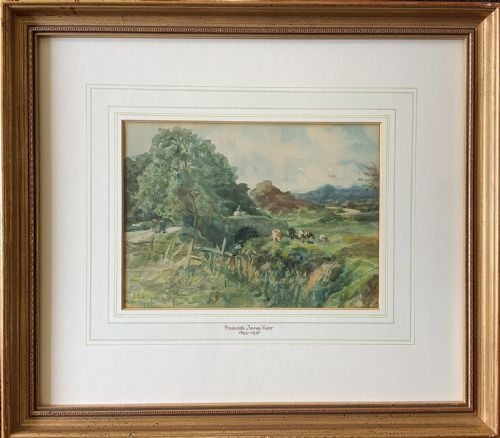
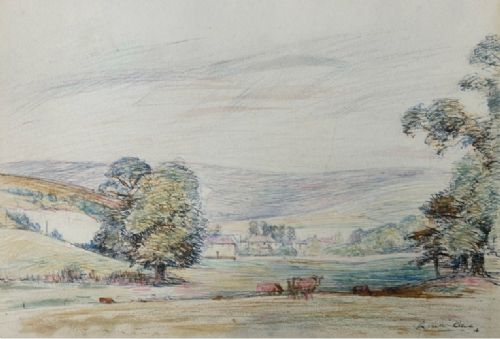
A cattle landscape watercolour depicts cows, bulls, or longhorns grazing in fields, watering in rivers, or driven along country lanes by herdsmen. These framed artworks record rural scenes from nineteenth-century Victorian studies to early twentieth-century British pastoralism.
The works on this page span the Victorian period through to the 1940s, capturing the changing moods of the countryside from Welsh valleys to Scottish highlands. Painters utilised paper as their primary support, applying pigment to render atmospheric light over pasture and livestock.
How they were made
Artists applied watercolour pigment onto paper, sometimes combining bodycolour or gouache to build opacity in the cattle and foreground details. Washes created the soft skies and distant hills characteristic of British landscape traditions.
Makers framed these paintings in wood, occasionally using gilt wood or burr frames to complement the tones of the pastoral scene. Gold leaf accents sometimes highlighted the inner mounts of Victorian presentations.
The archive spans the Victorian period, 1850, 1890, 1900, 1920, 1930, and 1940.
What varies in quality
The handling of light and atmospheric depth distinguishes accomplished pastoral paintings from stiffer topographical records. Master painters captured the natural movement of beasts of burden and the shifting weather over English and Scottish valleys.
The preservation of the paper support and the vibrancy of the pigment determine the longevity of the piece. Contemporary framing in original wood or gilt surrounds enhances the integrity of the surviving artwork.
Thomas Sidney Cooper·Henry John Kinnaird·Cornelius Pearson·Thomas Francis Wainwright·Anthony Vandyke Copley Fielding
The Cattle Landscape Watercolour Glossary
- Watercolour pigment
- Finely ground colour mixed with a water-soluble binder, applied in washes to paper. It creates translucent effects suited to shifting skies and rural light.
- Gouache
- An opaque watercolour paint containing pigment mixed with a binding agent and white filler. Artists used it to add solid highlights to cattle and figures.
- Pastoral realisim
- An artistic style focused on authentic depictions of rural life and agricultural landscapes. It dominated British painting through the Victorian era.
- Bodycolour
- Watercolour mixed with Chinese white to increase opacity. This technique allowed painters to build heavier impasto in foreground details.
Cattle Landscape Watercolour: Frequently Asked Questions
How should I hang a vintage watercolour?
Keep watercolours away from direct sunlight to prevent the pigment from fading over time. UV-filtering glass provides essential protection for antique paper works.
Choose interior walls with stable humidity levels to protect both the paper support and the original wood or gilt frame.
What subjects appear alongside cattle?
Artists frequently placed herdsmen, milkmaids, or figures tending livestock near rivers, bridges, and country lanes. Rural architecture such as cottages, churches, and ruined castles often anchors the background.
Sheep and horses also share the pasture in many pastoral compositions from the Victorian period.
How do I identify a Victorian pastoral painting?
Victorian watercolours typically feature detailed studies of longhorn or highland cattle rendered in naturalistic tones. The palette often relies on earthy greens and browns under soft overcast skies.
Signatures, dates, and framing styles frequently help anchor the piece to the nineteenth or early twentieth century.
Are these paintings original artworks?
Every piece listed is an original painting created by hand on paper rather than a modern reproduction. Artists signed many of these works, while others remain attributed to known schools or periods.
Original frames from the Victorian or Edwardian eras frequently accompany the paintings.