


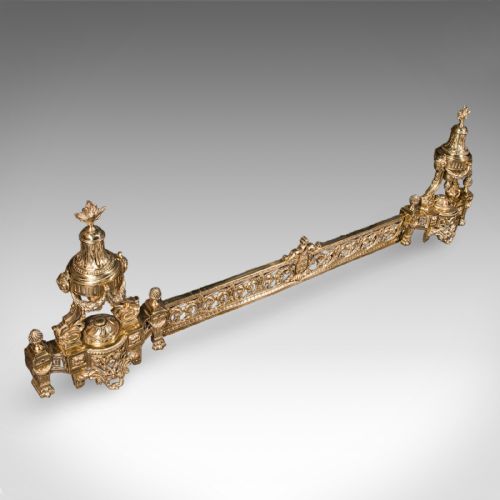
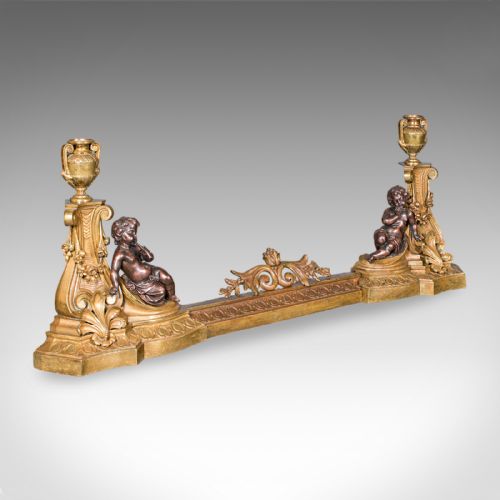


Cast Brass Fire Fender
These cast brass fire fenders protect hearths while framing coal fires with period weight and polish.
Cast Brass Fire Fender
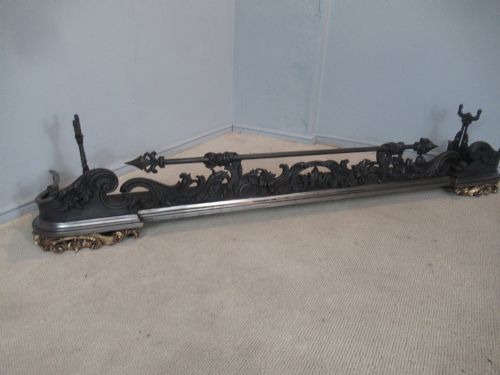
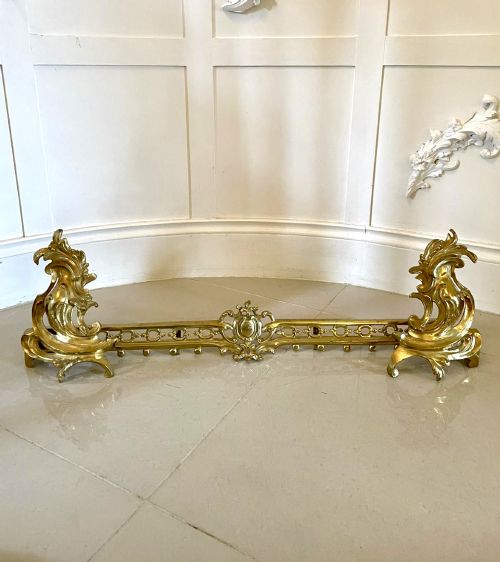
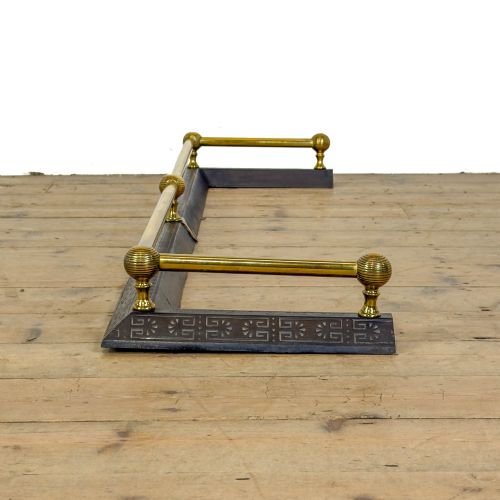
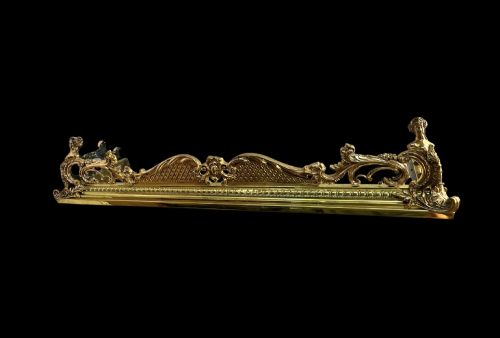
A cast brass fire fender sits upon the hearth to keep embers contained within the grate. These pieces take various forms including adjustable kerbs, curved hearth barriers and ornate extension pieces.
The versions met on this page span the Victorian and Edwardian eras, alongside pieces dated around 1860, 1880, 1890 and 1900. English and French origins predominate, appearing alongside French Rococo, Louis XV, French Empire and Art Nouveau styles.
Many examples incorporate extending mechanisms to fit different fireplace widths. Others combine cast brass with cast iron, bronze or steel to provide substantial weight around the hearth.
Materials and construction
Makers utilised heavy cast brass, bronze and cast iron to build these durable hearth barriers. Components often combine brass structures with iron or steel bases for added stability.
Surface decoration relies on casting techniques to produce scrolled details, garlands and lions. Gilded brass and gilt bronze finishes appear alongside polished metal surfaces.
Cast Brass Fire Fender Retail Price Guide 2026
Typical asking prices for cast brass fire fender among the pieces listed under this phrase on Sellingantiques today, from the lower quarter to the upper quarter. They describe what is for sale here now, not the wider market.
One nineteenth-century steel club fender originates specifically from the prominent In & Out Club.
Judging quality
Quality rests upon the gauge of the metal and the crispness of the cast decoration. Heavy gauge brass and well-defined garlands separate substantial examples from lighter pieces.
The complexity of the style, from French Rococo scrolls to simple Victorian curbs, dictates the depth of workmanship. Intricate extending mechanisms and fully restored frames also distinguish the work.
The Cast Brass Fire Fender Glossary
- Kerb
- A low barrier placed around a hearth to contain ashes and stray coals. This serves as an alternative term for a fire fender.
- Club fender
- A low, padded-seat fireplace fender that allows people to sit close to the fire. These often feature iron and brass construction.
- Extending fender
- A hearth barrier designed with sliding sections to adjust in width. This mechanism allows the piece to fit varying fireplace openings.
- Gilt bronze
- Metal alloy treated with a gold-coloured finish or gold leaf layer. This treatment provides a rich decorative surface on French period pieces.
- Rococo revival
- A nineteenth-century design style mimicking the flowing curves and asymmetrical scrolls of the eighteenth century. This aesthetic appears frequently on ornate Victorian and French hearth accessories.
Cast Brass Fire Fender: Frequently Asked Questions
What is a cast brass fire fender?
A cast brass fire fender is a hearth accessory designed to prevent hot coals and embers from rolling onto the floor. These heavy metal barriers sit directly in front of the fireplace.
They appear in various styles ranging from simple nineteenth-century curbs to ornate French Rococo and Art Nouveau designs. Many incorporate extending mechanisms or paired materials like cast iron and bronze.
How do you use an extending fender?
An extending fender adjusts in width to fit the exact dimensions of your fireplace hearth. The sliding sections pull apart or push together to span the opening.
Position the fender squarely on the hearth floor in front of the grate before lighting the fire. Ensure the metal barrier rests securely to catch any stray embers.
How do I date a Victorian brass fender?
Dating a Victorian brass fender involves examining the weight, construction methods and stylistic motifs. Pieces from this era often feature heavy gauge brass, cast iron internal components and specific dates or registration marks.
Stylistic influences also provide clues, as mid-century pieces lean towards French Rococo Revival whilst later examples adopt Art Nouveau lines. Comparing the complexity of the casting and any extending mechanisms helps narrow the decade.
What is the difference between a fender and a fireguard?
A fender is a low barrier that sits flat on the hearth around the base of the fire. Its primary role is containing coals and framing the fireplace opening.
A fireguard stands taller to block flying sparks from reaching the room. Some nineteenth-century pieces combine both functions into a single brass and steel guard structure.