



Cased Travel Clock
A cased travel clock is a portable timepiece housed in protective leather, metal or fitted cases, prized by collectors for precision mechanics and compact elegance.
Cased Travel Clock
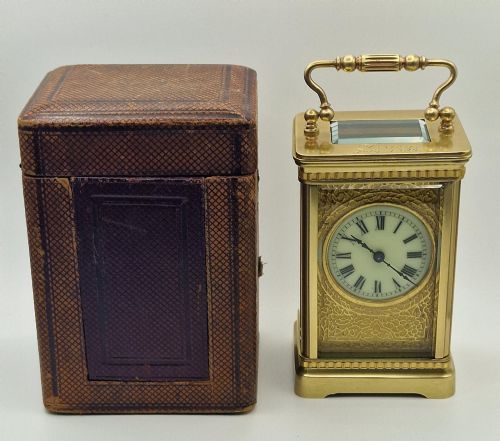
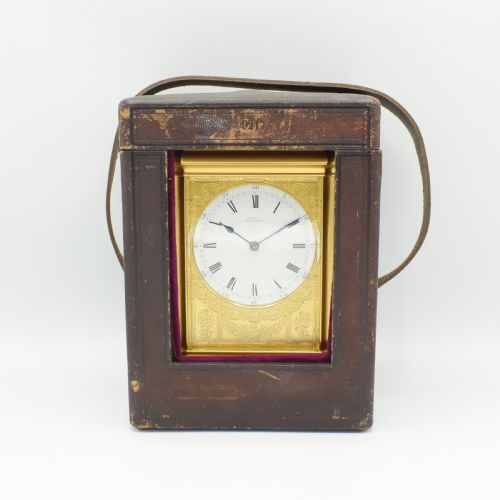
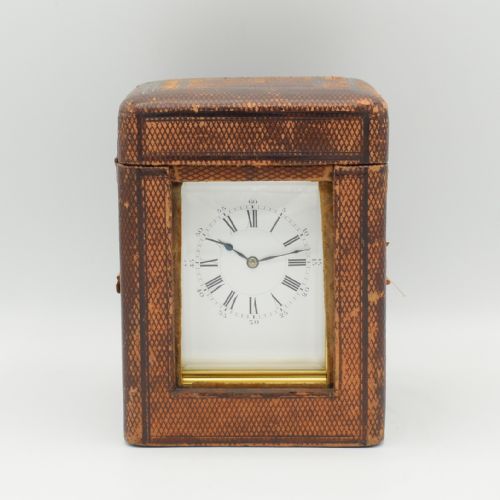
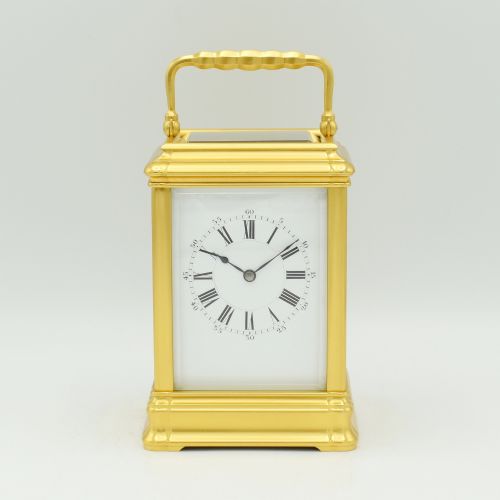
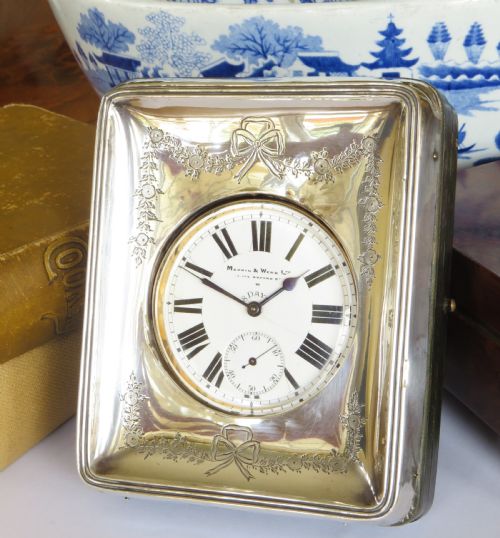
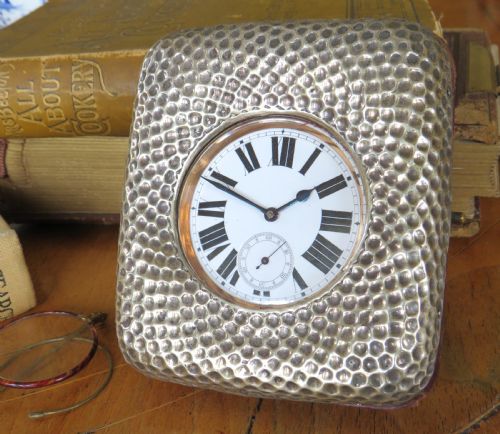
A cased travel clock represents a mechanical timekeeper designed to be moved safely, frequently taking the form of heavy brass carriage clocks accompanied by original leather travel cases. These objects span periods from the mid-nineteenth century through the Edwardian era, with French and English makers producing robust pieces intended for journeys.
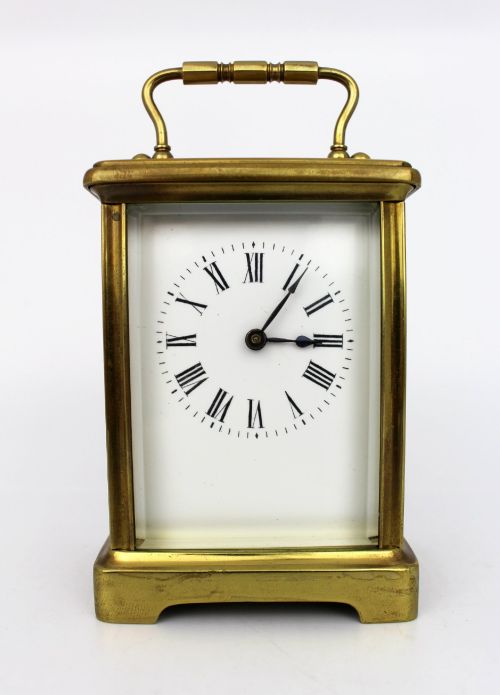
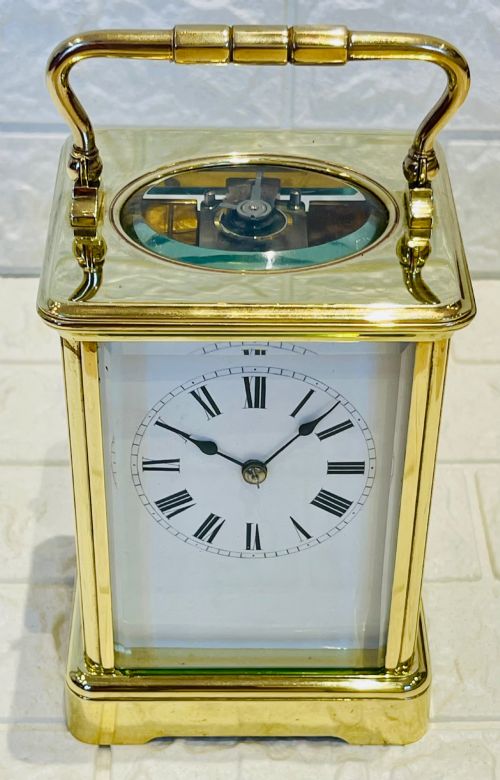
The most common examples on this page are brass and gilt brass carriage clocks featuring glass panels that reveal the escapement, often preserved in fitted leather outer cases. Victorian and late nineteenth-century pieces dominate, combining utility with ornamental dial engraving and subsidiary alarm functions.
Buyers encounter variations ranging from miniature bedside timepieces to giant gorge-cased striking clocks, each utilising mechanical movements ranging from simple timepieces to complex repeating and sonnerie mechanisms.
How they were made
Clockmakers constructed these housings predominantly from heavy brass, gilded brass, and cast bronze, frequently housing movements within stepped gorge frames or solid plates. Silver and chrome-plated metals appear alongside glass panels that permit direct observation of the internal gear trains and escapements.
Outer travel cases relied upon sturdy wood foundations wrapped in grained leather, lined with velvet or silk to cushion the portable clock during transit. Metalwork often involved fire gilding, hand engraving, and champlevé enamel decoration applied to dials and mask plates.
The documented pieces span from the mid-nineteenth century Victorian period through the Edwardian era and into Art Deco designs.
What varies in quality
Quality separates through the complexity of the internal movement, distinguishing a simple time-only piece from a grand sonnerie or repeating mechanism with alarm functions. Finer examples display crisper hand engraving on the brass mask and case, alongside signed backplates from notable makers.
The survival of the original leather travel case and matching box heavily influences desirability and historical integrity. Superior pieces retain original gilding, unbroken bevelled glass panels, and robust Swiss or French platforms that maintain accurate timekeeping.
Henri Jacot·Drocourt·Mappin and Webb·Antoine Redier·Margaine·Jaeger LeCoultre
The Cased Travel Clock Glossary
- Gorge case
- A distinct rectangular brass case style featuring stepped mouldings at the top and base. This housing design became standard for high-grade carriage clocks during the nineteenth century.
- Striking mechanism
- A mechanical train that sounds the hours and half-hours on a gong or bell. More complex versions include repeating functions that restrike the last hour upon command.
- Escapement
- The internal mechanism that controls the unwinding of the mainspring by delivering impulses to the balance wheel. Platform escapements replaced pendulum setups to allow portable clocks to function while moving.
- Sonnerie
- A complication that automatically strikes the hours and quarters as they pass without requiring manual activation. Petit sonnerie strikes quarters on the quarter-hour and hours on the hour, while grande sonnerie strikes both at every quarter.
- Platform
- A small, self-contained module holding the balance wheel, hairspring, and escapement. This assembly sits visibly on top of the movement in high-grade carriage clocks.
Cased Travel Clock: Frequently Asked Questions
What is a carriage clock?
A carriage clock is a small, spring-driven portable timepiece designed for travellers during the nineteenth century. They typically feature heavy brass frames with glass panels and a folding handle on top.
Most houses include an escapement visible through the top glass, allowing the owner to monitor the balance wheel while the clock operated inside its protective leather case.
How do you wind a travel clock?
Winding requires a dedicated key inserted into square arbors located on the underside or backplate of the movement. Turning the key clockwise tensions the mainsprings that drive the time, strike, and alarm trains.
Care must be taken not to overwind the springs, stopping the rotation the moment resistance increases firmly.
How do I date a travel clock?
Dating relies upon stylistic clues in the case architecture, dial signatures, and escapement type. Early nineteenth-century examples often use simpler platform designs, while late Victorian pieces adopted more refined lever escapements and specific maker marks on the movement plates.
The presence of original leather outer cases and retailer stamps also helps narrow the production window to specific decades.