
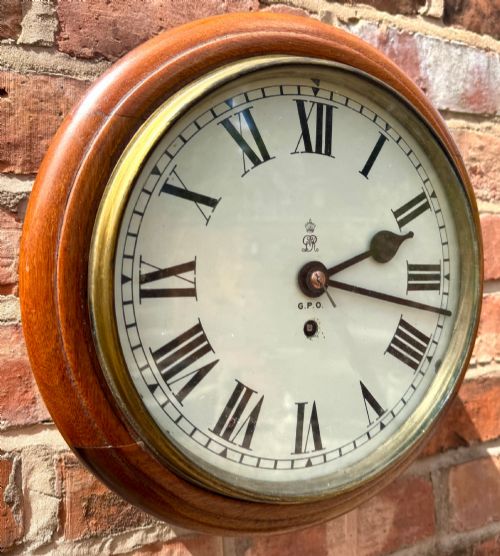
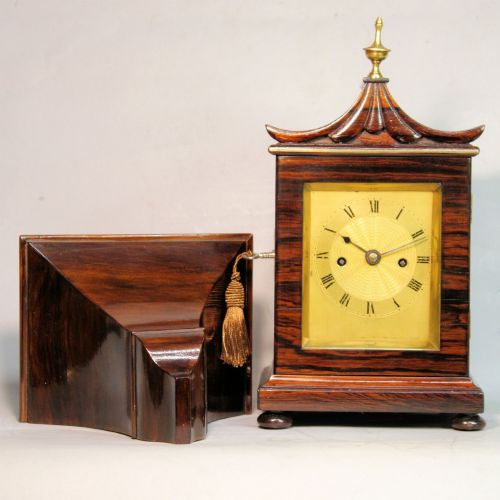
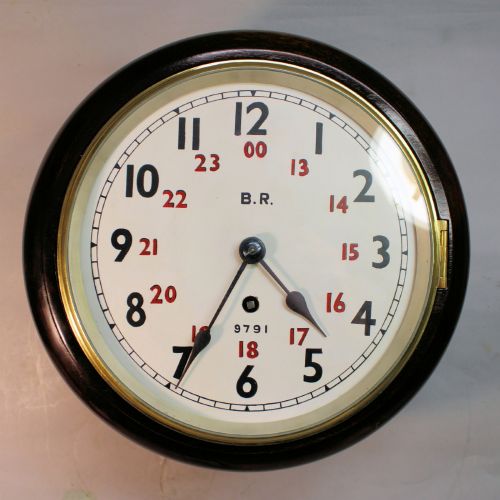


Cased Fusee Wall Clock
A cased fusee wall clock combines precision timekeeping with architectural timber framing, built to regulate public spaces and private rooms alike.
Cased Fusee Wall Clock
When you search for a cased fusee wall clock, you are looking at timepieces driven by a fusee movement contained within a wooden or brass enclosure. These clocks were essential for keeping accurate time in public offices, railway stations, and homes across Britain.
The versions you are most likely to meet on this page date from the 18th century through to the mid 20th century, spanning Georgian, Victorian, Edwardian, and George V periods. They appear in distinct formats such as drop-dial, drum-dial, octagonal, and standard round wall cases.
Makers housed these movements in robust timber housings designed to be hung securely on walls. The styles reflect the utilitarian or decorative demands of their era, from simple railway office clocks to refined rosewood and mahogany examples.
How they were made
Craftsmen built the housings using solid hardwoods including mahogany, oak, rosewood, and walnut, fitted with glass doors and brass bezels. These timbers provided the structural stability needed to protect the delicate internal mechanism from atmospheric changes.
The fusee movement itself utilises brass, steel, and silvered brass components arranged to equalise the declining power of the mainspring as it unwinds. This mechanical arrangement ensures steady force is delivered to the escapement for accurate timekeeping.
The styles represented span Georgian, Regency, Victorian, Edwardian, George V, 1930s British Military, and 1940s periods.
What varies in quality
Quality in these clocks rests upon the precision and finish of the fusee movement and the selection of the timber case. Finer examples display crisp engraving on silvered brass dials, clean wheel-cutting within the movement, and carefully selected mahogany or rosewood veneers.
The grade of the clock often aligns with its intended destination, whether a standard railway office or a refined domestic library. Superior pieces maintain original components and retain clear maker signatures on the dial or movement.
L Morris Islington·Peter Debaufre·Joyce of Whitchurch
The Cased Fusee Wall Clock Glossary
- Fusee
- A conical pulley used in mechanical clocks to equalise the torque of the mainspring as it runs down. This device ensures consistent power is delivered to the gear train.
- Drop-dial
- A clock case featuring a circular dial at the top above a short trunk or drop box below. This shape accommodated the descending pendulum or extra weight train.
- Verge
- An early type of escapement used in timepieces before the anchor escapement became common. It works with a crown wheel to regulate the speed of the clock.
- Silvered brass
- A brass dial plate treated with a silver compound to produce a bright, legible metallic surface. The numerals and markings are typically dark-filled for clarity.
- Chapter ring
- The separate ring on a clock face that bears the hour numerals. In some dials, this is applied as a distinct ring rather than being painted directly onto the metal plate.
Cased Fusee Wall Clock: Frequently Asked Questions
How do fusee clocks work?
A fusee clock uses a conical pulley connected to the mainspring via a cord or chain. As the spring unwinds, the leverage changes to maintain even tension on the gear train.
This mechanical cleverness compensates for the decreasing power of an uncoiling spring, keeping the timekeeping steady.
Where were these clocks used?
These clocks hung in railway stations, government offices, military installations, and private homes. Their robust construction suited spaces that required reliable timekeeping.
Railway companies and the GPO relied on them to keep operations running to a strict schedule.
How do I date a wall clock?
Dating relies on case styles, timber choices, dial materials, and maker signatures. Georgian and Regency pieces often feature specific cabinet work, while Victorian and Edwardian examples show different dial treatments.
Matching the movement type with the case style provides a reliable window of manufacture.
How should I hang a wall clock?
Mount the clock securely to a solid wall using appropriate fixings that can support the weight of the hardwood case and heavy movement. Ensure it hangs level so the pendulum swings evenly.
A stable wall prevents vibrations that might interfere with the beat of the escapement.