


Carved Wooden Folding Chair
These carved wooden folding chair pieces offer portable seating across diverse historical styles.
Carved Wooden Folding Chair
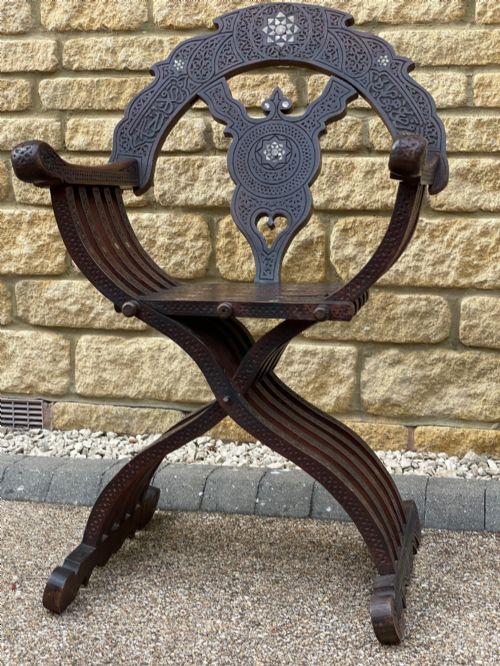
A carved wooden folding chair combines practical mobility with decorative ambition, spanning regional traditions and European revival styles. You will encounter forms ranging from Syrian and Indian iterations to Victorian library steps and campaign designs.
The selection on this page leans heavily into nineteenth-century production, featuring oak, walnut, and teak woods alongside intricate inlay work. Metamorphic library chairs and Savonarola designs dominate the offerings, serving both domestic and study spaces.
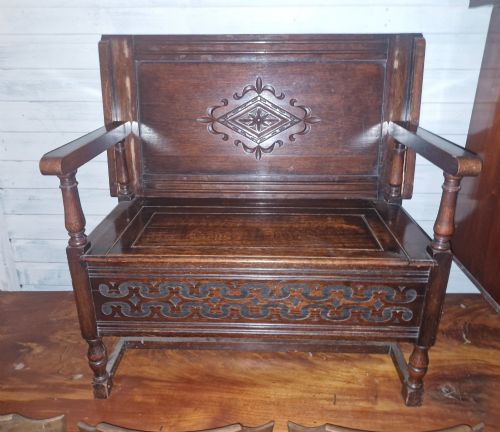
Makers drew on Gothic Revival, Arts and Crafts, and Middle Eastern vocabularies to decorate these frames. Whether configured as a hall seat or a campaign chair, each piece folds compactly while retaining a distinct sculptural presence.
How they were made
Carpenters utilised solid timbers such as oak, walnut, teak, and mahogany, shaping structural elements through sawing, turning, and joinery. Pierced carving on crest rails and frame components provides much of the primary surface ornament.
Intricate ornamentation relied on contrasting materials, incorporating mother-of-pearl, bone inlay, and brass fixtures into the wooden armature. Metamorphic variants incorporated clever mechanical hinges and pivots to transform from seating into library steps.
Listings feature nineteen-century production predominantly, spanning oak, walnut, teak, and mahogany frames.
What varies in quality
Quality rests upon the crispness of the hand-carved detail and the precision of the inlay work, where tight fitting distinguishes finer examples. The structural integrity of the folding mechanism and the smoothness of its operation dictate everyday utility.
The choice of timber and the complexity of the design, such as metamorphic library steps or multi-material bone and mother-of-pearl decoration, elevate the ambition of the piece. Preservation of the original surface patination remains vital to the overall character.
The Carved Wooden Folding Chair Glossary
- Savonarola chair
- A type of X-frame folding chair originating in the Italian Renaissance, characterised by multiple intersecting curved slats. Nineteenth-century revivals often incorporated heavy carving and Middle Eastern motifs.
- Metamorphic furniture
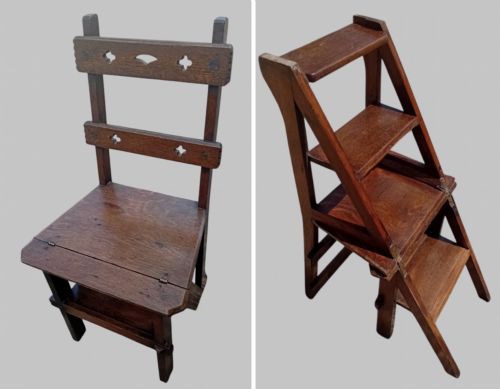
- Pieces designed to transform from one furniture form into another, such as an armchair converting into a flight of library steps. This engineering demanded precise hinges and robust wooden framing.
- Campaign chair
- Portable folding furniture built for travel, typically constructed from durable woods like walnut or mahogany with brass hardware. They allowed officers and travellers to pack seating flat.
- Bone inlay
- A decorative technique where small pieces of bone are set into recesses carved into the wooden surface to form geometric or floral patterns. It frequently appears alongside mother-of-pearl on Middle Eastern and Asian pieces.
Carved Wooden Folding Chair: Frequently Asked Questions
How do folding library steps work?
These metamorphic library chairs operate through hinged wooden frames that pivot outward to reveal a sturdy flight of steps. Users simply unfold the upper back and seat sections to transition the piece from a chair into a functional ladder.
Such dual-purpose designs suited compact nineteenth-century libraries where floor space was at a premium. The mechanical joints require careful handling to ensure smooth movement during transformation.
Where were inlaid folding chairs made?
Many inlaid folding chairs originated in Syrian and Middle Eastern workshops, utilising intricate geometric patterns. Craftsmen combined walnut or other regional woods with mother-of-pearl and bone inlay.
These pieces reflect international trade and nineteenth-century European enthusiasm for exotic furnishings. They bring rich textural contrast to contemporary interiors.
Are these chairs suitable for daily use?
Most antique folding chairs function well for occasional seating when handled with appropriate care. Their folding mechanisms and carved joints reward gentle operation rather than heavy daily strain.
Placing them in low-traffic areas helps preserve fragile inlay and nineteenth-century structural timber. They work particularly well as accent pieces or desk chairs.