
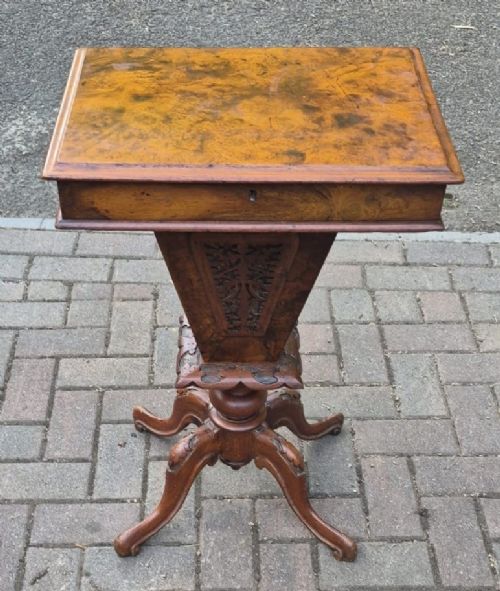


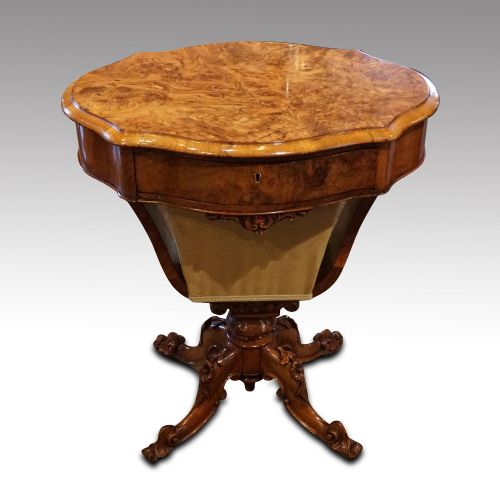


Carved Walnut Worktable
A carved walnut worktable brings the refined utility of the Victorian sewing room straight into a modern drawing room.
Carved Walnut Worktable
A carved walnut worktable is a versatile nineteenth-century piece designed primarily for needlework, writing, and games. Most examples on this page date from the Victorian era, spanning the middle and latter decades of that century.
Forms vary from standard sewing tables and work tables to trumpet workboxes, occasional tables, and games tables. Oval and freestanding formats appear frequently across these listings.
Makers utilised rich timbers and elaborate carving to elevate these functional items into handsome household furnishings.
Materials and construction
Construction relies heavily on walnut and burr walnut timber, prized for its deep tone and striking grain patterns. Cabinetmakers often enhanced these surfaces with fruitwood inlay and wood inlay.
Support structures combine carved and turned timber elements with brass hardware and fabric interiors for sewing compartments. Ceramic components also appear in specific fittings.
Listings span the nineteenth century, capturing Victorian craftsmanship across work tables, games tables, and sewing tables.
Assessing quality
Quality rests upon the selection of timber and the depth of the cabinetmaker's skill. Burr walnut veneers with lively, symmetrical grain figures elevate a piece far above plain timber surfaces.
The sophistication of the carving upon the supports and the precision of any fruitwood inlay distinguish superior workshop production from standard domestic furniture.
The Carved Walnut Worktable Glossary
- Burr walnut
- A prized timber harvested from the warted growths of walnut trees, yielding complex and swirling grain patterns. It forms the primary decorative veneer on better Victorian pieces.
- Trumpet workbox
- A sewing table shaped like an inverted trumpet, featuring an octagonal or circular hinged lid above a flared octagonal basket. This specific silhouette is typical of mid-nineteenth-century design.
- Fruitwood inlay
- The practice of inserting contrasting light and dark fruitwood into carved recesses to create geometric or floral motifs. It adds delicate colour variation to the dark walnut body.
- Freestanding
- A piece finished on all sides so that it looks correct when placed in the centre of a room rather than against a wall. These models command attention from every angle.
Carved Walnut Worktable: Frequently Asked Questions
What is a worktable used for?
These tables served as private workstations for Victorian ladies, housing sewing equipment, threads, and small writing materials inside fitted compartments and under-baskets.
Today, they function as elegant bedside stands, hallway accents, or compact writing desks in smaller modern spaces.
How do I date a walnut worktable?
Dating relies on observing structural details like turned supports, carved pedestals, and the presence of burr walnut veneers typical of the Victorian era.
Specific design cues, such as the trumpet shape or inlaid fruitwood motifs, help narrow the period down to the mid or late nineteenth century.
Are these tables sturdy enough for daily use?
Victorian cabinetmakers built these pieces from solid timber and sturdy veneers designed to withstand active household tasks like sewing and writing.
While they handle everyday modern living well, their fitted interior compartments and delicate inlaid surfaces require gentle treatment.