
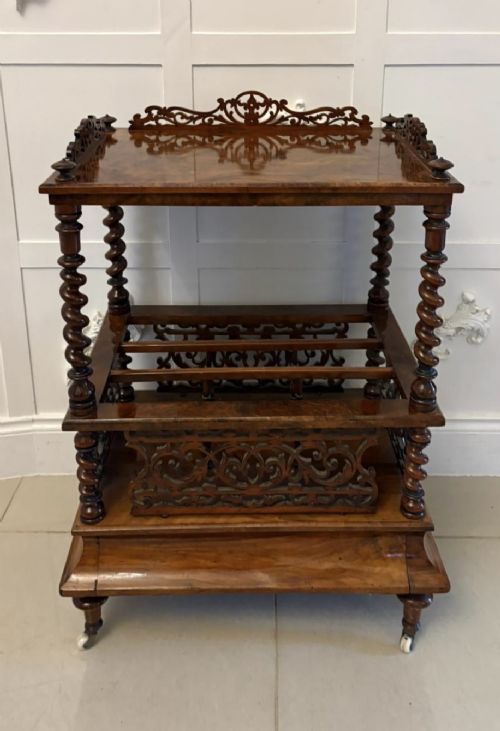
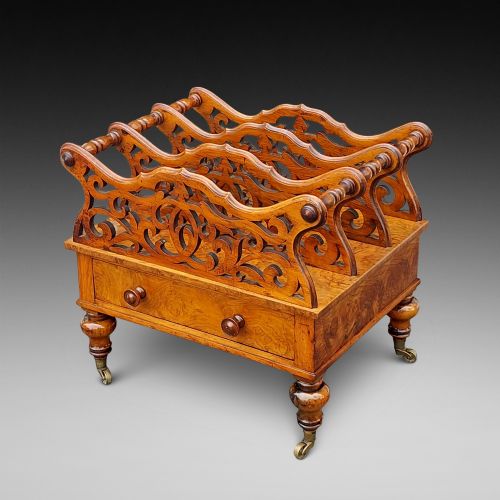
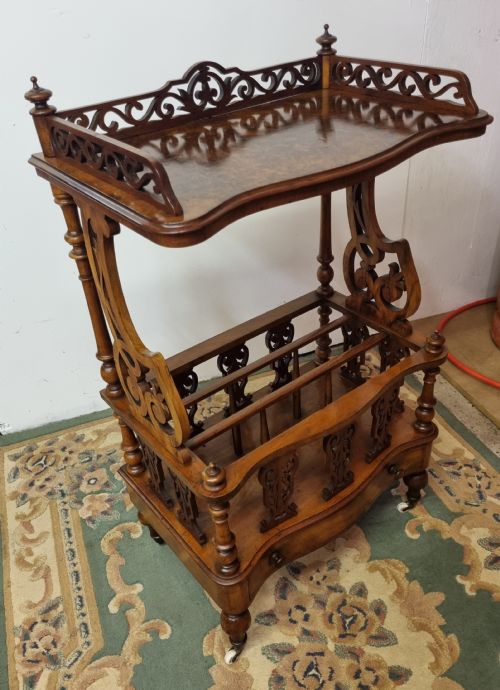
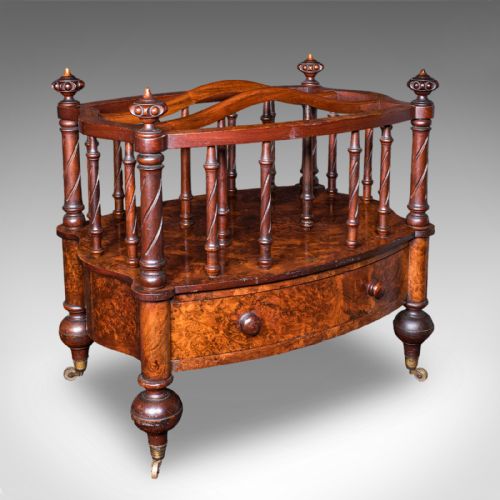


Carved Walnut Sheet Holder
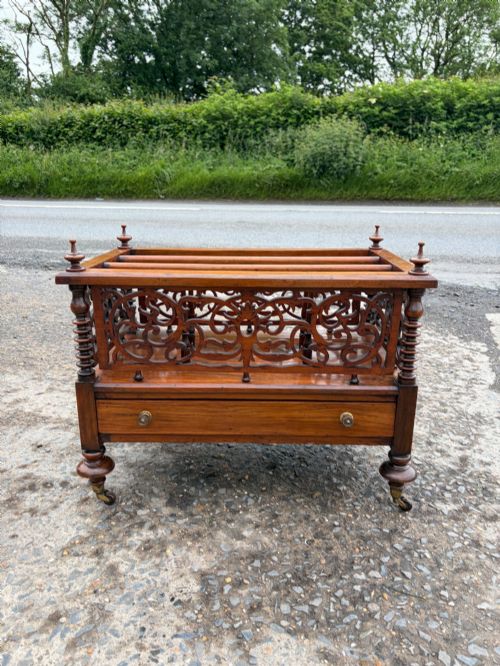
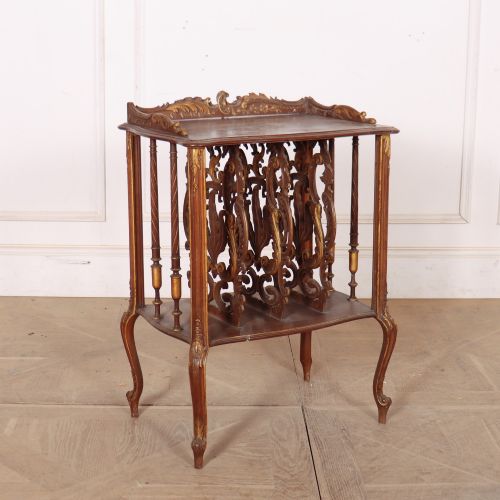
These carved walnut sheet holder pieces are nineteenth-century furnishings designed for organising folios and folios of music, periodicals, and papers in the parlour.
Carved Walnut Sheet Holder
A carved walnut sheet holder typically takes the form of a canterbury, music stand, or magazine rack originating from the Victorian and Regency periods. These furnishings were built to hold sheet music, periodicals, and newspapers close to the piano or seating area in nineteenth-century drawing rooms.
The pieces seen here range from serpentine-shaped canterburys with under-drawers to elaborate duet music stands and Black Forest portfolio racks. Burr walnut and figured walnut provide the predominant timber surfaces, frequently enhanced with inlaid wood and fretwork.
Most examples date from the mid-nineteenth century, around eighteen-fifty to eighteen-seventy, reflecting the domestic musical habits of the Victorian era. Buyers searching for a carved walnut sheet holder encounter versatile occasional tables that combine compartmented storage with decorative woodcarving.
What varies in quality
The distinction between standard production and exceptional work lies in the selection of burr walnut veneer and the crispness of the hand-carved ornamentation. Pieces featuring serpentine forms, substantial proportions, and integrated drawers demonstrate superior cabinet-making ambition.
Refined detailing such as intricate wood inlay, fretwork panels, and original brass or ceramic hardware elevate certain canterburys and music stands above simpler, plain-timber counterparts.
Several pieces include secret under-drawers originally intended to catch stray piano tuning keys and rogue guitar picks.
The Carved Walnut Sheet Holder Glossary
- Canterbury
- A low stand with partitioned uprights for holding sheet music or loose papers, often fitted with a drawer below. This form became a staple of nineteenth-century domestic interiors.
- Burr walnut
- A prized veneer sliced from walnut tree growths, exhibiting swirling, knotty grain patterns. Cabinetmakers utilised this timber for its decorative impact on prominent surfaces.
- Fretwork
- Openwork ornamentation cut from thin wood panels in geometric or botanical patterns. It appears frequently on Victorian canterbury partitions and galleries.
- Serpentine shape
- A undulating outline featuring alternating concave and convex curves along the front edge or sides of a piece. This contour adds movement and visual complexity to cabinetwork.
- Black Forest
- A nineteenth-century carving style originating in Switzerland and Germany, characterised by naturalistic motifs of animals and foliage. Pieces in this manner show deep, three-dimensional foliage and animal figures.
Carved Walnut Sheet Holder: Frequently Asked Questions
What is a canterbury used for?
A canterbury serves as a compartmentalised rack designed specifically to hold sheet music, folios, and periodicals near a piano or seating area. The vertical dividers keep unbound papers upright and accessible in a nineteenth-century drawing room.
Many examples also incorporate a low drawer beneath the partitions for smaller musical accessories or writing materials. This dual function made them essential companions for domestic musical evenings.
How do I identify a Victorian walnut piece?
Victorian walnut furniture typically displays deep brown tones with rich figuring, especially when burr walnut veneer is utilised on the main surfaces. The styling often incorporates nineteenth-century revival motifs such as French Rococo curves or pierced fretwork.
Structural traits like turned wooden supports, brass castors, and integrated drawers help date these furnishings to the mid-nineteenth century. Examining the construction methods inside the under-drawers confirms the period origin.
Can these stands hold modern magazines?
The vertical compartments of a nineteenth-century canterbury accommodate modern magazines and newspapers quite naturally. Their original purpose of holding large sheets of music matches the dimensions of contemporary periodicals.
Placing one beside a modern sofa provides functional storage while introducing period wood grain and carving to the room. The sturdy walnut construction supports everyday handling of modern reading material.