



Carved Timber Lion Sculptures
These carved timber lion sculptures bring formidable presence to a room, spanning centuries of craftsmanship from European walnut figures to Chinese temple guards.
Carved Timber Lion Sculptures
When you search for carved timber lion sculptures, you encounter figures shaped from timber across the seventeenth, eighteenth, and nineteenth centuries, alongside twentieth-century works. These pieces range from architectural elements like newel post finials and wall masks to freestanding statues, bookends, and temple guards.
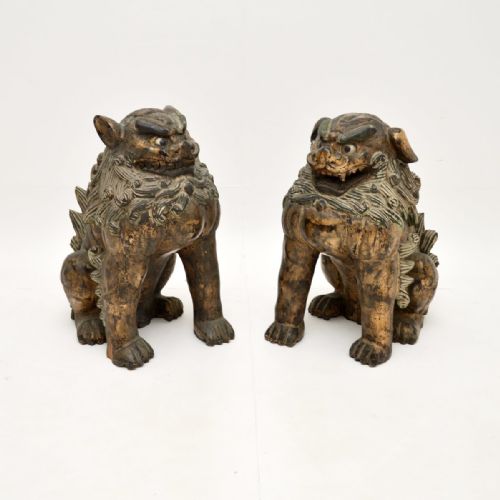
You are most likely to meet nineteenth-century walnut and pine representations, including pairs of Medici lions and Chinese Foo dog statues. The selection also includes specific forms such as tiger heads and Black Forest wall carvings, reflecting diverse regional traditions.
The origins span traditional Chinese craftsmanship and European revival styles, touching upon Gothic Revival, Jacobean, and Georgian aesthetics. Each object serves either a decorative function or a structural role within architectural salvage.
How They Were Made
Many surfaces received applied finishes including gilt, polychrome paint, or dark stains to accentuate the carved grain and detail, while architectural fragments retain the marks of their original structural placement.
Carved Timber Lion Sculptures Retail Price Guide 2026
Typical asking prices for carved timber lion sculptures among the pieces listed under this phrase on Sellingantiques today, from the lower quarter to the upper quarter. They describe what is for sale here now, not the wider market.
Among the guardians stand winged griffins and fierce tiger heads, proving that the carved menagerie extends well beyond standard lions.
What Varies in Quality
The distinction between ordinary and exceptional carving lies in the anatomical precision and depth of relief achieved by the maker, where musculature and facial expression display dynamic tension rather than stiffness.
Condition and integrity dictate the standing of a piece, particularly whether original surfaces like early paint or gilding remain intact beneath later accumulation of wear and age.
LUIGI FRULLINI
The Carved Timber Lion Sculptures Glossary
- Newel Post Finial
- An ornamental carving finishing the top upright post of a staircase. These pieces often take sculptural animal forms.
- Foo Dog
- A traditional Chinese guardian lion statue. They are typically depicted in pairs guarding temple entrances.
- Medici Lion
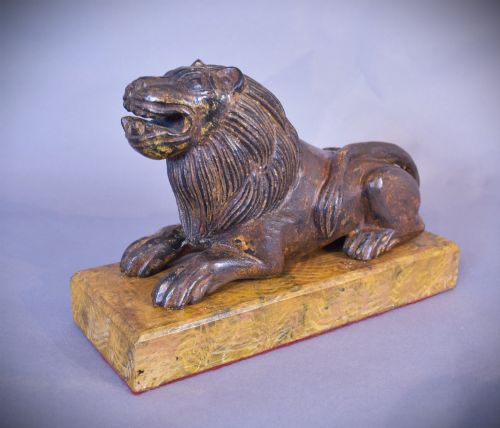
- A representation of the classical marble lions guarding the Villa Medici in Rome. These forms were widely copied during the Grand Tour period.
- Black Forest
- A style of wood carving originating from the mountain region in Germany. It is noted for naturalistic depictions of animals in walnut.
- Wall Mask
- A sculptural relief carving designed to hang flat against a vertical surface. They often feature dramatic facial expressions and mane details.
Carved Timber Lion Sculptures: Frequently Asked Questions
Where were these sculptures placed originally?
Many larger examples served as architectural salvage, positioned on staircases as newel posts or mounted directly onto walls as masks. Others functioned as temple guards or freestanding decorative ornaments within grand interiors.
Smaller items like bookends and pairs of figures were designed for domestic display on mantelpieces or libraries.
How do I care for antique timber sculptures?
Keep wooden sculptures away from direct sources of heat and rapid fluctuations in humidity to prevent the timber from splitting. Dust them gently with a dry, soft cloth without applying modern chemical polishes.
Preserve original surfaces, including early paint or gilt, by maintaining stable indoor environmental conditions.
What is a Grand Tour lion?
Grand Tour pieces are sculptures acquired by travellers visiting cultural sites across Europe during the eighteenth and nineteenth centuries. These timber replicas capture the classical form of the Medici lions found in Italy.
They allowed collectors to bring classical antiquity and academic sculptural style back to British homes.
How do I distinguish Chinese Foo dogs from European lions?
Chinese Foo dogs, or lion dogs, exhibit distinct stylistic conventions including stylized curly manes, broad snouts, and often paw placed upon a ball or cub. European representations follow anatomical traditions derived from classical or Gothic art.
Materials and carving techniques also help separate Asian temple carvings from European walnut or pine pieces.