
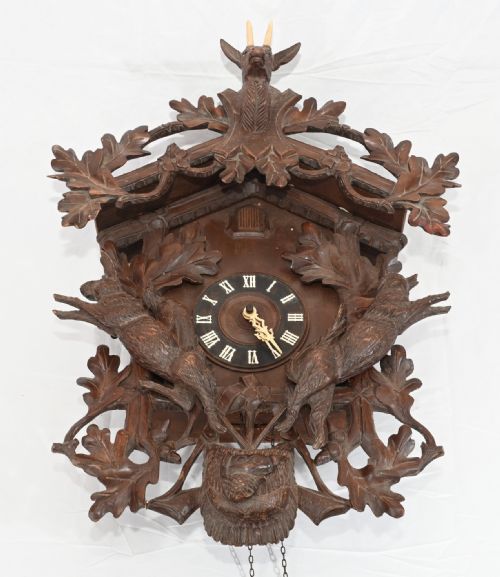


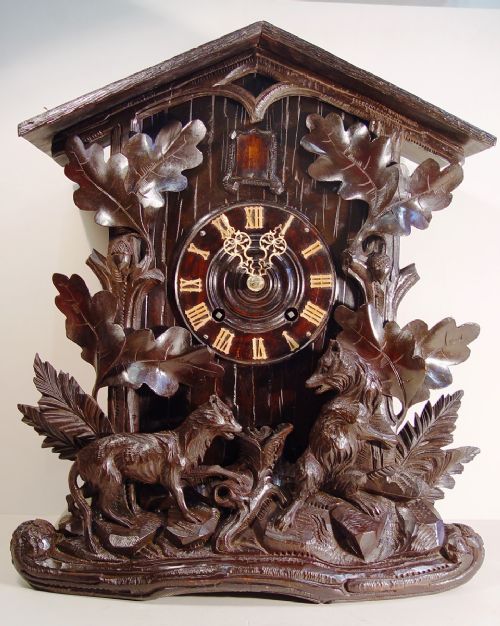
Carved Timber Clock
These carved timber clock pieces bring robust architectural presence and intricate animal carvings into a room, offering both practical timekeeping and striking nineteenth-century decoration.
Carved Timber Clock
A carved timber clock combines heavy wooden cabinetry with detailed sculptural elements, spanning wall-hung regulators, bracket clocks, and mantel pieces. The inventory centres heavily on nineteenth-century Black Forest production, alongside Victorian English bracket clocks and Georgian grandfather clock cases.
Buyers encounter walnut and linden wood constructions most frequently, often decorated with deep relief carvings of animals or architectural Gothic motifs. These objects function equally as reliable timepieces and as prominent focal points for domestic interiors.
Materials and construction methods
Craftsmen utilised dense domestic hardwoods such as walnut, oak, and pale linden wood to construct the heavy carcasses and clock cases. Linden wood provided the ideal pliable medium for the deep, high-relief undercut foliage and animal figures characteristic of the Black Forest tradition.
Movements relied on brass components, while dials incorporated contrasting materials like white ceramic or bone numerals. Glazed doors protected the delicate interior mechanisms and paper or enamel dial faces from dust.
One grand timepiece case is carved to depict an actual king, watching over the hours from his wooden throne.
Distinguishing quality in timber timepieces
Superior examples separate themselves through the crispness and depth of the wood carving, where animal figures and foliate scrolls possess distinct muscle definition and layered relief. Workshops like Beha and Bergen & Co achieved finer articulation in their sculptural timber work than anonymous regional makers.
The integration of the movement into the wooden housing also dictates worth, with high-grade twin fusee movements and signed dials commanding greater attention. Timber selection plays a role, with richly grained walnut and unblemished linden wood marking out the superior tier of production.
Bergen & Co·Connell of London·Beha
The Carved Timber Clock Glossary
- Black Forest
- A style of wood carving and clockmaking originating from the mountainous region of Germany, noted for naturalistic animal and foliage motifs.
- Fusee
- A conical pulley used in spring-driven clocks to equalize the driving force as the mainspring unwinds.
- Linden wood
- A pale, fine-grained timber favoured by nineteenth-century carvers for its uniform texture and resistance to splitting during intricate work.
- Bracket clock
- A portable domestic clock originally designed to sit on a wall bracket or table surface.
- Dial
- The visible face of a clock upon which the hours and minutes are marked.
Carved Timber Clock: Frequently Asked Questions
What is a Black Forest clock?
A Black Forest clock is a nineteenth-century timber timepiece originating from Germany, recognised by its deeply carved wooden case depicting foliage or animals.
These pieces often feature cuckoo mechanisms and elaborate hand-carved pediments using linden wood or walnut.
How do fusee movements work?
A fusee movement uses a conical pulley attached to a cord or chain to regulate the pull of the mainspring.
This mechanism ensures the clock maintains even power and accurate timekeeping as the spring runs down.
Where should I place a bracket clock?
A bracket clock sits securely on a sturdy mantelpiece, sideboard, or dedicated wall shelf at eye level.
Ensure the surface is level to allow the pendulum or movement to operate without obstruction.