
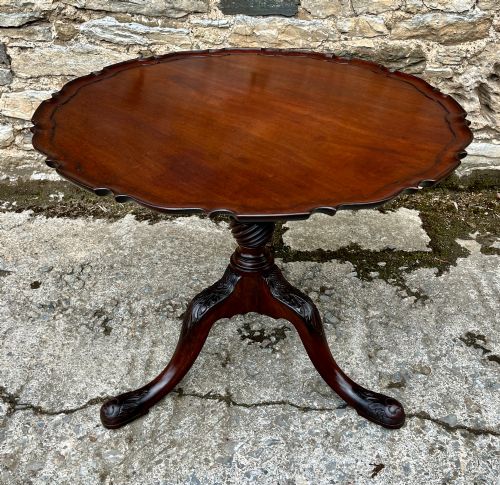
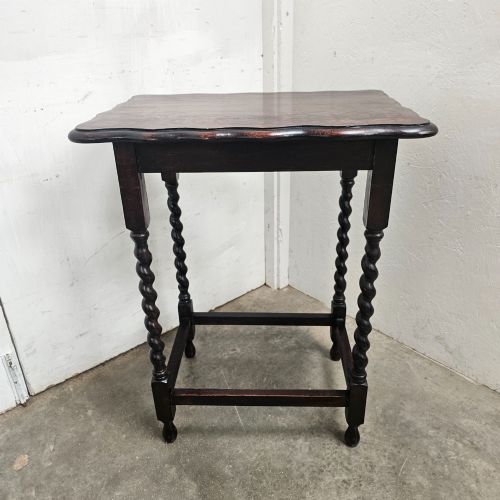


Carved Pie Crust Table
A carved pie crust table brings distinct raised, scalloped edges and period timber work to a traditional sitting room.
Carved Pie Crust Table
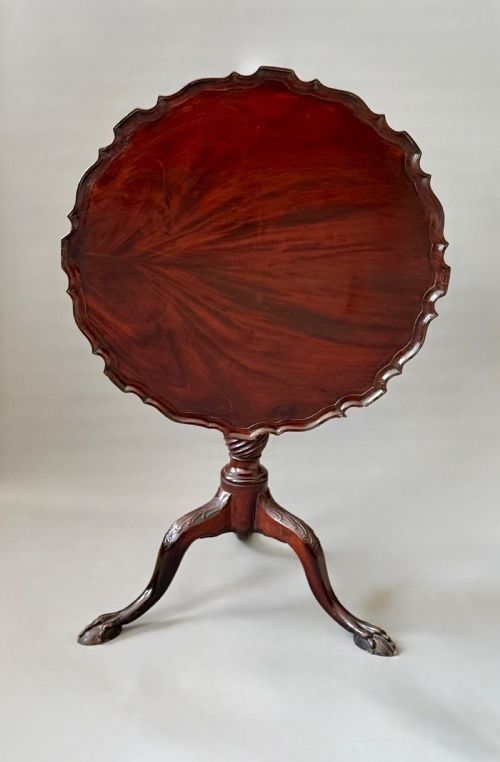
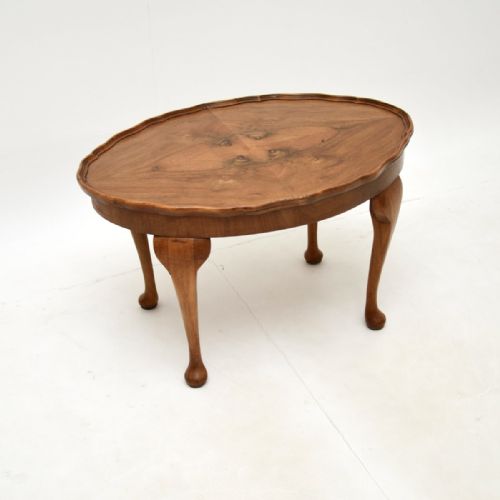
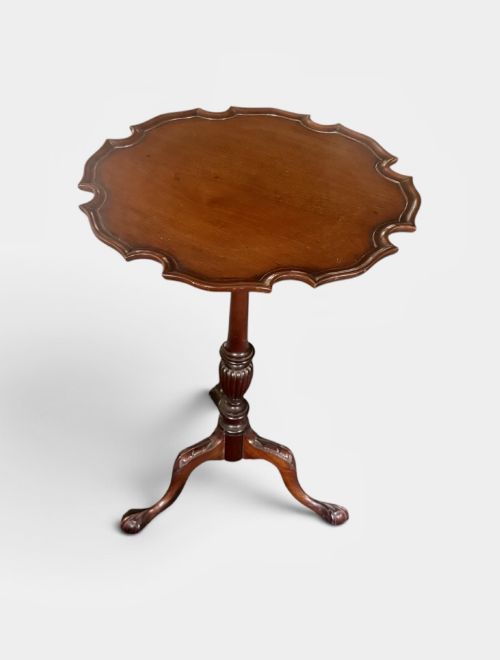
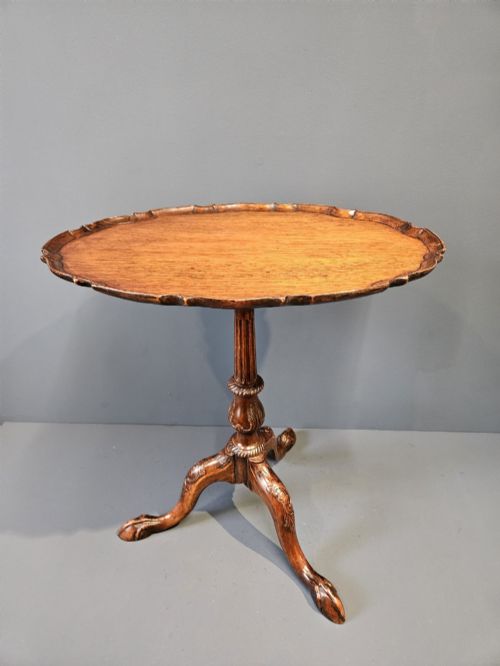
A carved pie crust table is a small occasional or tea table defined by its raised, intricately moulded rim that resembles pastry work. These tables appear in forms ranging from compact wine stands and coffee tables to larger tilt top examples.
The pieces on this page span the eighteenth century through to the early twentieth century, including revival periods like the Edwardian era and the interwar decades. Mahogany and walnut dominate the selection, appearing across tripod bases, occasional tables, and coffee tables.
Buyers are most likely to encounter Edwardian and 1930s walnut or mahogany adaptations alongside genuine eighteenth-century George III originals. Tripod configurations with snap top or tilt top mechanisms are common formats across all periods.
How they were made
Cabinetmakers constructed these tops predominantly from solid mahogany, oak, or walnut, frequently utilising figured walnut veneer on later pieces to create rich surface patterns. The characteristic raised rim required meticulous hand carving from solid timber planks rather than simple turning.
Tripod bases feature slender shaped legs curving downward to pad or claw and ball feet, often joined to a central pillar by way of a birdcage mechanism or tilt top hinge. Joinery relied on traditional mortise and tenon methods alongside finely fitted pivots for the tipping mechanism.
Tea tables were once tipped vertically against the parlour wall to double as decorative wooden panels when tea time ended.
What varies in quality
The crispness and depth of the carved moulding along the rim separate standard production from finer cabinet work. Sharp, well-defined lobes on the pie crust edge demonstrate superior hand chiselling.
Timber selection dictates the visual weight of the piece, with richly figured walnut veneers and dense, old-growth mahogany commanding greater regard than plain timber boards. The proportion between the slender pillar, the spread of the tripod legs, and the diameter of the top determines the overall elegance.
Gillows
The Carved Pie Crust Table Glossary
- Pie crust rim
- A raised, scalloped edge carved directly from the solid timber of the table top. This decorative moulding emulates the crimped crust of a traditional pastry pie.
- Tilt top
- A pivoting table top mechanism allowing the surface to fold vertically when not in use. These are frequently mounted on birdcage frames to save space in smaller parlours.
- Tripod base
- A support structure consisting of three curved legs radiating from a central turned column. This configuration provides stability on uneven floorboards.
- Birdcage
- A timber framework beneath the table top that permits the surface to both tilt and rotate independently. This construction is typical of finer eighteenth-century examples.
- Chippendale revival
- A late nineteenth and early twentieth-century design movement recreating the carved mahogany styles associated with Thomas Chippendale. Pieces from this era often incorporate elaborate pie crust edges and acanthus carving.
Carved Pie Crust Table: Frequently Asked Questions
What is a carved pie crust table used for?
These tables served historically for serving tea, holding lamps, or functioning as wine stands in formal reception rooms. Today they act as decorative occasional tables or low coffee tables in contemporary living spaces.
Their compact footprints make them useful for positioning beside armchairs or sofas where a larger surface is impractical.
How do I identify an eighteenth-century table?
Eighteenth-century examples display dense, patinated timber surfaces, hand-carved details with minor irregularities, and traditional peg joinery. The timber grain and structural wear patterns reflect genuine age rather than modern replication.
Revival pieces from the Edwardian period or the 1930s often utilise machine-assisted cutting or modern adhesives, alongside different secondary woods beneath the surfaces.
Why do some tables have tilting tops?
The tilting mechanism allowed historical households to store tables flat against walls when rooms required clear floor space. This practical feature is especially common on tripod tea and wine tables.
The hinge and catch components vary in complexity, ranging from simple brass pivots to sophisticated birdcage assemblies.
How do I care for a walnut coffee table?
Polishing the timber periodically with natural wax preserves the moisture and deep lustre of mahogany and walnut surfaces. Avoid placing hot cups or moisture directly onto the antique finish.
Keeping the table away from direct sunlight and steady heat sources prevents the timber from drying out or the veneer from lifting.