
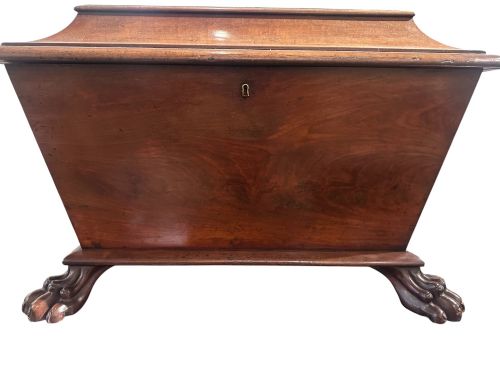


Carved Paw Foot Chest
A carved paw foot chest brings substantial presence to a room, offering both period character and practical storage in solid mahogany or oak.
Carved Paw Foot Chest
A carved paw foot chest encompasses sturdy oak coffers and grand mahogany cellarettes or wine coolers resting upon carved paw feet. You will frequently encounter sarcophagus-shaped cellarettes from the Regency and Georgian periods alongside nineteenth-century chests of drawers.
The pieces emerge from eighteenth, nineteenth, and early twentieth-century workshops, executed in styles ranging from George III and Regency to Victorian and Anglo-Indian. Buyers select these items for their architectural proportions and distinctive claw or paw supports.
Materials and construction
Cabinetmakers constructed these pieces primarily from figured mahogany and solid oak, occasionally applying paint to timber bases or incorporating brass hardware, iron accents, and velvet or textile linings.
Carvers shaped the distinctive paw feet directly from the primary timber or attached carved elements securely to the base, ensuring structural integrity beneath heavy sarcophagus bodies and drawer units.
Cellarettes doubled as portable wine cellars, keeping valuable vintages safely locked away from thirsty household staff.
Judging the standard of workmanship
Quality rests upon the crispness of the paw foot carving and the depth of figure within the mahogany or oak timber. Superior examples display careful matching of wood grain across large surfaces and robust internal construction.
The distinction between standard utility items and finer showroom pieces lies in the subtlety of the carved details and the proportion of the sarcophagus or chest body.
The Carved Paw Foot Chest Glossary
- Cellarette
- A lockable container used for holding bottles of wine or spirits, often shaped like a sarcophagus and raised on paw feet.
- Sarcophagus
- A monumental coffin-like chest shape with a domed or hinged lid, popular during the Regency and Georgian eras for wine coolers.
- Figured mahogany
- Timber exhibiting attractive, rippled grain patterns that catch the light, chosen for high-status furniture.
- George III
- The stylistic period spanning the mid to late eighteenth century, known for refined classical proportions and quality cabinetmaking.
Carved Paw Foot Chest: Frequently Asked Questions
What is a cellarette?
A cellarette is a specialised storage piece designed to keep wine bottles cool and secure near the dining table. Many examples feature fitted interior compartments and substantial carved feet.
Historically, servants kept these containers filled with ice or water to chill bottles before serving. Today, they function well as side tables or statement storage in living spaces.
How do I date a mahogany chest?
Dating relies upon examining the timber selection, construction methods, and stylistic cues such as sarcophagus contours or carved paw feet. Regency and Georgian pieces display specific classical motifs not found in later reproductions.
Secondary woods inside drawers and the ageing of the timber provide further clues to the exact period of manufacture.
Where should I place a wine cooler?
These low, substantial pieces suit placement beside a sofa, beneath a window, or as a focal point in a dining room. Their sculptural paw feet make them effective when viewed from all angles.
Keep them away from direct heat sources to protect the polished mahogany or oak surfaces from drying out.
Are paw feet always made of wood?
Paw feet are typically carved directly from the solid mahogany or oak of the base framework. In some instances, distinct wooden feet were joined to the main body during construction.
The carving style ranges from naturalistic lion paws to more stylized bracket variations depending on the period.