
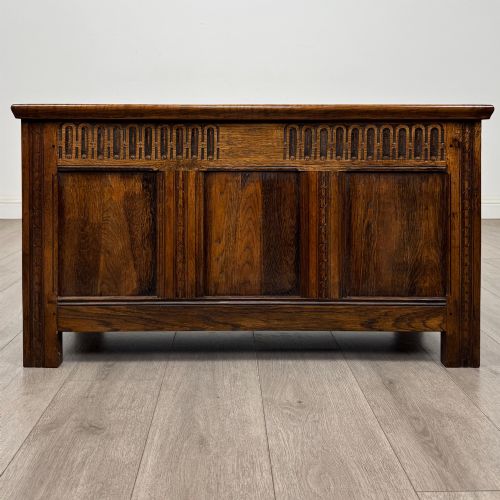
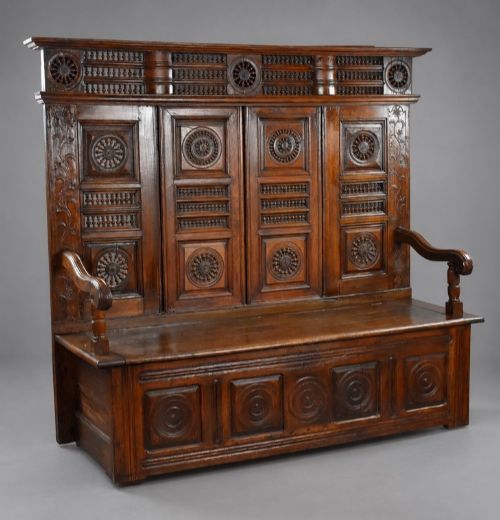
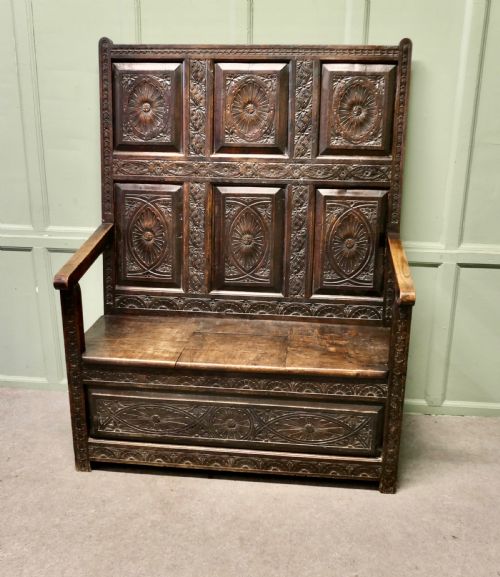
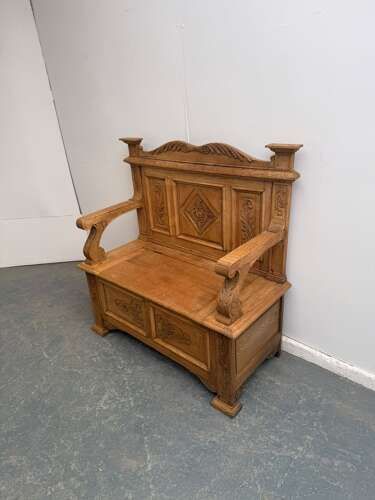
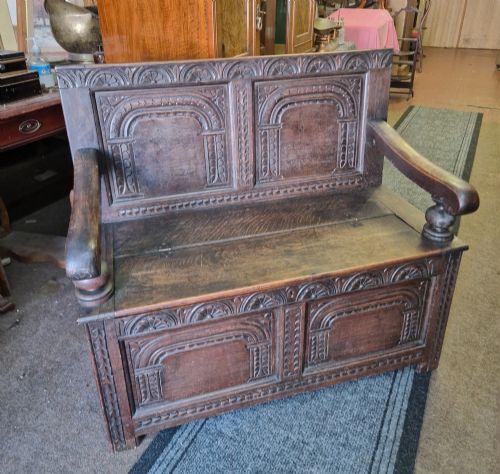
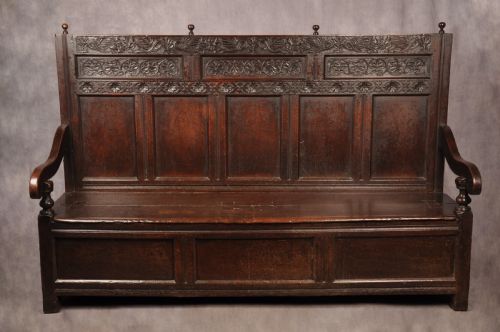

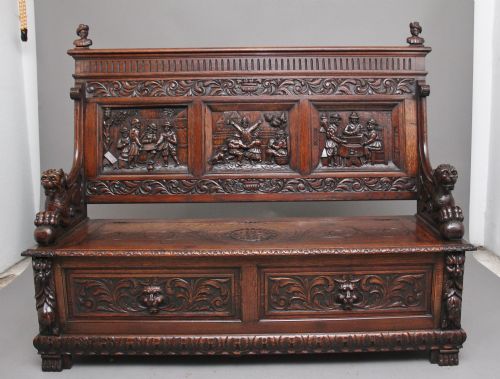


Carved Panel Coffer Bench
A carved panel coffer bench offers dual utility as a sturdy seat and a deep storage chest, fashioned from robust timbers.
Carved Panel Coffer Bench
A carved panel coffer bench functions as a seat with a hidden compartment beneath the lid, often integrating a high back and arms to shield against draughts. These pieces span from the seventeenth century through to the twentieth century, encompassing revival movements and country house aesthetics.
The versions most commonly met on this page are constructed from oak and rendered in seventeenth century or eighteenth century styles, frequently displaying carved panels along the backrest. Variations include fruitwood and Brazilian mahogany examples alongside later Edwardian and 1920s interpretations.
Materials and construction methods
Makers relied principally on oak, supplemented by fruitwood and Brazilian mahogany, joined using traditional pegged mortise and tenon frames. Iron and brass fittings such as hinges and brackets appear on lids and storage compartments.
Surface decoration relies on chip carving, relief carving, and panel moulding rather than applied veneers. Wax finishes protect the timber while preserving the natural grain and colour developed over centuries.
The listings span from the 17th century through the Georgian and Victorian periods up to the 1930s, constructed in oak, fruitwood, and mahogany.
Judging the standard of execution
Depth and crispness of the carving distinguish finer examples from plain or heavily reworked pieces. Relief work on the back panels demonstrates the skill of the hand that shaped it.
Proportion and structural integrity matter greatly, particularly the retention of original floor timbers, arm supports, and box bases. Alterations to height or the replacement of lid boards alter the integrity of the piece.
The Carved Panel Coffer Bench Glossary
- Coffer
- A large wooden chest used for storage, which forms the base of a settle bench.
- Settle
- A wooden bench with a high back, solid arms, and a closed base to keep out cold air.
- Wainscot
- A type of wooden panelling, often applied to the backrests of early seventeenth century seats.
- Box settle
- A variation featuring a hinged seat lifting to reveal a storage cavity underneath.
- Jacobean Revival
- A nineteenth or twentieth century style copying the heavy carved ornamentation of the early seventeenth century.
Carved Panel Coffer Bench: Frequently Asked Questions
What is a carved panel coffer bench used for?
These pieces served historically in halls and kitchens to provide both seating and enclosed storage for blankets, linen, or dry goods. The high back shielded occupants from cold draughts in old stone buildings.
In modern interiors, they function effectively in hallways or boot rooms as a practical seat with ample capacity for shoes and bulky items.
How do I date an antique oak settle?
Dating relies on observing construction marks, joint types, and the style of the carved decoration on the panels. Hand-cut pegs, uneven board widths, and tool marks point towards earlier seventeenth or eighteenth century origins.
Later revival pieces from the Victorian and Edwardian eras often display more uniform machine sawing and cleaner timber edges despite mimicking older motifs.
Are these benches comfortable to sit on?
Early wooden benches possess rigid upright backs and solid seats designed for posture rather than lounging. They are intended for upright seating in hallways or dining spaces rather than prolonged relaxation.
Adding a loose fabric cushion or squab pad to the wooden seat base softens the surface while retaining the visible appearance of the antique timber.
What wood types are most common?
Oak is the predominant timber found across these pieces, reflecting its abundance and durability in British cabinet making. It was valued for its strength in structural framing and panel work. Coffer benches also appear in fruitwood and Brazilian mahogany, particularly among specific regional variations and twentieth century interpretations.